
Morocco exposed Ronald Koeman's tactical cowardice in Monterrey
The Monterrey Autopsy
Estadio Monterrey sits beneath the shadow of Cerro de la Silla, a jagged monument of rock that dwarfs the pitch below. In the sweltering heat of Nuevo Leon, where temperatures hovered at 30 degrees C, the Netherlands and Morocco produced a match that was meant to be a showcase of their deep footballing connections. Instead, it became an autopsy of tactical regression. Ronald Koeman spent two years building a functional, balanced team, only to dismantle it in a moment of reactive panic. This was not a defeat of thin margins, but a self-inflicted tactical collapse.
Concrete Cages and World Cup Stages
This was a fixture loaded with cultural backstory, playing out like a local derby on the global stage. As The Guardian detailed in their preview, many of Morocco's players were born and raised in the Netherlands, sharpening their technical skills in the concrete street football cages of Rotterdam and Amsterdam. Noussair Mazraoui, Sofyan Amrabat, and Anass Salah-Eddine were lining up against the country of their birth. The tactical battle promised a collision between Dutch positional structure and the front-footed street audacity of the Atlas Lions. It was a beautiful narrative, but Koeman turned it into a turgid, defensive retreat. He abandoned the very tenets of Dutch football to play a reactive game.
The Passive Pivot and the High Press
Morocco manager Mohamed Ouahbi aligned his team in an expansive, aggressive shape, pushing his wingers high and allowing his midfielders to rotate freely. The 18-year-old Lille midfielder Ayyoub Bouaddi dictated the tempo from deep, flanked by the tireless running of Ismael Saibari. Morocco's structural fluidity contrasted sharply with the static Dutch setup. Koeman countered by abandoning his usual high-pressing lines, retreating into a deep shell. The Netherlands set up in a passive mid-block, refusing to contest possession in the middle third and allowing Morocco to dominate the ball. The double pivot of Jerdy Schouten and Tijjani Reijnders was completely overrun, unable to bridge the gap to Teun Koopmeiners.
Morocco found space in the half-spaces, exploiting the distance between the Dutch midfield and defensive lines. Achraf Hakimi was a constant threat, overlapping down the right and combining with Saibari. In the 52nd minute, Morocco almost broke the deadlock when Hakimi cut inside and unleashed a fierce drive. The ball flew past Bart Verbruggen but crashed back off the crossbar, as Sky Sports reported live. Koeman reacted not by adjusting his midfield spacing, but by pulling his lines even deeper. Virgil van Dijk and Jan Paul van Hecke sat deep, defending their box rather than squeezing the play. This reactive stance invited pressure from the first whistle.
Gakpo's Grief and the Cowardly Recoil
The Netherlands had struggled to create clean progression, relying on Brian Brobbey to hold up long clearances. Yet, the quality of their individual talent briefly papered over the tactical cracks. Cody Gakpo, playing with immense personal courage following the tragic loss of his unborn son, was the solitary bright spot in the Dutch attack. When a rare counter-attack broke down the left, Gakpo positioned himself perfectly at the back post. In the 72nd minute, he met a deep cross and fired a clinical finish past Yassine Bounou to give the Netherlands a lead they scarcely deserved. It was an emotional moment, but it triggered a fatal response from the bench.
At 1-0, the game was Koeman's to manage. He had the tactical tools to exploit Morocco's necessary risk-taking. Instead, he chose defensive self-sabotage. Koeman withdrew his active attacking outlets, signaling a complete retreat into a low block. He left proven attacking weapons like Memphis Depay and Donyell Malen on the bench, choosing instead to pack his defensive lines. Zlatan Ibrahimovic, speaking on the US broadcast, was scathing in his assessment of the Dutch manager's cowardice. Zlatan compared Koeman to a defensive Italian manager who had completely betrayed the identity of Dutch football.
"I don’t like it at all," Zlatan said. "They’re not playing with their identity. He is like an Italian coach, playing not to lose."
While Koeman cowered, Ouahbi gambled. Down 1-0, the Moroccan head coach introduced three under-21 players, injecting raw energy into his attack. Morocco flooded the Dutch box, recycling second balls and winning every physical duel. The Dutch midfield, exhausted by the heat and stripped of outlets, could no longer clean up possession. They resorted to milking the clock, conceding cheap fouls, and lumping set pieces aimlessly down the pitch. It was an embarrassment for a nation that once defined modern positional play. The lack of structural organization in the Dutch defensive line was glaring.
The Inevitable Collapse
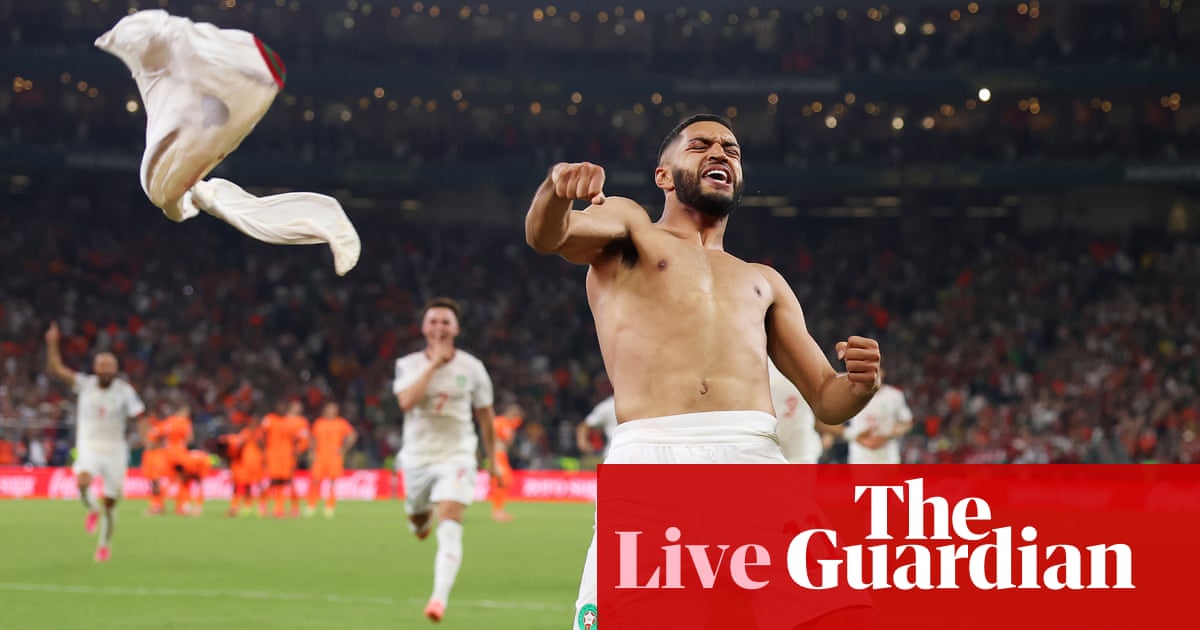
The equalizer had been coming for twenty minutes. In the 90+1 minute, Morocco got the reward their boldness deserved. A corner was cleared only as far as the edge of the box, and when the ball was recycled, Issa Diop rose highest. The center-back powered a header past Verbruggen to send the Monterrey crowd into absolute delirium. The Dutch defensive structure had collapsed, undone by the very pressure they had invited. Van Dijk was caught underneath the flight of the ball, while Van Hecke was blocked off by a smart screen from Amrabat. It was a tactical checkmate.
Extra time was a grueling exercise in survival. The heat took a massive physical toll, leaving players on both sides cramping on the turf. Saibari played through the pain with a cut eye and a shirt soaked in his own blood. Van Hecke, who had suffered a head injury earlier, battled on with a bandaged head. The Netherlands showed zero offensive ambition, content to drag the match to penalties. In the 116th minute, Crysencio Summerville went down under a heavy challenge from Mazraoui. He was forced off for treatment, leaving the Dutch to play with ten men before he reentered a minute later. It was a foreshadowing of the disaster to come.
The Shootout of Errors
A penalty shootout is often called a lottery, but this shootout was defined by technical exhaustion and pressure. Under the intense lights of Monterrey, four elite players failed to even hit the target. Teun Koopmeiners opened the scoring for the Dutch, but Morocco's Bilal El Aynaoui immediately hit the crossbar. Justin Kluivert, brought on specifically to take a penalty, hit the post. Soufiane Rahimi equalized for Morocco, his penalty slipping through Verbruggen's hands and trickling over the line off the goalkeeper's heel. The shootout was becoming a comedy of errors.
Wout Weghorst restored the Dutch lead, and Alaeddine Talbi leveled for Morocco. Then the wheels fell off for Koeman's men. Jurrien Timber missed his penalty wide, but Hakimi wasted the advantage by hitting the post. With the shootout locked at 2-2, Summerville stepped up. The winger, clearly compromised by his late injury, saw his weak shot saved by Bounou's left hand. Ismael Saibari, the bloodied hero of the match, then stepped up and coolly dispatched the winning spot-kick to seal a 3-2 victory for the Atlas Lions, as The Guardian's live minute-by-minute reaction captured in Monterrey. The Dutch campaign was over, ended by a team that refused to play with fear.
The Verdict of Monterrey
The final whistle triggered wild celebrations in Rabat, where fans honked car horns into the early hours. For the Netherlands, the exit is a disaster of Koeman's own making. It was a complete structural failure, born of a manager who feared his opponent more than he trusted his own players. The Dutch controlled only thirty-seven percent of the ball in extra time, a damning statistic for a nation with their resources. They played not to lose, and in doing so, guaranteed their own defeat. Koeman's contract runs for another two years, but his tactical credibility has been shattered in Monterrey.
For the local Mexican fans in the Monterrey crowd, there was a sweet sense of karmic justice in this result. Twelve years ago today, at the 2014 World Cup in Fortaleza, a highly disputed late penalty by Klaas-Jan Huntelaar had sent Mexico home and the Dutch through. The Monterrey natives had not forgotten. They cheered every Dutch miss and celebrated Saibari's winner as if it were their own. The Oranje supporters' bus had traveled 1,118 miles from Kansas City, where they defeated Tunisia on Friday, only to witness a tactical capitulation. History has a long memory, and in Monterrey, it finally caught up with the Oranje.
Read Next
- Why Morocco's Dutch-born stars are about to haunt their creators
- Koeman's five-back gamble has Dutch fans stressing before Morocco clash
- Why Germany's World Cup exit was a disaster of Nagelsmann's own making
- Why Sweden's high-risk style will play right into French hands
- 🏆 World Cup 2026 — Full Coverage Hub
- 🇳🇱 Netherlands World Cup 2026 — Oranje Hub
- 🇲🇦 Morocco World Cup 2026 — Atlas Lions Hub
- 🇧🇷 WC 2026 Group C — Brazil, Morocco, Scotland, Haiti
- ⚽ Liga MX 2026 Hub — El Clásico Nacional & WC2026 Mexico
Amazon Fire TV Stick 4K, support for Wi-Fi 6, Dolby Vision, HDR10+
Stream every Premier League knockout and World Cup qualifying match in crisp 4K.
Frequently Asked Questions
How did Morocco defeat the Netherlands in Monterrey?
Who is the manager of the Morocco national football team?
Who are the Moroccan players with Dutch connections?
What tactical mistakes did Ronald Koeman make against Morocco?
Who dictated the midfield tempo for Morocco during the match?
More Coverage

Tuchel's England look completely rattled by Man City's guilty verdict
1 day, 22 hours ago
Enzo Maresca's Socrates quotes won't hide Man City's 114 guilty verdicts
2 days, 9 hours ago
Sebastien Pocognoli's Scotland face immediate tactical test in Ljubljana
2 days, 17 hours ago
Liverpool almost sold Cody Gakpo to Man City and it makes zero sense
3 days, 1 hour ago
Ireland are heading into Hungary in crisis after their Pristina collapse
4 days, 4 hours ago
Jürgen Klopp got the chaos he expected in a wild debut against the Dutch
4 days, 5 hours agoMore Analysis
Liverpool almost sold Cody Gakpo to Man City and it makes zero sense
3 days, 1 hour ago
Jürgen Klopp got the chaos he expected in a wild debut against the Dutch
4 days, 5 hours agoMorocco and Senegal are Africa's only real 2026 World Cup heavyweights
1 week, 1 day ago
Liverpool fans are spiraling over Virgil van Dijk's contract limbo
2 weeks, 1 day ago
Liverpool's sluggish start shows Andoni Iraola is running out of answers
2 weeks, 1 day ago