Europe's youngest top-flight manager is defying the odds
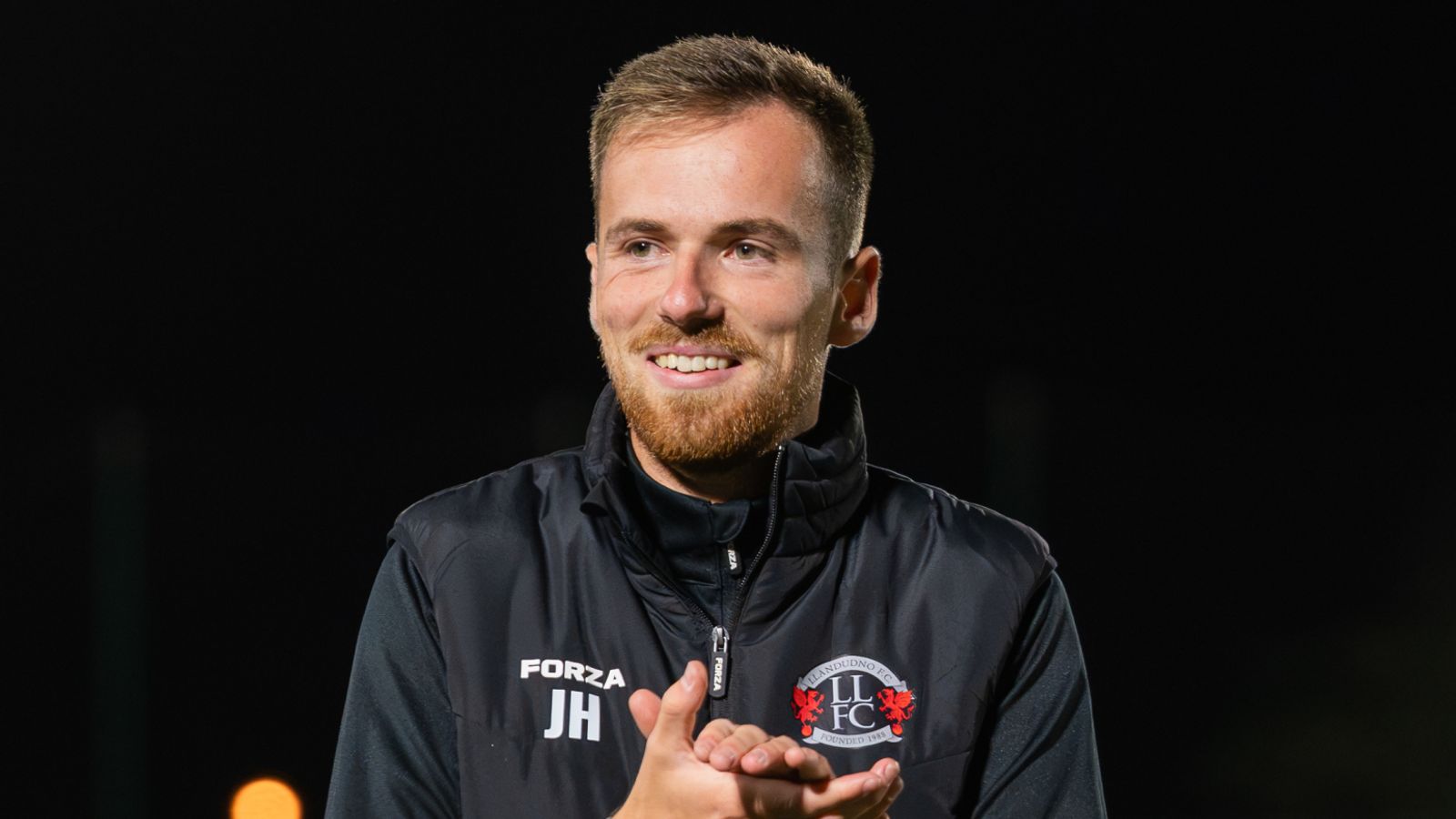
Every tactical hipster in Britain loves talking about Fabian Hürzeler. The Brighton boss took over at 33 and immediately became the poster boy for precocious dugout appointments. Yet over the border in North Wales, Jordan Hadaway was already doing the job at 25.
Hadaway is currently the youngest top-flight manager in European football. Having guided Llandudno back into the Cymru Premier at the end of the 2025/26 campaign, he is running an elite operation while holding down a day job.
This is not an accident of circumstance. Hadaway was coaching junior sessions at 14 and secured his Level 1 badge two days after turning 16. By 18, he was barking tactical instructions at Caerwys to a center-back captain who was 41.
That kind of baptism strips away any performative authority. If an 18-year-old cannot organize a defensive block with conviction, veteran non-league players will chew him up before halftime. Hadaway survived it, refined it, and collected his UEFA A Licence in 2024.
His progression mirrors the wider shift across European dugouts. Former playing careers no longer dictate managerial credentials. Thirteen head coaches across the English Football League and Premier League sit under the age of 40, but Hadaway's timeline remains entirely distinct.
He spent time working for the Real Madrid Foundation. He picked the brains of experienced professionals like Nigel Adkins and Robert Earnshaw. He even cold-emailed Roy Hodgson during his Caerwys days, earning an invitation to Crystal Palace that was ultimately derailed by the pandemic.
As detailed in his recent profile with Sky Sports, Hadaway built his coaching foundation around relentless daily discipline. That graft defined his rise through the Welsh pyramid.
"While I was studying at Liverpool Hope University, some days I'd be up at 2.30am or 3am going to work in the bakery for a family friend as they'd lost staff because of Covid. I'd stay there until 9.30am, go to a lecture from 11am until 2pm and then I'd coach from maybe 4pm until 9pm."
Rebuilding from ground zero
That absurd schedule prepared him for the crisis that landed on his desk in August 2023. Llandudno were in freefall. Their artificial surface was condemned by the Welsh FA, triggering a catastrophic collapse of club personnel.
The senior staff walked away. Almost the entire first-team squad dissolved overnight. Hadaway, who had only joined eight months earlier as head of youth development, was handed interim control of an empty dressing room.
He had exactly two weeks to build a squad from scratch. There was no scouting department, no pre-season fitness base, and only one registered senior player on the books.
The boardroom gave him a simple mandate: keep the club alive. Relegation was acceptable to the directors as long as Llandudno survived as an active football entity. His own family questioned the wisdom of walking into the fire.
"I had the smallest budget in the league by a country mile. I had one player two weeks before the start of the season and no management team. I had to put all that together in two weeks. We were favourites to get relegated, but I never once thought we would."
Llandudno did not just survive that chaotic 2023/24 season. Hadaway led them to a finish of 12th out of 16 and reached a domestic cup final. It was a staggering managerial salvage job that laid the foundation for last spring's promotion push.
The tactical flaws of a part-time operation
Now comes the actual test. The jump from the Cymru North into the Cymru Premier is a tactical chasm. It is where fairytale coaching narratives crash straight into hard physical reality.
Let us be blunt about the flaws in this setup. Hadaway still works full-time as a school teacher, meaning his match preparation is crammed into evenings around classroom responsibilities. That operational split is a massive disadvantage against seasoned semi-professional setups.
When Llandudno face established top-tier outfits, their structural shortcomings become visible quickly. In possession, they rely on rigid passing lanes rather than fluid rotational overloads. That predictability allows well-drilled midfields to step up and suffocate their progression.
Their transition defense is also vulnerable when opponents attack the wide channels. Because part-time squads have limited tactical training hours, Hadaway cannot drill complex pressing triggers into his wide midfielders. If their initial press is bypassed, the backline sits exposed.
You cannot out-coach a severe conditioning deficit across 90 minutes. In late game states, Llandudno routinely concede territory, dropping their defensive line deeper toward their own penalty box. That conservatism invites sustained pressure that turns routine points into nervy scrambles.
Fatigue is inevitable when players balance construction jobs and office shifts with midweek away trips. Against top-tier sides that cycle possession at speed, Llandudno's lateral shifting breaks down around the 70-minute mark. Opponents exploit those tired legs by overloading the half-spaces.
Why the Seasiders will survive anyway
Yet writing them off for relegation ignores Hadaway's defining tactical trait: pragmatic defensive organization under duress. He is not an ideological purist who demands suicidal play out from the back. He builds compact blocks that deny central space.
His side defends in a disciplined 4-4-2 shape out of possession. The front two drop deep to block passes into the opponent's pivot, forcing play wide where Llandudno can contest duels against the touchline. It is simple, unglamorous, and brutally effective.
His squad buys into the plan without hesitation. Young players respect his age and relatable communication style, while older veterans respect the UEFA A Licence on his wall. In non-league dressing rooms, respect is earned through tactical clarity, not past international caps.
Look at the lower end of the Cymru Premier table this season. Several rival relegation candidates suffer from bloated budgets and disjointed squads assembled without a coherent tactical vision. Llandudno have the opposite: a lean roster that understands its exact defensive triggers.
Hadaway does not need his team to control 60 percent possession to win matches. He needs them to win second balls, execute set-piece routines, and protect their central penalty area. That formula reliably generates points in bottom-half survival dogfights.
The wider football media will soon start linking Hadaway to English lower-league vacancies. When a 25-year-old manager achieves European top-flight promotion on a shoestring budget, National League and League Two clubs take notice.
However, jumping across the border right now would be premature. As Hadaway made clear in his discussion with Sky Sports, he is conscious of not overreaching before his methods are fully battle-tested.
He has stated clearly that he is not chasing quick stardom. His commitment to his teaching post and his desire for club stability indicate an unusually grounded operator who values process over vanity.
So what happens by the end of the 2026/27 campaign? Here is the call: Llandudno will comfortably avoid the automatic relegation zone. They will finish 9th in the Cymru Premier table, securing top-flight survival with two games to spare.
They will not qualify for Europe or mount a Cinderella cup run. The physical limitations of a part-time squad will keep them firmly locked in the bottom tier of the split. But they will accumulate enough gritty 1-0 home wins to stay up.
Hadaway will reject early exploratory interest from English non-league clubs to remain at the helm for another year. At 25, he has already rebuilt a broken club from zero. Keeping Llandudno in the top flight will cement his status as the sharpest young tactician in Welsh football.