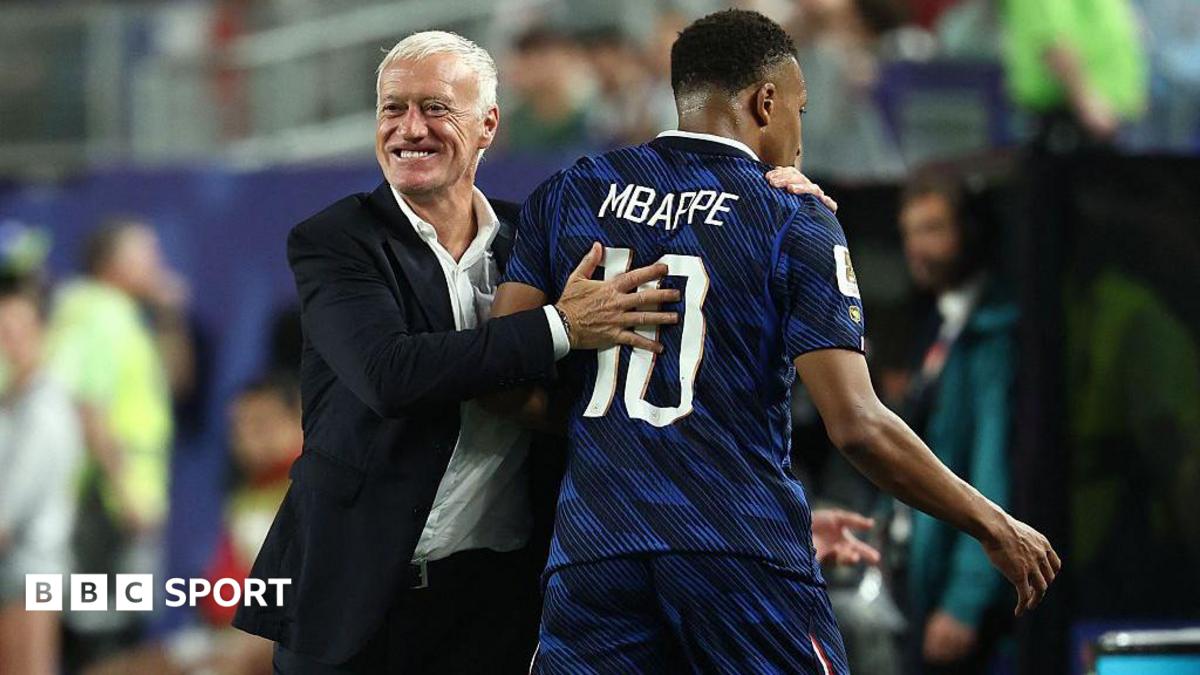
France enters the Round of 32 at the 2026 World Cup facing Sweden in a matchup that feels far more volatile than the talent gap suggests. While Les Bleus possess the deepest roster in international football, their group stage campaign was defined by friction and rapid tactical evolution. The narrative surrounding Didier Deschamps has long been one of conservative pragmatism, yet his real genius lies in mid-tournament course corrections.
Today, on June 30, 2026, the French national team is once again rebuilding its airplane mid-flight. Deschamps took the reins in 2012 and has spent over a decade perfecting this cycle of tournament iteration. The opening match against Senegal exposed significant structural flaws that would have panicked a lesser coach, but instead triggered a chain reaction of changes.
The False Nine Friction: Why Deschamps' Initial Blueprint Clogged
In that opening fixture, France started in a lopsided shape that resembled a 4-2-4 or a 4-2-3-1 on paper. With Hugo Ekitike sidelined by injury, Desire Doue stepped into the left-wing role. The central attacking axis was supposed to feature Ousmane Dembele operating as a roaming false nine just behind Kylian Mbappe.
This structure was designed to replicate the club roles of France's primary superstars. Mbappe, now 27 years old, wants to touch the ball in deeper areas rather than simply stretching the defense as a last-line runner. Deschamps wanted to accommodate this preference by giving him license to roam toward the left channel.
Meanwhile, Michael Olise was deployed on the right wing to recreate his Bayern Munich role, hugging the touchline and cutting inside. Dembele was positioned centrally to exploit the spaces he occupies under Luis Enrique at Paris Saint-Germain. It was a logical attempt to maximize individual comfort, but it failed to function as a collective unit.
The primary failure occurred out of possession. France attempted to press high in a 4-4-2 shape, with Mbappe and Dembele forming the front line. Olise dropped back to defend the right flank, leaving a double pivot of Aurelien Tchouameni and Adrien Rabiot to cover the center.
This arrangement left huge vertical distances between the front press and the midfield line. Senegal's centre-backs easily bypassed the initial pressure by shifting the ball to their full-backs. From there, a simple diagonal pass found their deep-lying midfielder occupying the vacant space in front of the French pivot.
Senegal repeatedly exploited this gap, creating high-value opportunities that exposed France's defensive transition. The lack of vertical compactness meant Rabiot and Tchouameni were constantly pulled out of position. The defensive block was stretched and vulnerable.
The problems persisted when France had the ball. Tchouameni dropped deep between William Saliba and Dayot Upamecano to form a back three, establishing a three-against-two overload against Senegal's front press. This was a sensible start to the build-up phase, but the subsequent lines were chaotic.
Left-back Theo Hernandez inverted into the midfield line, while Olise drifted inward from the right wing into an incredibly deep holding role. Having Olise drop this deep was an attempt to utilize his elite long-range passing from a quarterback position. However, it clogged the central zone and left the right flank entirely vacant.
With Olise occupying deep areas, Jules Kounde had to hold the width on the right wing. Kounde is a defensive-minded fullback who lacked the dynamic dribbling required to exploit the wide space that Senegal deliberately conceded. The attack became slow and predictable.
Up front, Dembele's natural instinct to drop deep as a false nine created a different issue. Whenever Mbappe also drifted deep or wide to get involved in the build-up, the penalty box was left completely empty. France had plenty of possession but zero presence in the critical scoring zones.
The Mid-Tournament Pivot: Swapping Olise and Dembele
Deschamps recognized these flaws before the Senegal match could slip away. As detailed in the BBC Sport tactical breakdown, the French coach restructured his system at halftime. His willingness to make drastic changes to his star-studded lineup remains his greatest asset.
The most significant modification was swapping the roles of Olise and Dembele. Moving Dembele out to the right wing and slotting Olise into the central number ten position transformed France's attacking dynamics. It was a bold decision that few international managers would make mid-game.
Dembele's work-rate on the right flank immediately stabilized the defensive block. France abandoned the aggressive high press that had failed so badly in the first half. Instead, they settled into a compact 4-4-1-1 mid-block designed to deny space in the central channels.
This defensive shift shielded Rabiot and Tchouameni from being overloaded. Senegal found themselves unable to play through the lines, and France's defensive solidity returned. The defensive structure went from porous to impenetrable within forty-five minutes.
Offensively, the swap unlocked both Olise and Mbappe. Olise is a natural playmaker who excels at finding small pockets of space in the final third. From his new central role, he became the primary service provider for Mbappe's runs in behind the opposition line.
This new alignment also solved the box-presence problem. Olise tends to stay deeper before making late, well-timed runs into the penalty area. When Mbappe dropped deep to drag a centre-back out of position, Olise made a counter-movement into the striker's zone.
Dembele also thrived in his restored right-wing role. Kounde was instructed to play more conservatively, taking a narrower position to provide cover against counter-attacks. This allowed Dembele to receive the ball in isolated, one-on-one scenarios against the opposing left-back.
Kounde supported Dembele by making decoy overlapping runs that dragged defenders away, giving the winger space to cut inside. This tactical adjustment paid immediate dividends. In the subsequent match against Norway, Dembele exploited this exact pattern to score a first-half hat-trick, demonstrating the potency of this shape as recorded in the match details.
The Swedish Test: What Lies Ahead in the Round of 32
The defensive cover provided by Kounde's narrow position allowed France's attackers to rotate with complete freedom. We saw Mbappe, Olise, Doue, Dembele, and Bradley Barcola exchanging positions across the forward line. These rotations were based on on-field understanding rather than rigid, pre-planned patterns.
This fluidity will be the primary weapon against Sweden. The Swedish defensive block is notoriously disciplined and physical, relying on low-block compactness to frustrate elite opponents. A rigid attacking system would play directly into their hands.
Sweden will likely defend in a deep 4-4-2, hoping to compress the space between their lines. They will challenge France to break them down through wide areas, hoping Kounde's lack of crossing quality will neutralize the right flank. This is where Deschamps' new variations become decisive.
If Sweden sits deep, Olise's ability to thread passes through tight windows will be tested. His link-up play with Mbappe in the central zone must be sharp. If Sweden focuses too heavily on Mbappe, Olise's late runs into the box will be the key to breaking the deadlock.
There are still areas of concern for France. Dayot Upamecano remains prone to occasional lapses in concentration when pressed, and Theo Hernandez can leave space behind him when he tucks inside. Sweden possesses the transitional speed to exploit these minor weaknesses if France turns the ball over cheaply.
However, the defensive transition has been significantly improved by the shift to the 4-4-1-1 block. With Tchouameni protecting the backline and Kounde staying narrow, France is no longer as vulnerable to quick counters. The defensive foundation looks secure enough to support their attacking talent.
Deschamps has shown that he is not wedded to a single system. His ability to identify friction and implement immediate fixes has saved France from the fate of other giants. As we saw in 2018, a flexible France is a championship France.
Sweden will put up a stubborn fight, but they do not have the defensive speed to cope with the fluid rotations of Mbappe and Dembele. France's attacking variations are simply too complex to contain for ninety minutes. Expect a professional, tactical masterclass from Les Bleus.
My prediction is a clear, convincing victory for France. Sweden will hold out for the first half-hour, but Olise will eventually find the key pass to unlock Mbappe. France will win 2-0 and march into the Round of 16 with their tactical identity fully resolved.
Read Next
- Why Sweden's high-risk style will play right into French hands
- Didier Deschamps has finally unlocked France's terrifying attack
- Why Sweden's high line will be destroyed by Didier Deschamps' tweaks
- Morocco exposed Ronald Koeman's tactical cowardice in Monterrey
- 🏆 World Cup 2026 — Full Coverage Hub
- 🇫🇷 France World Cup 2026 — Les Bleus Hub
- ⚽ La Liga 2025-26 — Title Race Hub