
FIFA's bloated 48-team World Cup was saved by its own players
The Inefficiency of 72 Games
FIFA wanted inventory, and they got it. The group stage of this expanded tournament required a staggering 72 games to eliminate a mere 16 teams. In terms of resource allocation and player energy, that is an incredibly heavy lift.
It is a system built for television broadcast slots rather than elite competitive drama. Yet, the expected dilution of quality did not happen. Instead of turgid, defensive blocks playing for goal difference, we witnessed an explosion of direct, high-scoring football.
The players, not the administrators, rescued this format. They did it by refusing to play safe, even when the math practically begged them to do so.
Look at the final day of Group F. Austria and Algeria faced off in a game where a goalless draw would have comfortably sent both through to the knockout rounds. Under older, more cynical tournaments, we would have seen 90 minutes of passive passing in the middle third.
Instead, the two sides tore into each other in a chaotic six-goal thriller. Algeria took the lead late, threatening to send Austria home.
Then, in the 96th minute, Sasa Kalajdzic latched onto a loose ball to score a desperate equaliser. The match ended in a wild 3-3 draw, salvaging Austria's tournament and sending their bench into pure ecstasy. It was a perfect encapsulation of how individual ambition overcame systemic design flaws.
This match was not an anomaly. Over the course of the group stage, teams scored a total of 215 goals. That is a historic record for a World Cup group stage.
More importantly, it represents a scoring rate that defies modern defensive structures. The average of 2.99 goals per game is the highest recorded at a World Cup since the 1950s.
We are seeing a fundamental shift in how teams approach these matches. The fear of losing has been replaced by the urgent need to score, driven by the complex math of the third-place qualifying spots.
Stat Inflation and the Quality Floor
Of course, this goal explosion comes with a caveat. When you expand the tournament to 48 teams, you inevitably lower the entry barrier.
Some of the matches looked less like elite international contests and more like early-round domestic cup ties. The stars did not hesitate to take advantage of this drop in opposition quality.
As Adam Bate on Sky Sports noted, there is a clear element of stat-padding occurring at the top of the Golden Boot race. Cristiano Ronaldo scored both of his group-stage goals against Uzbekistan.
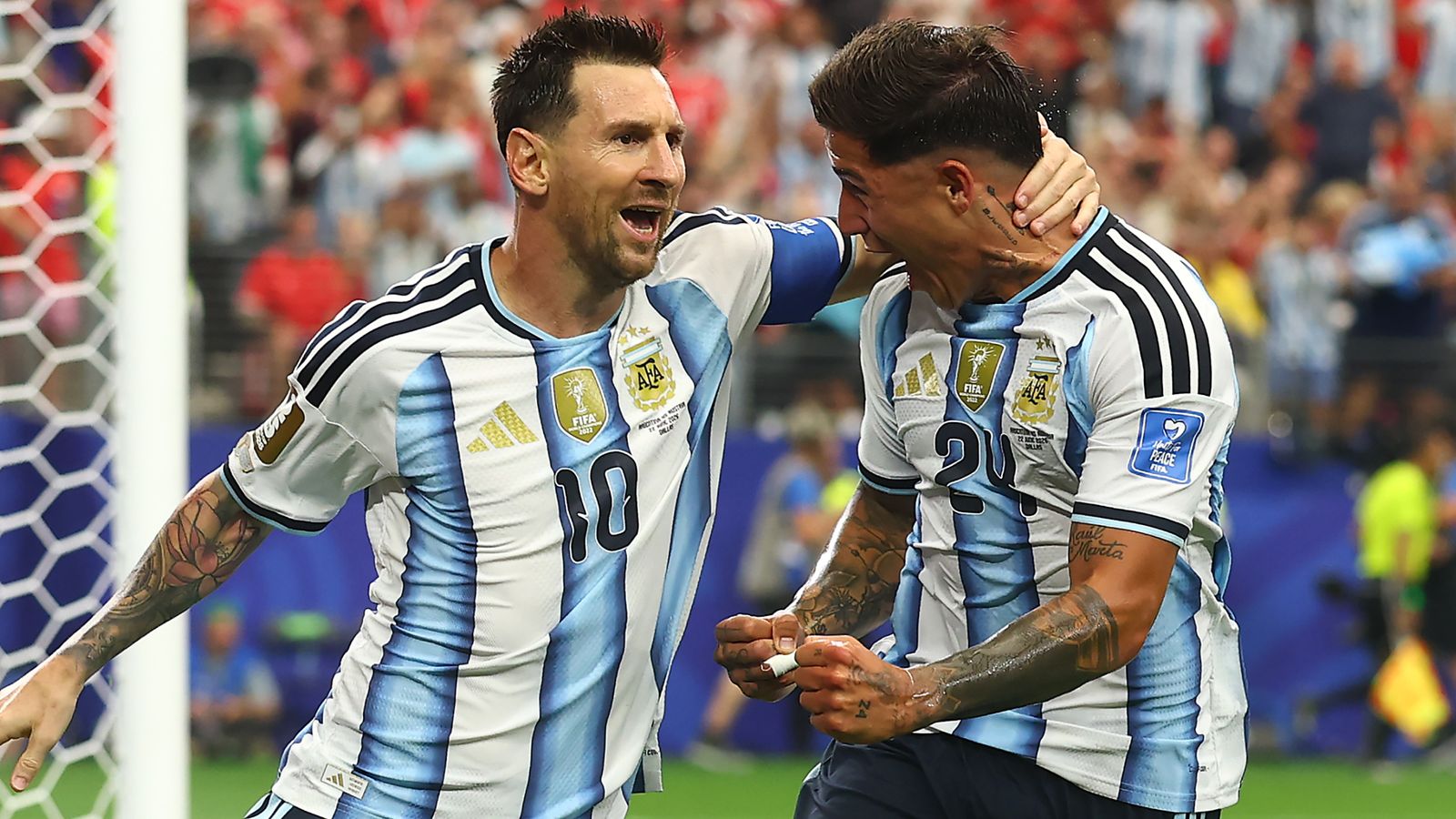
Lionel Messi, who started his tournament with a hat-trick against Algeria, added another to his tally against Jordan. Kylian Mbappe and Erling Haaland each scored twice against an Iraq side that looked completely out of its depth.
Iraq's presence in this tournament is a study in expansion politics. They missed the automatic qualifying spots in their initial Asian group, finishing behind South Korea and Jordan.
They then lost to Saudi Arabia in the subsequent stage, only to sneak through the backdoor via a playoff. Under the old format, Iraq would have been watching this tournament on television.
This dilution has drawn fierce criticism from inside the game. Ghana manager Carlos Queiroz did not hold back when discussing the expanded structure. His comments highlighted the growing unease among coaches who feel the tournament is losing its prestige.
"The number of teams that can qualify for this competition can turn it into something vulgar and ordinary. The World Cup should be something with meaning and significance. It should be rare. But, as you know, today, money talks."
Queiroz is not wrong about the financial incentives driving this expansion. FIFA has created a bloated product designed to maximise broadcast revenues.
The group stage felt less like an elite filter and more like an extended warm-up. But the sheer unpredictability of the minnows kept the spectacle alive.
The Counter-Attack of the Minnows
While the traditional powers padded their stats, the newcomers refused to play the role of easy victims. None of the debutants or lower-ranked teams suffered humiliating, double-digit defeats.
Instead, they provided some of the most memorable moments of the past three weeks. They played with a fearlessness that exposed the arrogance of the established football order.
Consider Jordan. They departed the tournament with three losses, but they scored in every single match they played.
That includes a spirited performance against the reigning world champions, Argentina. They did not park the bus; they went toe-to-toe with the best in the world.
Then there is Curacao. Their last-minute equaliser against Germany will go down as one of the greatest moments in their sporting history.
It was a goal born of pure transition play, catching the German backline completely flat-footed. It proved that on any given day, the gap between the elite and the rest can be bridged.
But the true fairytale of this group stage belongs to Cape Verde. The island nation went undefeated through their three matches to secure a spot in the last 32. Their players and supporters celebrated wildly as their historic run continued into the knockout rounds.
Led by their 40-year-old goalkeeper Vozinha, Cape Verde showed defensive resilience and tactical discipline. They now face Lionel Messi and Argentina in the round of 32. It is a mismatch on paper, but Cape Verde's defensive organization suggests they will not be easily brushed aside.
The tournament has also been a platform for emerging talent. Bosnia-Herzegovina's 18-year-old Kerim Alajbegovic announced himself to the world with a series of fearless displays in midfield. At the other end of the career spectrum, Kevin Pina dominated the middle of the pitch for Cape Verde, proving that veteran presence remains invaluable in tournament football.
Continental Divergences and the Bielsa Grind
The sheer volume of matches created a tactical environment that felt closer to club football than the historically slow, possession-based style of international tournaments. We saw Giovanni Reyna execute a stunning trivela pass for the United States, sparking a fluid attack that Folarin Balogan finished. The American side played with a high-tempo energy that rattled their opponents.
Mexico also found their moment of magic through Raul Jimenez, who scored an emotional goal that kept their hopes alive. Meanwhile, Ecuador played with a joy and freedom that made them one of the neutral's favourites. Their vertical transitions were among the fastest in the group stage.
In contrast, Marcelo Bielsa experienced a series of frustrating travails on the bench. His high-pressing system requires physical perfection, and the relentless schedule seemed to exhaust his players. Yet, their commitment to his demanding style never wavered, even when the results did not follow.
We also witnessed moments of sheer fortune and individual brilliance. Algeria's Rafik Belghali scored a bizarre goal with a distinct help from a corner flag, proving that the ball still bounces unpredictably in North American stadiums. Every match seemed to produce a weird, unscripted moment that defied tactical analysis.
Away from the pitch, the scale of this tournament was visible in the streets. Ahead of their Group I match against Senegal, Norway fans took over Times Square in New York, turning the intersection into a sea of red and white. It was a reminder that despite the administrative bloat, the event still commands global attention.
The group stage also revealed a fascinating divergence in continental strength. South America remains incredibly elite, with Uruguay being the only CONMEBOL side to fail to progress. Their tournament was a disaster; they failed to win a single game and looked toothless in attack.
Africa enjoyed a historic showing, demonstrating the depth of quality on the continent. Out of 10 African nations that qualified, nine advanced to the round of 32. Only Tunisia failed to make the cut, exiting early after a series of toothless performances.
Europe saw a mixed bag, losing only three of its representatives. The Czech Republic were unfancied and departed early, while Turkey and Scotland failed to survive their first World Cup appearances in 24 and 28 years, respectively. But the big story was the collapse of Asia's mid-tier teams.
Asia saw seven of its representatives eliminated in the group stage. While South Korea and Jordan advanced, the rest of the continent's sides struggled to cope with the physical intensity of the tournament. The extra spots awarded to Asia did not translate into knockout-stage representation.
Swiping the Credit Card
Now, the safety net is gone. The 72-game warm-up is over, and the tournament shifts to a single-elimination bracket. The bloated group stage allowed many teams to survive on mediocrity, but the knockouts will not be so forgiving.
Queiroz, despite his criticisms of the format, perfectly described the transition to the next phase. His second quote outlines the shift in psychological pressure that occurs when the group stage ends.
"The group stage is the warm up and qualification for the next round is like a credit card. Now you have to start paying. Everything goes to the winner, every game is drama, nobody can hide."
We are left with 32 teams, the exact size of the entire tournament in previous editions. In a sense, FIFA has forced us to watch 72 matches just to reach the traditional starting line. It is an inefficient way to run a tournament, but the sheer quality of the matches has made it palatable.
The bracket is set, and the route to the final is clear. The stars have padded their stats, the minnows have earned their respect, and the tactical systems have been tested. The real World Cup begins now.
Read Next
Nike Men's Mercurial Superfly 9 Academy Firm Ground Soccer Cleats
Speed-focused boots to help you dominate your local pickup game.
Frequently Asked Questions
Why did FIFA hold 72 group stage games in the expanded World Cup?
What was the average goals per game in the World Cup group stage?
How did the Austria vs Algeria group stage match end?
Who did Messi and Ronaldo score against in the group stage?
How did Iraq qualify for the expanded World Cup?
More Coverage
Heimir Hallgrimsson is walking Ireland into a Nations League nightmare
2 days, 14 hours ago
Folarin Balogun transfer picture grows murky after FIFA World Cup row
2 days, 20 hours ago
Gianni Infantino is backing down after his FIFA privatization plan collapsed
5 days, 9 hours ago
Top 10: Top Moments in FIFA's Governance War
5 days, 9 hours ago
Gianni Infantino wants us to believe FIFA can actually fix itself
5 days, 10 hours ago
FIFA turned the 2026 World Cup into a 28-hour junk food infomercial
6 days, 1 hour agoMore Analysis
Heimir Hallgrimsson is walking Ireland into a Nations League nightmare
2 days, 14 hours ago
Did Mike Dean really refuse to blow his whistle in Fulham vs Wolves?
3 weeks, 1 day ago
Middlesbrough and Wrexham kick off a Carabao Cup Friday night sprint
1 month, 2 weeks ago
West Ham are treating the Carabao Cup like a fever dream
1 month, 2 weeks ago
West Ham are rolling the dice with Bowen against Norwich
1 month, 2 weeks ago