
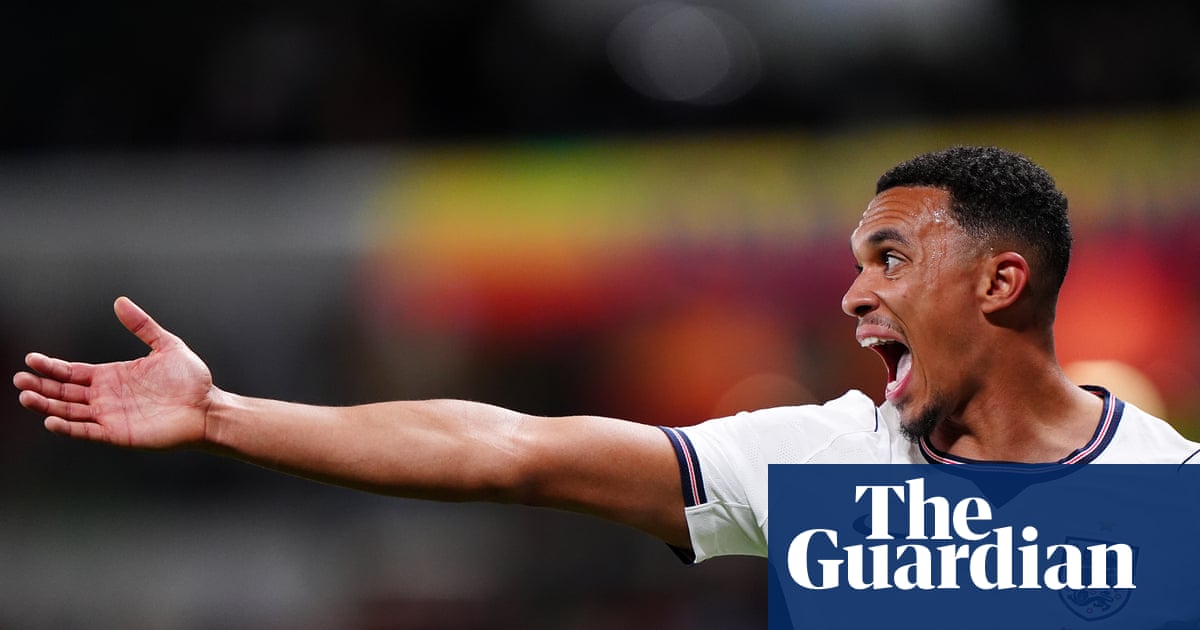
Thomas Tuchel is still overthinking Trent Alexander-Arnold
The Prague Experiment and the Low Block Problem
Prague on a crisp late-September night is rarely a place for subtle tactical revelations. Yet as England labored against Czechia in Nations League Group A3, Thomas Tuchel was handed a reminder of an uncomfortable truth. When an international opponent retreats into a shell, lateral passing will not save you.
You need a passer who takes direct risks. Without one, possession becomes an empty exercise in control.
Three days earlier, England collapsed into stagnant predictability during a defeat to Spain. In that match, Jarell Quansah occupied the right-back role with standard defensive diligence. His overlapping runs were honest, but his delivery from wide areas consistently failed to hit the mark.
Meanwhile, Alexander-Arnold sat on the bench for ninety minutes while England chased an equalizer. It was a baffling decision for a team desperately lacking imagination.
Tuchel changed course for the trip to Czechia, handing the Real Madrid defender his first international start of the new era. It marked only Alexander-Arnold's 35th cap in eight years of senior international service. For a player who turns 28 next week, that number remains a bewildering reflection of England's generational caution.
The opening twenty minutes in Prague did little to soothe Tuchel's nervous baseline. England’s rebuilt back four looked disjointed and hesitant in build-up. Alexander-Arnold himself looked noticeably rusty after spending months away from regular international minutes.
His initial link-up play with Bukayo Saka lacked timing and rhythm. One loose touch on the touchline handed possession back to the Czech press. Minutes later, a wayward crossfield attempt drifted far over the head of Phil Foden, almost igniting a dangerous Czech counterattack.
Tuchel stood on the touchline with his arms folded, scribbling notes as Alexander-Arnold adjusted his positioning. If the match had remained an even eleven-on-eleven contest, those early errors might have dominated the post-match narrative. But the contest pivoted dramatically midway through the first half.
Czech midfielder Pavel Sulc misjudged a sliding challenge and caught Elliot Anderson full on the achilles. The referee showed no hesitation in pulling out the red card. The decision instantly altered the entire geometry of the pitch.
Reduced to ten men, Czechia retreated into an ultra-compact 5-4-0 low block. Their forward line dissolved into five defenders stretched flat across the penalty box. Space inside the final third vanished entirely.
For forty-five minutes against Spain on Saturday, England had faced a similar wall without answers. Now, with a numerical advantage, they risked falling into the exact same sideways possession loop. Passing around the perimeter changes nothing against ten men on the eighteen-yard line.
Unlocking that kind of deep defensive block requires something more than tidy recycling. It requires an unbalancing pass delivered before the defensive structure can reset. That is precisely why Alexander-Arnold was on the pitch.
Anatomy of an Assist: What Only Trent Can See
Tuchel made a subtle positional adjustment at the interval to exploit Czechia's deep shape. He instructed Alexander-Arnold to invert slightly higher into the half-space rather than hugging the right touchline. The shift gave the fullback clearer passing lanes over the five-man defensive wall.
The decisive breakthrough arrived early in the second half through a broken passage of play. A hurried Czech interception spilled loose twenty-five yards out on the right channel. Standard fullback protocol dictates taking a touch, checking back, and recycling the ball to the center-backs.
Alexander-Arnold did none of those things. He spotted Czechia’s backline stepping up unevenly after clearing the primary ball. Before the opposition shape could set itself, he adjusted his footing with one swift touch.
Without waiting for overlapping support, Alexander-Arnold whipped a curve-filled delivery directly into the corridor of uncertainty. The trajectory bypassed three defenders while dropping perfectly into the path of Anthony Gordon. Gordon met the ball cleanly on the move, snapping his header past the keeper to break the deadlock.
It was a moment of technical artistry that few fullbacks in world football can replicate. Where others see crowded penalty boxes, Alexander-Arnold finds passing angles that bypass low blocks entirely.
“I always feel I can see things others can’t see”
That self-assessment from Alexander-Arnold, made years ago during his rise at Anfield, was verified again on Tuesday night. Over nine seasons in Merseyside, he registered 86 assists in 354 appearances for Liverpool. Those are numbers usually reserved for elite central playmakers, not wide defenders.
Harry Kane added a second goal later in the half to secure the 2-0 victory in Prague. But it was Alexander-Arnold’s instant decision-making that broke the match open. His assist was not an accident of territory; it was pure spatial vision.
When England play with Quansah or Kyle Walker, wide attacks rely on speed and overlap routines. When Alexander-Arnold plays, the right flank becomes a secondary quarterback station. That structural difference changes how opponents set up their mid-blocks.
Defenders cannot simply shift across to cover the wing when a player can hit the far post from thirty yards out. Alexander-Arnold forces defensive blocks to stretch horizontally. That extra yard of space is what opens up passing lanes for players like Foden and Kane inside the box.
The Flaws, the Rust, and the Defensive Dogma
Honesty requires acknowledging that this performance was not a flawless masterclass. Alexander-Arnold’s critics will rightly point out the favorable conditions of the second half. Playing seventy minutes against ten Czech defenders in their own penalty area provides an ideal canvas for any attacking passer.
Czechia offered almost zero counter-attacking threat after Sulc was sent off. Alexander-Arnold spent the entire second period camped forty yards from the opposition goal. His defensive positioning and aerial discipline were never subjected to real stress.
Against elite wingers, the questions surrounding his defensive work rate remain valid. Tuchel’s long-standing skepticism regarding Alexander-Arnold’s defensive know-how has not vanished overnight. Prior to Tuesday, Tuchel had fielded eight different players at right-back before turning to the Real Madrid defender.
Before Prague, Alexander-Arnold’s total playing time under Tuchel consisted of a solitary midfield cameo against Andorra in June 2025. That omission spoke volumes about where he sat in the managerial hierarchy. He was viewed as a situational luxury rather than a foundational starter.
Andy Robertson recently pushed back against that narrative on the Stick To Football podcast. Robertson noted how his former Liverpool teammate consistently contained world-class wingers like Kylian Mbappé in high-stakes Champions League ties. Yet international managers remain strangely unconvinced by those big-match credentials.
Sir Gareth Southgate struggled with the exact same tactical dilemma for six years. Southgate left Alexander-Arnold out of key tournament squads and aborted an experimental midfield role at Euro 2024 after two matches. Safety-first managers routinely treat his unique skillset as a defensive liability rather than an offensive cheat code.
That perspective misdiagnoses how modern international matches are actually won. At major tournaments, top nations face deep defensive shapes in almost every group match and knockout fixture. Worrying exclusively about a fullback's defensive cover against limited opposition is an exercise in misplaced priorities.
England's recurring problem over the last decade has rarely been defensive fragility in wide areas. Their recurring failure has been an inability to control possession and break down organized defensive blocks. Blaming Alexander-Arnold for collective possession flaws misses the fundamental issue entirely.
Stop Treating Elite Vision Like a Luxury Risk
Consider the stark history of England’s big-stage exits. During the 2022 World Cup quarter-final against France, England trailed 2-1 in the closing stages while searching desperately for an equalizer. Southgate opted against bringing Alexander-Arnold off the bench, choosing instead to stick with predictable crossing options.
Leaving your most creative passer on the bench during a knockout chase is tactical dogma at its worst. It reflects a culture that prioritizes minimizing individual mistakes over maximizing goal creation. Tuchel was hired precisely to eradicate that culture of international timidity.
Yet eight right-back experiments later, Tuchel has hovered dangerously close to repeating Southgate's patterns. Starting Quansah over Alexander-Arnold against Spain showed a familiar instinct to choose defensive comfort over creative upside. The loss in Madrid was the direct result of that cautious selection policy.
England cannot afford to waste the peak years of one of the finest passers the nation has ever produced. Alexander-Arnold possesses a passing range that alters the entire tempo of a match. His ability to deliver fast, curved balls into tight spaces cannot be replicated by any other defender in the squad.
Building a functional team requires balancing individual defensive duties with systemic attacking threat. If Tuchel insists on perfect defensive metrics before selecting a player, he will continue to field rigid teams that struggle against organized blocks.
The solution is not to hide Alexander-Arnold or convert him into an emergency midfielder. The solution is to design a defensive framework that covers his forward movements. Partnering him with a disciplined central defender allows England to unlock his creative passing without sacrificing balance.
Against Czechia, Alexander-Arnold proved once again that he holds the key to England’s low-block problem. His cross for Gordon was not just an assist; it was a demonstration of high-level football intelligence. Tuchel must now decide whether he has the courage to make that intelligence a permanent feature of his starting eleven.
Read Next
- Thomas Tuchel's England defence is turning build-up play into self-sabotage
- England lost to Spain but the Nations League is actually working
- England lost to Spain again, so why is nobody screaming at Thomas Tuchel?
- Cole Palmer made the right call prioritizing Chelsea over the Nations League
- 🏴 England World Cup 2026 — Three Lions Hub
- 🏆 UEFA Nations League Final Four 2026 Hub — June 4-8, Lisbon
Fever Pitch: A Reporter's Education by Anthony Swofford
The quintessential cult-classic book about the obsessive, often painful, life of
Frequently Asked Questions
How did Trent Alexander-Arnold perform against Czechia for England?
Why was Pavel Sulc sent off in the England vs Czechia match?
Who played right-back for England against Spain before Czechia?
What tactical formation did Czechia use after the red card?
What club does Trent Alexander-Arnold play for?
More Coverage

Tuchel got his win in Prague, but Trent and VAR are still causing arguments
35 minutes ago
Dominik Szoboszlai targeted in Belfast as Hungary's Nations League slumps
9 hours ago
Szoboszlai and Kerkez clear tough physical test during Hungary duty
9 hours ago
Thomas Tuchel is playing with fire after England's Wembley disaster
10 hours ago
Why Ruben Amorim is misusing Goncalo Ramos at AC Milan
13 hours ago
Sarina Wiegman dropping Toone and Kelly is a massive gamble for the Lionesses
13 hours agoMore Analysis
Tuchel got his win in Prague, but Trent and VAR are still causing arguments
35 minutes ago
Dominik Szoboszlai targeted in Belfast as Hungary's Nations League slumps
9 hours ago
Szoboszlai and Kerkez clear tough physical test during Hungary duty
9 hours ago
Thomas Tuchel is playing with fire after England's Wembley disaster
10 hours ago
Why Ruben Amorim is misusing Goncalo Ramos at AC Milan
13 hours ago