The Day the Music Stopped at Ibrox
Put down your pints, look me in the eye, and admit it. We all knew this was coming, and anyone acting shocked today is lying through their teeth. For years, Scottish football has treated its most toxic rivalry like a cool party trick, ignoring the smoke alarms because the fire looked neat on social media.
Well, the fire finally caught the curtains on Sunday, March 8, 2026. That was the day Celtic visited Ibrox for a Scottish Cup quarter-final, and the resulting chaos was so bad it took an independent investigator four months to dissect the wreckage.
Today, sports event consultant Mark Blackbourne released his 37-page report, and it reads like a horror script. As Tom English reported for BBC Sport, this document arrived with a mighty thud. It is a damning, unfiltered look at how close we came to a full-blown tragedy on Glasgow soil.
Let's cut through the bureaucratic jargon. The review explicitly states that the matchday operations were a minor miracle away from a fatal outcome. When an independent safety expert tells you that you got lucky, you don't argue; you listen.
But of course, this is Scotland. Instead of fixing the problem, the clubs are already retreating to their respective bunkers to throw mud at each other.
Four Minutes of Pure Terror
Let's run back the tape to March 8 to remind ourselves of how this disaster unfolded on the pitch. The football itself was a tense, forgettable slog that finished 0-0 after extra time, but the real action started when the whistle blew.
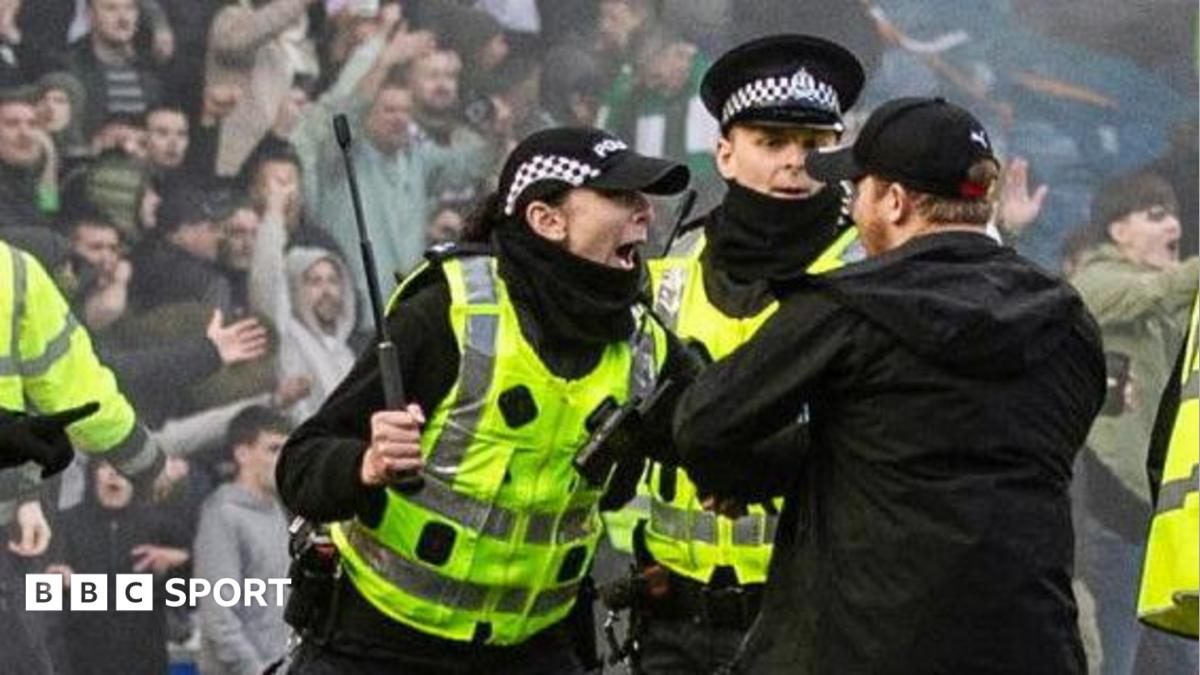
Celtic won the penalty shootout 4-2, securing their ticket to the semi-finals. As the away side celebrated, Celtic supporters flooded the pitch, sparking the exact sort of security breakdown everyone in the planning meetings had ignored.
Inside the stadium, a group of masked Rangers supporters equipped with poles and reinforced gloves broke through the cordon. They marched directly toward the celebrating Celtic fans. For exactly 4 minutes and 28 seconds, the two sets of supporters stood in a terrifying stand-off on the grass.
Think about that time frame for a second. That is nearly five minutes of potential life-threatening violence where stadium security was utterly useless and the police were caught flat-footed.
While the pitch invasion was happening, the situation outside on Broomloan Road was somehow even worse. Celtic ultras overwhelmed the turnstile staff, rushing the gate and creating an immediate crushing hazard.
The report notes that police officers were left petrified of managing future games under these conditions. When the people with batons and riot shields are terrified, you know the system has broken down completely.
Police Scotland have since made 37 arrests in connection with the disorder. That number tells you everything you need to know about the scale of the madness that afternoon.
The Myth of the Risk Assessment
How did we get here? Blackbourne's report points the finger directly at a lazy, complacent planning process that ignored the basic laws of arithmetic.
Rangers based their entire safety plan on previous league matches. But league matches had been played with away allocations cut to just 700 fans, or in some cases, zero fans due to the ongoing ticket war between the clubs.
The Scottish Cup is different. SFA rules dictate a 20% away allocation, meaning Celtic fans were handed exactly 8,042 tickets for this quarter-final.
You do not need a degree from Glasgow University to see the issue here. Rangers tried to manage a crowd of over eight thousand visiting fans using a playbook designed for seven hundred.
According to the damning review of crowd disorder, the risk assessment was fundamentally flawed from the start. It completely failed to account for the physical space needed to funnel that many away fans safely into the Broomloan stand.
To make matters worse, the review found that key personnel in charge of the event lacked recent experience managing such a massive away following. Sidelining the Safety Advisory Groups meant that the experts who actually knew how to handle large crowds were left out of the loop.
There was no multi-agency exercise before the game to run through worst-case scenarios. Everyone just crossed their fingers, hoped for the best, and got exposed on national television.
The Rise of the Organized Ultras
One of the most eye-catching parts of the Blackbourne report is how it characterizes the supporter groups. We are not talking about rowdy fans who had one too many lagers before kickoff.
The report compares the Union Bears and the Green Brigade directly to organised crime groups. It points to their internal hierarchies, coordinated planning, and use of intimidation to bypass security checks.
These groups do not care about the game. They care about territory, optics, and making sure they can smuggle pyrotechnics and weapons into the ground to look tough on internet forums.
By letting these groups dictate the culture inside the stadiums, Celtic and Rangers have created monsters they can no longer control. The clubs coddle them for the atmosphere they create, then act shocked when those same fans invade the pitch with reinforced gloves.
We are past the point of minor fines and wrist slaps. The report calls for aggressive measures, including partial stadium closures and heavy financial penalties for repeat offenses.
If the clubs refuse to police their own stands, the authorities must force their hand. Locking the turnstiles shut might be the only language they understand.
The SFA and the Great Blame Game
Predictably, the aftermath of this report has turned into a circus of deflection. The SFA has charged both clubs under Disciplinary Rule 37 for failing to maintain good order and security, with hearings set for August 13, 2026.
Rangers immediately fired back, stating they do not accept all the findings. Their main complaint is that the review did not examine the SFA's role in forcing them to accept the 8,000 away ticket allocation.
This is classic Old Firm behavior. Rangers are essentially arguing that because the SFA made them follow the rules, the SFA is responsible for Rangers' own security failures.
Meanwhile, Celtic have also indicated they are in dispute over certain elements of the review. However, they did release a statement acknowledging the safety lessons and stating that nobody should ignore the findings.
Rangers have already confirmed they have zero plans to restore normal away allocations for future league matches. The pettiness is exhausting, and it is holding the entire game back.
Instead of working together to make sure nobody gets hurt, the two biggest clubs in the country are arguing over ticket numbers like children in a playground.
Where Do We Go From Here?
This report is the loudest warning bell Scottish football has ever received. The Blackbourne review calls the Ibrox incident a Wembley 2021 moment, referring to the chaotic Euro 2020 final where fans stormed the gates in London.
But London learned its lessons and beefed up security. In Scotland, the response seems to be more finger-pointing and stadium ban threats that are never actually enforced.
If we do not see real reform before the August 13 hearings, the next Old Firm derby is going to be a disaster. The police are scared, the clubs are defensive, and the ultras are feeling bolder than ever.
Scottish football has been running on pure luck for a long time, but luck is a finite resource. If the authorities do not act now, the next independent review won't be about crowd disorder; it will be an inquest.
It is time for both Celtic and Rangers to grow up, take responsibility, and clean up their houses before someone pays the ultimate price.
Read Next