Anatomy of a four-minute security void
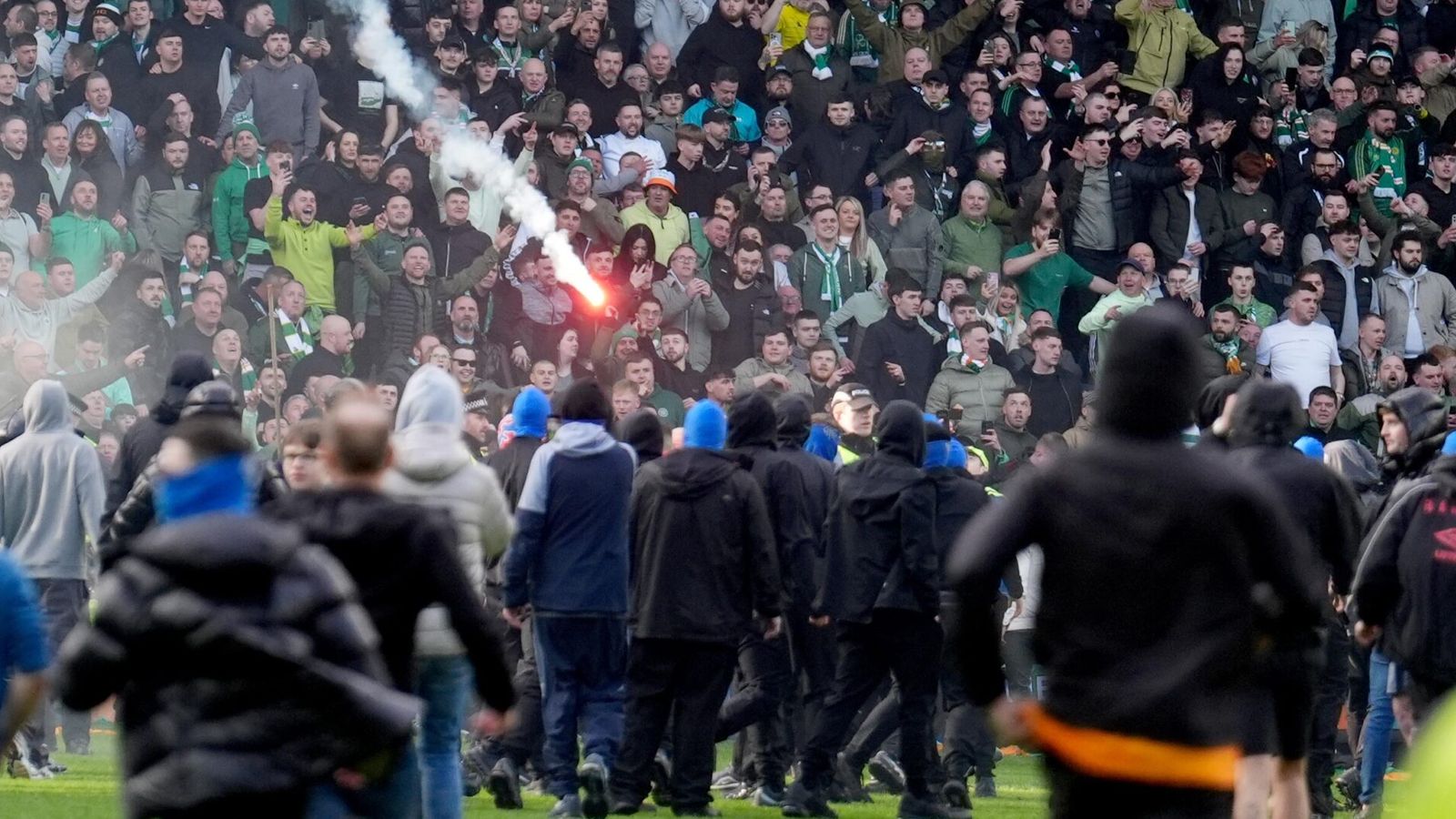
In football, four minutes is the length of a lengthy VAR review or the injury-time period where a team desperately chases an equalizer. But on March 8, 2026, it was the exact duration during which the pitch at Ibrox ceased to be a football ground. Instead, it became a zone of potential life-threatening violence, exposing systemic vulnerabilities that had been building for years.
Celtic had just advanced to the Scottish Cup semi-finals after a grueling 0-0 draw, winning the penalty shootout 4–2. The moment the final penalty was converted, Celtic supporters breached the thin line of stewards and flooded the pitch. This was not a standard post-match pitch invasion, but the catalyst for a chaotic chain of events.
According to the 37-page independent review led by UEFA match delegate Mark Blackbourne, it took the security apparatus exactly four minutes and 28 seconds to re-establish control. During this window, a section of Rangers fans known as the Union Bears launched a reactionary and overtly confrontational charge toward the pitch. Many of them were masked and armed with poles and reinforced gloves, ready for physical combat.
Only fortunate circumstances and the narrow physical gap between the two factions prevented a mass confrontation. The police officers tasked with maintaining the peace were completely overwhelmed. In a subsequent safety meeting, experienced Police Scotland officers admitted they were petrified of policing future editions of the fixture.
When the police themselves admit to terror, it is clear that the standard crowd control model has reached its limit. This was not a sudden, unpredictable explosion of passion, but the inevitable breakdown of a security system under immense pressure.
The complacency of the 8,000 away allocation
The core planning failure did not happen when the fans breached the barriers. It occurred weeks earlier in the offices where the matchday risk assessment was signed off. For years, the Old Firm has operated under restricted away allocations, reducing the travelling contingent to a tiny fraction of the stadium capacity.
In the previous league encounters, Celtic's allocation at Ibrox was limited to just 700 or 800 tickets, which allowed for tight police escort lines and zero corridor leakage. But for this Scottish Cup tie, the SFA insisted on returning to the traditional cup allocation of approximately 8,000 away fans. This represented a massive ten-fold increase in the size of the visiting support, dramatically shifting the crowd dynamics.
The raw numbers highlight the operational deficit. During the previous 700-ticket derby games, the steward-to-fan ratio in the away corner was approximately 1 to 10. For the March 8 cup match, that ratio was diluted to nearly 1 to 50, leaving the stewards completely incapable of holding the perimeter line when the final whistle blew.
Despite this massive increase in visiting supporters, Rangers' safety team submitted a risk assessment that was virtually identical to previous fixtures. It was the security equivalent of playing a high defensive line against elite speed without adjusting your center-backs. You are asking for disaster by relying on assumptions that no longer apply to the field of play.
The Broomloan Road stand, which housed the Celtic contingent, became a bottleneck before the match even kicked off. Blackbourne's review details a severe crush risk outside the stadium as Celtic ultras overwhelmed the security staff. A gate was forced, and a significant number of fans entered without tickets, throwing off the stadium's capacity calculations.
As the BBC reported, the planning inadequacies were scathing. If you do not control the entry metrics, you lose control of the internal environment. By the time the game kicked off, the stadium was already operating at an inflated risk level.
Rangers' subsequent statements pointed a finger back at the SFA, arguing that the decision to enforce the large away allocation materially changed the risk profile of the fixture. While true, this defense does not excuse the club's administrative paralysis. If you know the risk profile has changed, you do not use the same playbook.
Organised chaos and institutional failures
The Blackbourne report does not mince words when discussing the Green Brigade and the Union Bears, comparing their operational styles to organised crime groups. These are not loose collections of loud supporters, but structured organizations with clear hierarchies, communications networks, and tactical objectives. They coordinate their movements, run counter-surveillance on police, and use pyrotechnics as tools of tactical disruption.
The review notes that over 120 flares and smoke canisters were smuggled into the stadium, primarily by the organized fan groups. This quantity of pyrotechnics is not just a safety hazard; it is a tactical tool used to create visual cover and confusion. Under the cover of thick green and blue smoke, the physical incursions were initiated, making real-time monitoring by the control room nearly impossible.
On March 8, these groups dictated the tempo of the afternoon. The police were reactive, chasing shadows while stewards stood by helpless. But the most bizarre findings in the review focus on the actions of the host club's staff.
The Rangers mascot, Broxi Bear, was twice observed by the official match delegate actively provoking the away supporters. He had to be formally warned by a stadium safety officer. Furthermore, the pre-match music selection was deemed to have deliberately antagonized the away end.
When a club's official mascot and stadium DJ are actively contributing to the hostility of a high-risk fixture, it suggests a culture that values tribalism over basic safety. This was not just a failure of police tactics; it was a failure of institutional self-control. The result of these compounding factors was a stadium that felt less like a sporting venue and more like a pressure cooker.
During the chaotic aftermath, children were struck by coins thrown from the stands, players were targeted, and police officers were assaulted. The police investigation, dubbed Operation Moonglint, has resulted in 37 arrests to date. However, the damage to the reputation of Scottish football is far harder to quantify.
What the August hearings must address
Both clubs now face identical notices of complaint for breaching SFA Disciplinary Rule 37, which covers the failure to maintain good order and security. As Sky Sports reported, the clubs will face these disciplinary hearings in mid-August.
Historically, SFA fines for crowd trouble have been viewed by clubs as a minor cost of doing business. But the Blackbourne report calls this event a watershed moment. If the SFA treats the upcoming hearings as business as usual, they will be ignoring a massive warning sign.
The numbers from March 8 show that the current model of policing and stewarding is obsolete when confronted with organized ultras. A fine of twenty or thirty thousand pounds will not change the structural design of these stadiums or the culture of the clubs. What is required is a complete overhaul of matchday operations, including biometric ticketing and physical segregation zones outside the ground.
If Celtic and Rangers are allowed to hide behind bureaucratic finger-pointing, then the next near miss will not be a miss at all. The statistics show that we got lucky at Ibrox. Next time, the four minutes and 28 seconds of chaos might end in a tragedy that Scottish football cannot recover from.
Read Next
- The world feels a little greyer without Mighty Mouse
- Manchester United's transfer window is a chaotic game of musical chairs
- Total chaos at the transfer wire leaves fan bases spiraling
- Anthony Taylor retires from refereeing after 16 years of absolute chaos
- ⚽ Scottish Premiership 2025-26 — Celtic vs Rangers Hub