
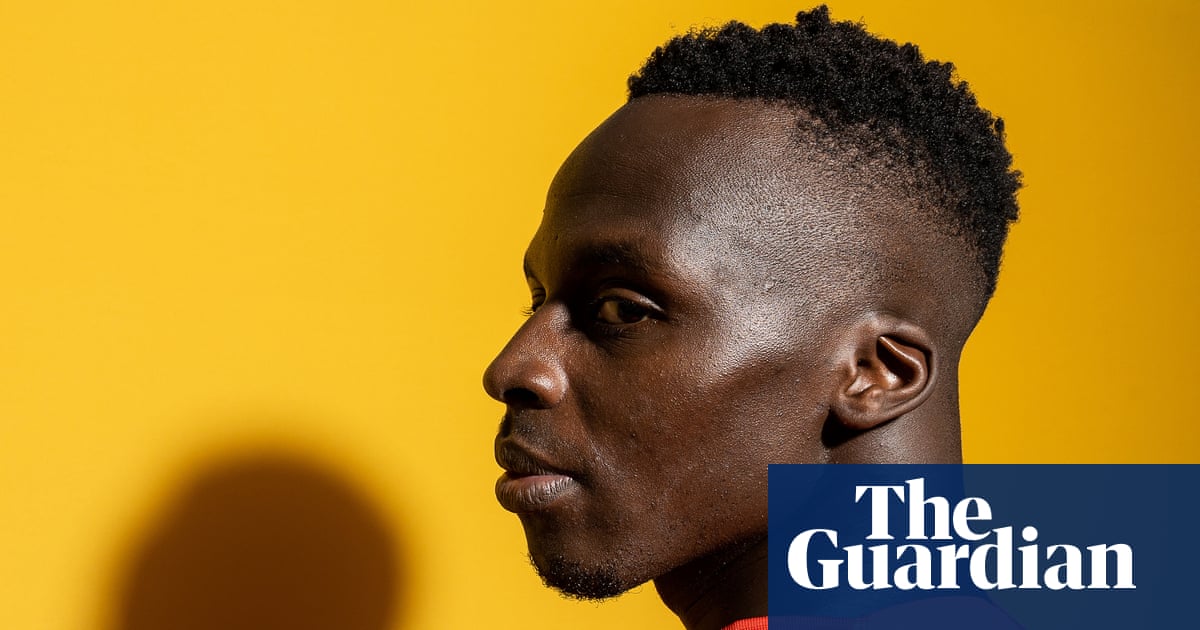
Édouard Mendy was right about the Champions League and Afcon
The Anatomy of a Stoppage-Time Panenka
In stoppage time of an agonizingly tense Africa Cup of Nations final at the Stade Prince Moulay Abdellah in Rabat, Real Madrid playmaker Brahim Díaz stepped up to take the penalty that would decide a continent's fate. Seconds earlier, Édouard Mendy had walked back onto the pitch with a fresh yellow card, having endured a chaotic 17-minute delay where Senegal abandoned the pitch in protest. As green lasers danced across Mendy's forehead and crowd noise reached deafening levels, Díaz began his approach.
Most goalkeepers in that high-pressure environment pick a side early and commit their momentum to a dive. Mendy did something far rarer: he read the physical mechanics of the shooter's stride. As he recalled to The Guardian, Díaz decelerated two full steps before impact rather than on his final plant foot.
That micro-adjustment in body language signaled a Panenka. Mendy held his ground, stood tall, and plucked the weak central chip out of the air as if it were a simple routine cross in training. Four minutes into extra time, Pape Gueye fired home Senegal's winning goal, securing their second Afcon title in four years on the pitch.
blockquote>"I realised two steps before he shot … usually when a player does a Panenka they slow down for the last step, but I noticed he did it early. I know his preferred side is on the right. But when I saw him slow down way before, I just stood up and managed to catch the ball."Goalkeeping at the absolute highest level is rarely about cat-like reflexes alone. It is about pattern recognition under severe psychological stress. Díaz had built a reputation across European football by forcing goalkeepers to commit early, but Mendy refused to sell himself.
Standing at six feet four inches, Mendy possesses the physical reach to delay his lateral push longer than shorter shot-stoppers. When a taker decelerates prematurely, a keeper with elite wingspan can remain centered without sacrificing coverage of the bottom corners. Mendy turned Díaz's own deception against him by relying on patient biomechanics rather than guessing.
The penalty sequence unfolded after minutes of pure hostility on the pitch. Senegal had just seen a potential winning goal disallowed moments earlier when Congolese referee Jean-Jacques Ndala whistled for a controversial foul by El Hadji Malick Diouf after a Morocco corner. Mendy had also complained about Bayern Munich forward Ismael Saibari stealing his towel from behind the net—a bizarre psychological ploy for which Saibari later apologized.
Yet, when the referee finally blew his whistle for the spot-kick, Mendy stripped away the surrounding circus. He isolated the shooter's hips, tracked the deceleration curve, and made a save that defined a generational career. It was a masterclass in elite goalkeeping composure.
The Bureaucratic Farce and Senegal's Self-Inflicted Chaos
Seven months after Senegal paraded the trophy through Dakar, the match remains technically unresolved in the corridors of power. In March, the Confederation of African Football issued a heavy-handed administrative ruling, declaring that Senegal had forfeited the final by leaving the pitch and awarding Morocco a 3-0 victory. A preliminary hearing at the Court of Arbitration for Sport in Switzerland is finally scheduled for next month.
Let us be completely honest about Senegal's behavior during that final: walking off the pitch was an unmitigated tactical and administrative failure. Regardless of referee Ndala's questionable calls, abandoning the playing surface for nearly twenty minutes set a dangerous precedent. Senior players lost their composure, risking a forfeit that almost handed Morocco the trophy without a fight.
When a team walks off the pitch during a high-stakes final, body temperatures drop, cardiovascular intensity resets, and mental sharpness evaporates. Senegal's emotional outburst was self-sabotage that could easily have cost them the match upon restart. Only Mendy's ice-cold execution on the goal line saved his country from self-inflicted disaster.
Mendy views the ongoing legal battle with pragmatic detachment. "The only thing we have to remember is that the game went to the end," Mendy stated in his Guardian interview. "We went off the pitch but the game restarted... you can’t change something that has already been decided."
His stance highlights a truth that sports governing bodies consistently ignore. Silverware is not validated by courtroom arguments or administrative memos. It is validated by 90 minutes of athletic combat and the emotional memory of a nation.
When Mendy claims that winning Afcon was ten times better than lifting the Champions League trophy with Chelsea, European commentators might express surprise. Club football represents an assembly of expensive global talent; national team football represents collective identity. Winning Chelsea's second Champions League title was a career peak, but securing Senegal's historic first Afcon title in 2022 transformed an entire nation's sporting narrative.
blockquote>"[Winning Afcon] was the best moment of my football career: it was 10 times better [than the Champions League]. To win for your club is something really incredible. But you cannot compare with winning for your country, especially when they have never won anything before."The difference in emotional weight explains why Mendy places his international achievements above European club silverware. At Stamford Bridge, he operated as the final defensive component of Thomas Tuchel's system. With Senegal, he served as the psychological bedrock of a national sporting revolution.
Consider the extraordinary resume Mendy accumulated across his 59 international caps: His achievements reflect elite consistency across multiple continents.
- Two Africa Cup of Nations titles won on the pitch in 2022 and 2026
- A clean sheet in the 2021 UEFA Champions League final against Manchester City
- Back-to-back Asian Champions League titles with Al-Ahli
- FIFA The Best Goalkeeper award winner in 2021
That collection of trophies places Mendy among the most accomplished goalkeepers of his generation. Yet his path to football's grandest stages was anything but conventional.
From the Job Center to Asian Champions League Glory
A decade before stopping Brahim Díaz in Rabat, Mendy was registered at a French unemployment office in Normandy. After suffering consecutive relegations with Cherbourg, his agent abandoned him, leaving the 23-year-old goalkeeper without a club for a full year. He trained alone on public pitches, wondering if his professional journey was over before it truly began.
Marseille eventually offered him a trial as a third-choice backup, sparking a rapid rise through Rennes to Chelsea. By May 2021, Mendy equaled the Champions League record for clean sheets in a single season with nine, shutting out Manchester City in Porto. His aerial dominance and cross-claiming command turned Chelsea's penalty area into a fortress.
During that 2021 Champions League run, Mendy's sweeping range allowed Chelsea's back three to push five meters higher up the pitch. His aggressive starting position eliminated space behind Thiago Silva and Antonio Rüdiger, stifling opponent counter-attacks before they materialized. That subtle positional awareness was just as vital as his reflex saves against Real Madrid in the semi-finals.
His transfer to Al-Ahli in Saudi Arabia was initially dismissed by skeptics as a lucrative exit strategy. Instead, Mendy anchored Al-Ahli to consecutive Asian Champions League titles, proving his shot-stopping mechanics remained world-class. His second Yashin trophy nomination this year alongside Gianluigi Donnarumma confirms that elite goalkeeping is measured by performance, not league geography.
Last week, Mendy officially announced his retirement from international football at age 34. A severe knee injury suffered against Norway during World Cup competition had highlighted the physical toll of his long career. Even a personal phone call from Senegal's new manager, Patrick Vieira, could not change his mind.
Vieira pitched the idea of building Senegal's new era around Mendy's veteran presence. Mendy requested time to reflect, consulted his family, and called Vieira back a few days later to stick to his decision. Knowing when to step aside is the mark of a self-aware professional.
Mendy's departure leaves a void in goal that technical talent alone cannot fill. He provided Senegal with complete tranquility during high-stakes shootouts and frantic knockout matches. Replacing that quiet authority is Patrick Vieira's most urgent task.
The Next Generation and the Legacy at Keur Massar
Senegal's tactical system must now adapt under Vieira's leadership. The national team's new core features promising talent like Monaco midfielder Lamine Camara—who attracted interest from Chelsea over the summer—and Aston Villa winger Ibrahim Mbaye. Both players favor a progressive, possession-heavy tactical approach.
However, creative midfield play requires a solid defensive backbone to succeed in tournament football. Camara's press-resistant dribbling will mean little if Senegal lose the structural compactness that Mendy provided for six years. The transition from Aliou Cissé's rigid defensive low block to Vieira's expansive setup will test Senegal's organizational discipline.
Beyond the tactical board, Mendy's legacy in Senegal is built on tangible social investment. In his parents' hometown of Keur Massar, he funds an educational facility that recently expanded to support 200 students. He also finances initiatives designed to mentor and launch young Senegalese entrepreneurs.
"There is so much talent in Senegal and we have a young population that is very dynamic," Mendy told The Guardian while reflecting on the project. "When my mum sees the school she is so proud and that is the biggest gift anyone can have."
When young goalkeepers across Dakar put on the No. 16 jersey, they are not merely wearing a squad number. They are honoring a player who fought from unemployment to the top of world football without losing his humility.
CAF's legal committees can alter match records and CAS arbitrators can debate regulations in Switzerland next month. But match results written on the pitch cannot be erased by bureaucratic pen strokes. Édouard Mendy stood firm when the pressure was highest, read the shooter's stride, and retired as a true champion.
Read Next
- Mourinho rants, Chelsea collapse, and Rangers shock Celtic before the break
- Top 10: Top Moments in the England Squad Selection Saga
- Morocco and Senegal are Africa's only real 2026 World Cup heavyweights
- Shaun Wright-Phillips on Strictly is a reminder of football's lost wingers
- 🇸🇳 Senegal World Cup 2026 — Lions of Teranga Hub
- 🇫🇷 WC 2026 Group I — France, Senegal, Norway
- ⭐ UCL 2026 — Champions League Quarter-Finals Hub
adidas Oceaunz League Soccer Ball
FIFA Quality certified match ball that looks as good as it plays.
More Coverage

Mourinho rants, Chelsea collapse, and Rangers shock Celtic before the break
17 hours ago
Top 10: Top Moments in the England Squad Selection Saga
21 hours agoMorocco and Senegal are Africa's only real 2026 World Cup heavyweights
2 days, 5 hours ago
Shaun Wright-Phillips on Strictly is a reminder of football's lost wingers
3 days, 3 hours ago
Xabi Alonso returning to Anfield headlines a wild Carabao Cup draw
5 days, 1 hour ago
Arsenal's defensive nightmare gets worse while Chelsea sweat over Joao Pedro
6 days, 9 hours agoMore Analysis
Mourinho rants, Chelsea collapse, and Rangers shock Celtic before the break
17 hours ago
Top 10: Top Moments in the England Squad Selection Saga
21 hours ago
Shaun Wright-Phillips on Strictly is a reminder of football's lost wingers
3 days, 3 hours ago
Xabi Alonso returning to Anfield headlines a wild Carabao Cup draw
5 days, 1 hour ago
Arsenal's defensive nightmare gets worse while Chelsea sweat over Joao Pedro
6 days, 9 hours ago