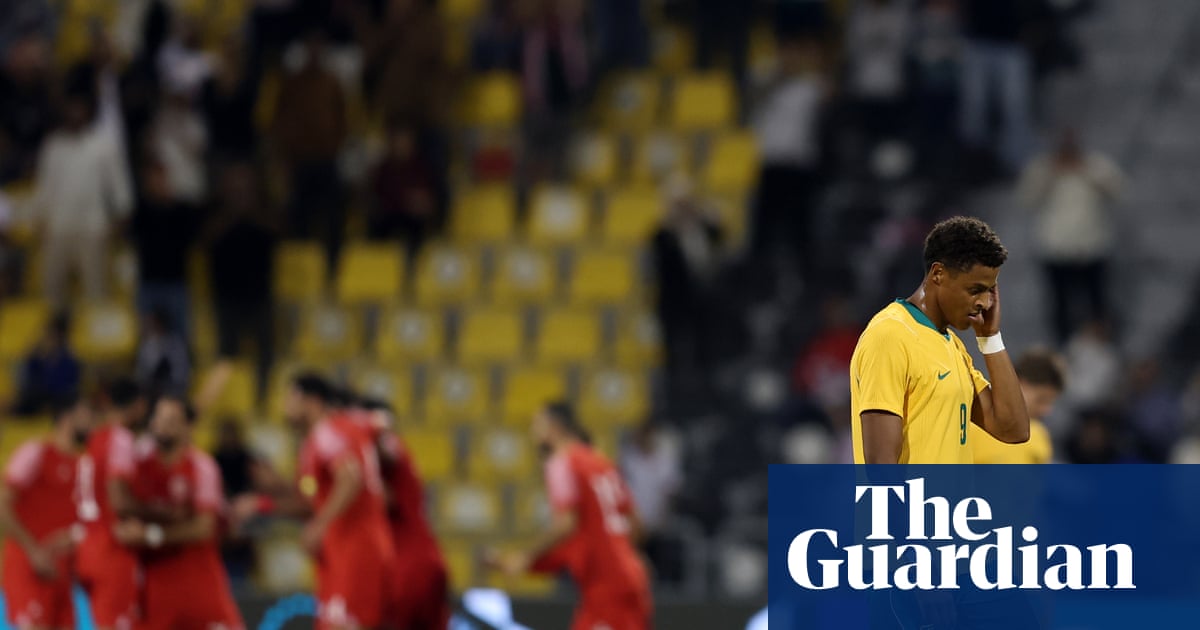
If you bought stock in Tony Popovic after Friday night's win against Qatar, I hope you kept the receipt. Beating the reigning Asian champions had everyone ready to plan parade routes and declare the national team completely fixed. Then Tuesday arrived in Doha, Musa al-Taamari showed up, and the entire illusion evaporated in an ugly 2-0 defeat.
This was not some unlucky friendly loss where you point to the bounce of the ball and move on. Jordan did not merely beat Australia; they turned the opening forty-five minutes into a relentless shooting gallery. If you followed The Guardian's match dispatch expecting a balanced tactical arm-wrestle, what you actually saw was complete panic against a side that played with twice the hunger.
The two-goal deficit genuinely flattered the Socceroos. Jordan hit the woodwork, exploited acres of vacated green space, and left Australia's backline looking like strangers at a bus stop. Ending 2026 on a performance this sloppy leaves everyone with a sour taste in their mouth.
The First-Half Blitz: Musa al-Taamari Runs Riot
Let us be real about those opening minutes. Jordan came out flying in Doha, cheered on by an electric crowd that made a relocated neutral-site fixture feel like a hostile cup final. The Australians looked like they were still running warm-up drills while Jordan attacked every duel like their careers depended on it.
Within seconds of kickoff, Mahmoud al-Mardi broke through and forced Alessandro Circati and Harry Souttar into desperate recovery defending to shepherd the ball wide. Moments later, Patrick Beach had to react sharply to deny Musa al-Taamari, who then skied another effort over the bar after Lucas Herrington was caught wandering upfield. That was three shots in six minutes, matching the exact total Australia conceded across ninety minutes against Qatar on Friday.
Al-Taamari was operating on a different wavelength than anyone else on the pitch. He accelerated into empty lanes, cut inside at will, and turned Australia's defensive structure into absolute rubble. Every single time the Socceroos coughed up possession in midfield, Jordan bolted forward with vicious intent.
Popovic looked shell-shocked on the touchline as his team lost every 50-50 challenge. His post-match assessment to reporters was a blunt reality check that cut straight through any excuses:
“Poor, very poor. We played into their hands; our ball speed, our aggression, we didn’t win any duels, and we constantly got caught on the counterattack.”
Popovic went even further, admitting the team got exactly what they deserved across that opening half. When your manager publicly states that your side lacked basic aggression and energy, that is not a minor tactical tweak. That is an indictment of the team's entire competitive approach.
Defensive Brain Fades and the Half-Time Mystery
Good teams can absorb pressure, weather the storm, and regroup when things get hairy. The Socceroos did the exact opposite by shooting themselves squarely in both feet before the break. The opening goal was an accumulation of unforced errors that would get you benched in regional amateur leagues.
In the 31st minute, al-Taamari slalomed into the eighteen-yard box and provoked Connor Metcalfe into a moment of pure panic. Metcalfe stuck out a lazy leg, caught the Jordanian winger, and gifted away an obvious penalty. Patrick Beach came up huge with a trailing leg save, but the reprieve lasted barely three minutes.
By the 34th minute, disaster struck when Lucas Herrington suffered a calamitous heavy touch on the ball. The ricochet landed at the feet of Amer Jamous, who immediately sliced a pass into the vacant channel abandoned by the Hull defender. Al-Taamari pounced, burst clean through, and buried his finish inside the bottom corner.
That chaotic stretch exposed everything broken about Australia's defensive balance on the night:
- Conceding three rapid-fire scoring opportunities inside the first six minutes of play
- Connor Metcalfe lunging into a reckless challenge in the box after losing his runner
- Lucas Herrington gifting away possession with an unforced heavy touch on the flank
- Harry Souttar and Alessandro Circati repeatedly getting turned around in foot races against dynamic runners
Then came the bizarre halftime substitution that had fans buzzing on social media. Harry Souttar was substituted for Diesel Herrington at the break and did not even return to the technical area. Instead, the Leicester City defender spent the second half sitting in the grandstands dressed in casual street clothes.
Seeing your towering defensive leader watching the match in civilian attire halfway through an international fixture is jarring. Whether it was precautionary management or frustration, it encapsulated an evening where nothing went according to script. Australia had lost their commanding presence, and the mountain only grew steeper.
One Shot on Target and Daniel Arzani’s Fifteen-Minute Meltdown
Whatever Popovic said inside the dressing room at halftime did not inspire a legendary comeback. Goalkeeper Patrick Beach pulled no punches when evaluating the team's collective mentality:
“Not good enough from us; not good enough. We know that. I think we had a good discussion at half-time about that. I think we went into the game with the handbrake up a bit.”
Entering an international match with the handbrake on is baffling when you are supposed to be building winning habits. While Jordan naturally lowered their pressing tempo after the restart, Australia could not conjure an ounce of creativity. Passes crawled across the turf, off-the-ball runs were non-existent, and Jordan's keeper never had to sweat.
When the final numbers rolled in, Australia had registered just one effort on target in ninety minutes of football. That lone chance was a tame 49th-minute hit from Riley McGree that never looked like troubling the scoreboard. For a squad that put Qatar to the sword four days earlier, generating one soft shot is an embarrassing regression.
Popovic went to his bench in search of any creative pulse, throwing Daniel Arzani into the fray. What followed was a total disaster in substitute management. Within fifteen minutes of stepping onto the grass, Arzani managed to collect two yellow cards and earned an early walk to the showers.
Down to ten men and running on fumes, Australia surrendered all remaining control. Jordan calmly managed the closing minutes before Ali Olwan delivered the finishing strike in the 93rd minute. It put an emphatic stamp on a night Australian supporters will want to scrub from their memory banks.
The Postponed Asian Cup and Tony Popovic’s Uncertain Future
The timing of this dud could not possibly be worse for Tony Popovic. With the Asian Cup postponed, as reported from Doha, Popovic is now out of contract at the close of 2026. Beating Qatar made an extension feel like a formality, but getting humbled by Jordan brings all the uncomfortable questions right back to the surface.
Popovic deserves credit for steadying the ship earlier in his cycle and integrating younger talents into the fold. But international football moves at breakneck speed, and good vibes evaporate after a single ninety-minute collapse. You cannot claim the program is flying when Jordan dominates you in every department on the pitch.
Alessandro Circati was quizzed about the coaching situation post-match and chose his words carefully. The defender noted that the boss has been fantastic for him personally and that the squad has enjoyed success under his leadership. Yet Circati admitted that Popovic's contractual fate is entirely in the hands of the federation hierarchy.
That leaves Football Australia facing a massive fork in the road heading into 2027. Do they commit to Popovic's vision despite glaring red flags against energetic Asian opposition? Or do they treat this Doha defeat as a clear warning sign that the ceiling with this setup has already been reached?
If this was indeed Popovic's final match at the helm, it is a depressing way to bow out. Going out on an evening featuring your star centre-back in the stands in civilian clothes and a reckless red card is hardly a storybook finale. Australian football needed a statement win to wrap up the year, but what they got was a painful reality check.
If Popovic stays, his first order of business in 2027 will be figuring out why this group swings between fearless and completely lifeless. If he leaves, whoever takes the reins inherits a team with serious structural flaws and an allergy to testing opposition goalkeepers. Either way, Tuesday in Doha was an ugly wake-up call that nobody in Australian football can afford to ignore.
Read Next
- Why November 16 is the wildest date on the football calendar
- Ranking the 10 defining moments for BBC Women's Footballer of the Year
- Klopp's Germany just dismantled the Dutch and the numbers make sense
- Wayne Rooney is about to win over every skeptic on reality TV
- 🇦🇺 Australia World Cup 2026 — Socceroos Hub