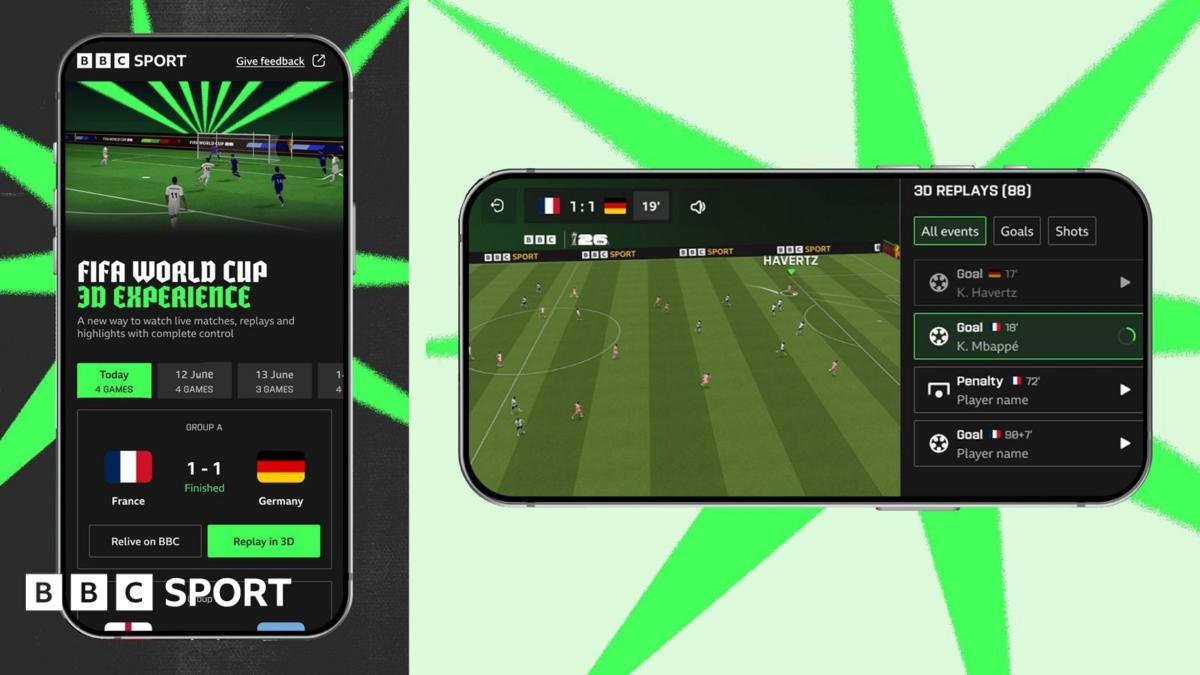
The spatial revolution in football analytics
For decades, the average fan has been trapped in the limitations of the traditional broadcast feed. We rely on the director’s cut, a medium that prioritizes spectacle over spatial awareness. That approach officially looks prehistoric given the new BBC data integration for the Spain versus Belgium fixture.
By allowing viewers to manipulate the camera angle, the broadcaster is essentially handing the analyst’s notebook to the audience. You can finally track the defensive line in real-time without wondering if the wide-angle camera caught the trailing fullback. If Luis de la Fuente instructs his wingers to hold the touchline, you no longer have to wait for the replay to confirm the spacing error.
Mapping the pitch beyond the broadcast
Consider the typical build-up play for Spain. Usually, we see a midfielder like Fabian Ruiz shifting the point of attack, but we miss the subtle lateral movement that drags the Belgian defensive structure out of horizontal compacting. By toggling to the full-pitch view, the structural failures become glaring.
We have long complained about television directors cutting away from the off-ball movement during a counter-attack. When a defensive midfielder makes a recovery run, the camera usually follows the ball, ignoring the tactical trigger occurring twenty yards away. Solving this with the 3D viewer is a genuine advancement in the way we decompose a team’s performance.
The pitfalls of excessive data
However, putting the tools of a professional scout into the hands of the public is not without risk. Football remains a fluid game of margins, one often decided by individual brilliance that renders tactical systems redundant. A perfect 3D view of a World Cup match cannot explain why a striker miscontrols the ball in 68th minute or why a keeper decides to rush off their line.
There is also the risk of paralysis. Does the average viewer want to spend 90 minutes managing camera angles, or do they want to watch the match? The interface requires significant engagement. If the user interface is not intuitive, this remains a gimmick rather than an evolution.
The statistical heavy lifting
Ultimately, this shift forces us to move past the superficial analysis of highlights. If you analyze a match solely through the 3D model provided in the BBC stream, you begin to see the game as a series of distance calculations. You can measure the yardage between a center-back and the half-space runner with near-perfect accuracy.
By the time a match reaches the 85th minute, fatigue patterns emerge more clearly in the top-down view than in the broadcast tracking shots. Defensive gaps that appear as minor blips in a highlight reel are revealed as systemic rot in a full-pitch tactical feed. We are moving toward a future where our critiques of a manager’s substitute choice are backed by hard spatial data rather than just gut instinct.
The integration of deep tracking data and 3D rendering moves us closer to the objective truth of football. Managers have had access to this level of analysis for years. It is about time the fan did, too.
Read Next