
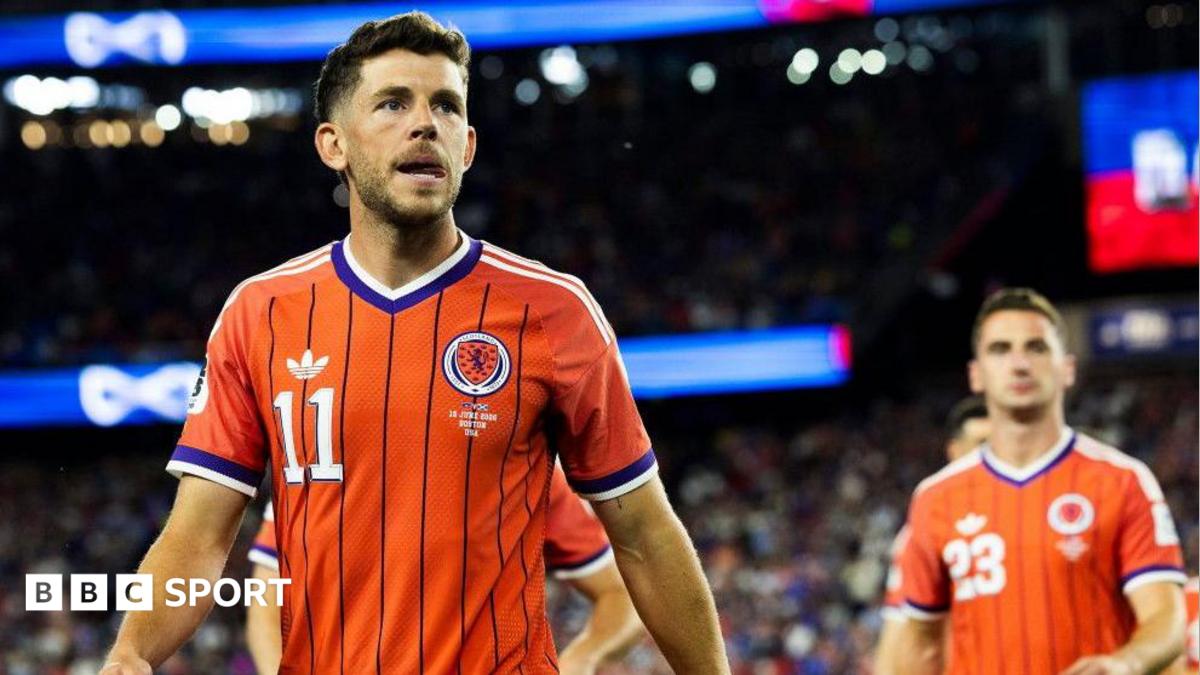
Thirty-six years of waiting ended with a single John McGinn strike in Boston, but Scotland's World Cup adventure was over in just eleven days.
The 1-0 victory against Haiti in Group C promised a new era for Steve Clarke's side. Instead, consecutive defeats to Morocco and Brazil sent the squad home before the knockout round began.
At the heart of this campaign was AFC Bournemouth midfielder Ryan Christie. At 31, he remains a key figure in Scotland's national setup, yet his role in this tournament highlights a deep tactical conflict.
Following the exit, as reported by BBC Sport, Christie expressed that he was "gutted" and "desperate" to help Scotland qualify for future major tournaments.
The midfielder recently signed a three-year contract extension at Bournemouth, keeping him in the Premier League until 2029.
His club form is spectacular, but his national team output is different. Why does a player who looks so dominant under Andoni Iraola struggle to elevate Scotland on the world stage?
The tactical evolution from Celtic to Andoni Iraola's engine room
To understand Christie's international struggles, one must first analyze his club transformation.
During the 2020/21 season at Celtic, Christie was utilized primarily as an attacking winger or a floating playmaker. In that final season in Glasgow, he averaged 0.82 tackles and 0.41 interceptions per 90 minutes. He was a creative spark, not a defensive anchor.
His transfer to Bournemouth in 2021 changed everything. Under Andoni Iraola, Christie underwent a radical positional shift. He moved from the final third into the defensive pivot.
In the 2025/26 Premier League season, Bournemouth secured a historic 6th-place finish, qualifying for the Europa League for the first time in club history. Christie was central to this success, averaging 2.64 tackles and 1.38 interceptions per 90 minutes.
This represents a 221 percent increase in tackling frequency compared to his Celtic days.
He has become a defensive destroyer. In Iraola's intense pressing system, Christie excels at winning the ball in the middle third. He recorded 78 recoveries in that zone last season.
His defensive evolution was particularly evident in Bournemouth's landmark victories during the 2025/26 campaign. In their 2-0 win over Aston Villa and the 1-1 draw against Newcastle, Christie's role was to screen the back four and break up transitions. He became a master of the tactical foul and the high-energy recovery.
Yet, this defensive conversion comes at a cost as his goal contributions have dropped. He scored only two goals in the entire 2025/26 Premier League campaign. He is no longer the player who unlocks deep defenses.
The Steve Clarke pivot: Why the Premier League system broke in Miami
Steve Clarke saw Christie's defensive growth and tried to replicate it for the national team. In their second Group C match against Morocco in Boston, Clarke abandoned his usual three-man backline.
Scotland deployed a 4-2-3-1 formation. Christie started in a double pivot alongside Lewis Ferguson, replacing his usual role as an advanced playmaker.
Morocco exploited this setup immediately. Ismael Saibari scored just 71 seconds into the match on June 19. The early goal completely disrupted Scotland's game plan, forcing them to chase the match against Morocco's organized defense.
This was a tactical error, and the numbers from the 1-0 defeat to Morocco are damning. Christie completed just 72 percent of his passes. Under Morocco's aggressive mid-block press, he struggled to progress the ball.
Scotland's creative output dried up entirely. The team registered a meager 0.45 expected goals (xG) against Morocco. Christie made three tackles and two interceptions, but his defensive work did not translate into attacking momentum.
When they faced Brazil on June 24 in Miami, the situation grew worse. Vinicius Junior scored after just seven minutes, exposing Scotland's fragile defensive shape. Matheus Cunha added a third in the 60th minute to seal the defeat.
Scotland lost 3-0 at Miami Stadium. In that match, the Scots managed a pathetic 0.12 xG and had only one shot on target. Christie was overrun by Matheus Cunha and Vinicius Junior, who exploited the spaces behind Scotland's midfield pivot.
Scotland finished third in Group C with three points. They missed the Round of 32 because of a goal difference of minus three. Their defensive solidity, which Christie was meant to guarantee, evaporated under elite pressure.
The systemic creation vacuum in Scottish football
The core issue is not Christie's work rate. It is Scotland's systemic lack of progressive passing.
At Bournemouth, Christie plays alongside dynamic ball-carriers like Antoine Semenyo and Lewis Cook, giving him immediate outlet options when he wins the ball. In the Premier League, Christie averaged 5.8 progressive passes per 90 minutes. He had targets who could receive the ball in space.
For Scotland, the environment is far more restrictive. During the 2026 World Cup, Scotland averaged only 3.2 progressive passes per 90 minutes. When Christie won possession, his passing options were static and predictable.
Steve Clarke's tactics force midfielders into rigid positions. John McGinn and Scott McTominay were pushed high to support Lawrence Shankland. This left a massive gap between the double pivot and the attack, isolating Christie.
Christie is not a natural tempo setter. He is a presser. When forced to act as the primary playmaker from deep, his limitations are laid bare.
His pass completion rate under pressure fell to 61 percent during the tournament. This is a significant drop from his 77 percent average in the Premier League. Without a creative outlet, Christie was forced to play safe lateral passes or lose possession, leading to a breakdown in transition.
A generation running out of tournaments
The parallel to Scotland's last World Cup appearance is striking. In 1998, Scotland also faced Brazil and Morocco, losing both matches and finishing with a single point.
In 2026, they improved slightly by beating Haiti, but the gap to the world's elite remains unchanged. The current squad is aging rapidly.
Andy Robertson is 32, Callum McGregor is 33, John McGinn is 31, Ryan Christie is 31, and Grant Hanley is 34.
This World Cup was likely the final tournament for this core group of players. Their physical peak is behind them, and the younger generation is not ready to replace them.
Christie's contract extension until 2029 means he will remain a Premier League player for three more seasons. He is determined to help Scotland reach future tournaments. But determination cannot fix a broken tactical model.
Clarke's defensive caution has reached its limit. To reach the next European Championship or World Cup, Scotland must find creative midfielders who can pass through lines rather than just running hard.
If they continue to rely on converting hard-working wingers into defensive midfielders, they will continue to suffer the same fate. Ryan Christie's World Cup disappointment was not an accident. It was the predictable result of a tactical system that values running over passing.
Read Next
- World Cup 2026 is becoming a test of who can handle the heat
- England's tactical flaws will catch up with them at the World Cup
- How the Folarin Balogun Savior Complex Ruined the USMNT's World Cup Dream
- Why Premier League keepers are heading for trouble after FIFA's corner reset
- 🏆 World Cup 2026 — Full Coverage Hub
- 🏴 Scotland World Cup 2026 — Tartan Army Hub
- 🇧🇷 WC 2026 Group C — Brazil, Morocco, Scotland, Haiti


