The Overseas Exodus Reshaping Scotland's National Team
When Sebastien Pocognoli announced his expanded 27-man Scotland squad on Tuesday, one statistical anomaly stood out immediately. Exactly 11 of the 27 selected players—a striking 40.7%—currently play their club football outside the United Kingdom.
For decades, Scottish national selections depended on a rigid backbone of domestic Scottish Premiership mainstays and English football regulars. That traditional balance has officially broken. Pocognoli's inaugural roster features talent stationed across Italy, Denmark, Croatia, Spain, Saudi Arabia, and the United States.
The Italian top flight has become the main destination for Scottish international talent. Serie A currently hosts five members of this selection: Lewis Ferguson at Bologna, Billy Gilmour at Napoli, Lennon Miller at Udinese, Nathan Patterson at Torino, and Josh Doig at Sassuolo. Italian clubs now employ 18.5% of Scotland's entire national team roster.
That Italian contingent is complemented by a wider global footprint. Defender Luis Binks represents Brondby in Denmark, Scott McKenna plays for Dinamo Zagreb in Croatia, Jack Hendry features for Al-Ettifaq in Saudi Arabia, Robbie Ure plays for Sevilla in Spain, and goalkeeper Angus Gunn plays for San Jose Earthquakes in Major League Soccer.
Contrast these figures with historic domestic pipelines. Only six players in this group represent SPFL clubs, while ten play within the English league structure across the Premier League, Championship, and League Two. Foreign leagues now supply more Scottish squad members than either domestic system operating individually.
This geographic dispersion presents a unique tactical dynamic for the Belgian manager. Playing abroad exposes young Scottish players to diverse tactical structures, contrasting sharply with the physical box-to-box demands of domestic British football.
However, it also creates immediate logistical challenges. Pocognoli must integrate players arriving from six different foreign leagues during a short warm-weather camp in La Manga.
Squad Refresh and the 22.2% Turnover Rate
Pocognoli inherits a national team at a defining crossroads. Following last year's demotion from Nations League A after a play-off defeat against Greece, the 39-year-old manager was tasked with modernizing a declining squad core.
He acted decisively by naming five uncapped players in his initial selection. He then added Blackburn Rovers midfielder Kristi Montgomery after Kieran Tierney and Kenny McLean withdrew through injury.
That addition brought the total number of uncapped newcomers to six across the 27-man group. This represents a 22.2% squad turnover rate within a single international window. Pocognoli is not merely tweaking Steve Clarke's legacy, he is executing a rapid structural reboot.
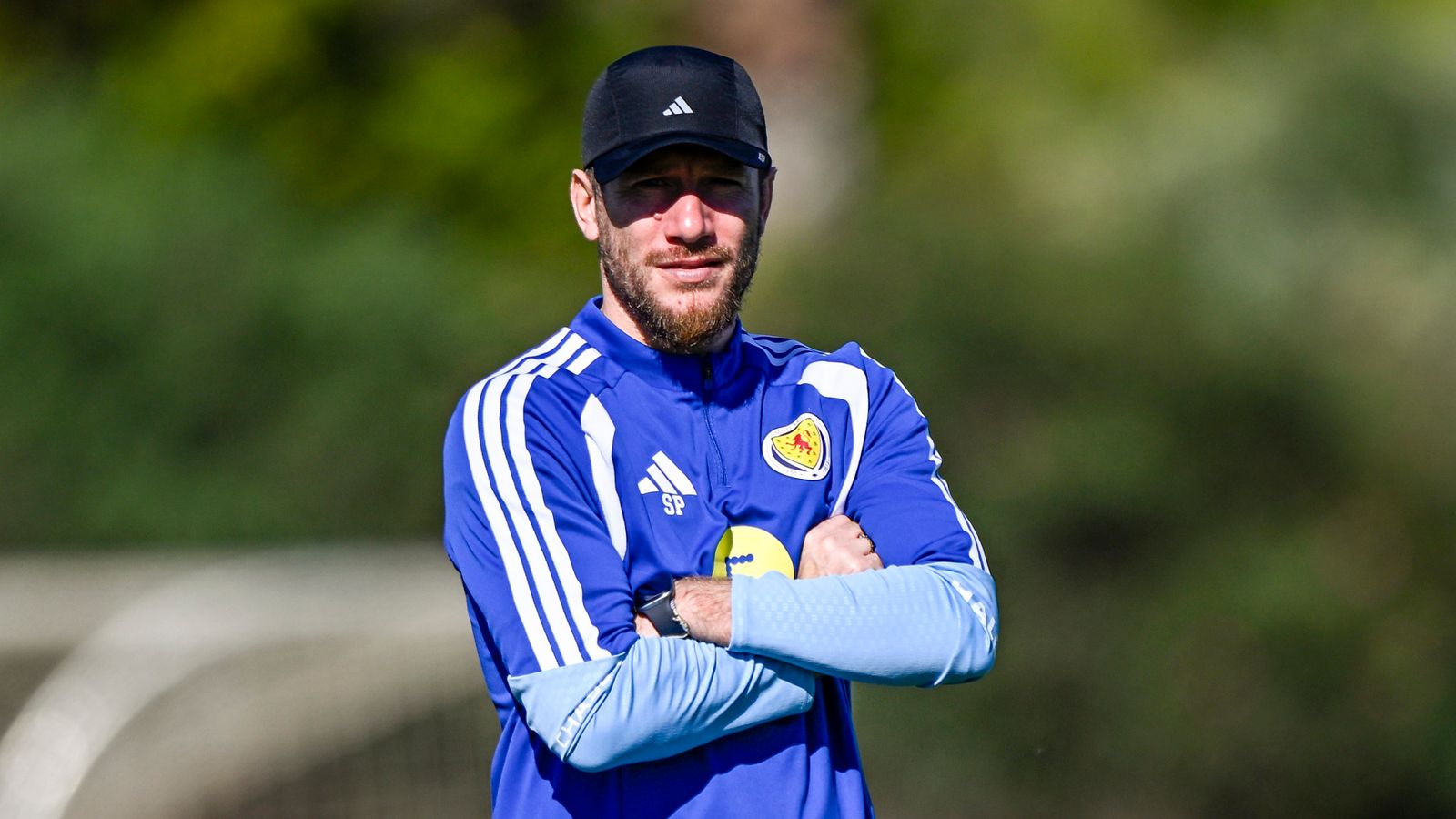
Speaking from Scotland's training base in La Manga ahead of Saturday's opener against Slovenia, Pocognoli outlined his core squad assembly principles.
"We have plenty of experience in the team, there are some new faces and young lads, and I think we have a good mix," Pocognoli told Sky Sports News. "We need to make sure that the balance stays right, and to keep what makes the Scotland team really strong."
Integrating six international novices in a high-stakes competitive environment involves clear operational danger. Tierney's injury deprives Scotland of their primary left-sided central defender, leaving Andy Robertson and Aaron Hickey with reduced defensive cover.
Without McLean in central midfield, Pocognoli must rely heavily on Montgomery to adapt instantly to international intensity. Transitioning six uncapped players into competitive matches without warm-up friendlies tests squad cohesion to its absolute limit.
Furthermore, tactical familiarity drops when nearly a quarter of the squad is learning new pressing patterns simultaneously. Pocognoli must balance rapid tactical instruction with physical recovery during an abbreviated training schedule.
Roster Misallocation: The Four-Goalkeeper Dilemma
While Pocognoli's outfield modernization shows clear vision, his positional squad distribution exposes a major operational flaw. The Belgian coach selected four goalkeepers in his 27-man squad: Angus Gunn, Scott Bain, Liam Kelly, and Jon McCracken.
Allocating four roster spots to keepers means devoting 14.8% of the squad to non-field positions. In a routine single-match window, such roster padding might be dismissed as harmless insurance. In this autumn schedule, it represents poor resource management.
Scotland must navigate a grueling schedule of four matches in 11 days across two packed international fixtures. They begin in Ljubljana against Slovenia on September 26 before hosting Switzerland at Hampden Park on September 29.
They then travel to Skopje to face North Macedonia on October 3 before returning to Glasgow to host Slovenia on October 6. Playing four competitive matches in under two weeks places massive physical demands on outfield starters.
By allocating a fourth spot to McCracken, Pocognoli surrendered a roster position that should have provided central midfield rotation. With McLean absent, midfield depth behind John McGinn, Ryan Christie, and Gilmour looks dangerously thin.
Forcing a condensed midfield unit to handle heavy workloads across four fixtures increases the risk of late-game physical breakdowns in Skopje and Ljubljana. Tactical flexibility drops significantly when substitute options are limited by unnecessary goalkeeping depth.
If central midfielders experience fatigue or minor knocks early in the window, Pocognoli will lack fresh legs to maintain high-intensity pressing during the final 30 minutes of matches.
- September 26: Slovenia vs Scotland (Away, Ljubljana)
- September 29: Scotland vs Switzerland (Home, Hampden Park)
- October 3: North Macedonia vs Scotland (Away, Skopje)
- October 6: Scotland vs Slovenia (Home, Hampden Park)
Tactical Evolution and Nations League B Reality
The positional composition of Pocognoli's forward group indicates a sharp departure from traditional Scottish attacking tactics. Under Clarke, Scotland frequently relied on a single isolated target man supported by late arriving runs from deep midfield positions.
Pocognoli has selected six distinct forward options: Kieron Bowie, Findlay Curtis, Ben Gannon-Doak, Oli McBurnie, Robbie Ure, and James Wilson. Three of those forwards—Bowie at Sassuolo, Ure at Sevilla, and Gannon-Doak at Bournemouth—are 22 years old or younger.
This youthful attacking line gives Scotland the mobility needed to implement a high-pressing defensive block. Pocognoli wants his forward line to disrupt build-up play rather than retreating into a passive low block.
Yet implementing a coordinated pressing system requires precise collective timing. Establishing those triggers during a brief four-day training camp in La Manga is a steep challenge for a new coaching staff.
Pocognoli framed his expectations directly during his first official media appearances before departing for Ljubljana.
"I want to see a team who are just really together, it's quite basic, attack together, defend together, but that's part of the Scotland mentality," Pocognoli said. "For me, in the Nations League, it's to stay competitive and try to be as much as possible higher in the ranking to go to League A."
Reclaiming League A status requires improving Scotland's ball retention numbers away from home. Scotland averaged just 40.8% possession during their previous top-tier Nations League campaign.
In League B, Pocognoli's continental contingent must demonstrate they can control tempo against disciplined European opponents. Defensive solidity cannot be sacrificed while chasing possession metrics in Ljubljana and Skopje.
The statistical profile shows a national side shedding domestic isolation in favor of European diversity. If Pocognoli can fix his midfield rotation flaws, Scotland's overseas exile movement could yield immediate results on the pitch.
Read Next