Fifty-three red cards in ninety minutes is an administrative impossibility made real on a scoresheet. When referee Fernando Patrick Drosghic Modesto blew his whistle on the Minas Gerais under-20 semi-final between Uberlandia and Mamore, he produced 53 dismissals. That single match report rewrote fifteen years of global football records.
The previous Guinness world record belonged to Argentine referee Damian Rubino, who showed 36 red cards during a fifth-division match between Atlético Claypole and Victoriano Arenas in February 2011. Modesto eclipsed that tally by 47.2 percent. That is not an incremental increase; it is an entirely new statistical universe.
To understand how a single football match yields 53 expulsions, you have to look past the brawl and examine the arithmetic of squad rosters. This was not a referee losing control in real time. It was a complete institutional collapse recorded retroactively in a dressing room.
Deconstructing the 53: How two rosters were wiped out
Modern football regulations operate on strict roster limits. Under standard competition rules, each club names a matchday squad of between 18 and 23 players, alongside a technical staff of roughly six to eight individuals.
Modesto's final disciplinary tally was staggering. He sent off 43 players, eight members of coaching staff, and two Uberlandia board members.
Consider the math of those 43 players. Exactly 22 players start on the pitch. If both squads brought the maximum permitted 23 registered players to the first leg, there were at most 46 players in uniform across the entire venue.
That means roughly 93.5 percent of all available athletes were expelled. Only three registered players in the entire stadium escaped without a red card.
In typical mass confrontations, referees target only the primary instigators. The 2011 match in Buenos Aires set the previous mark because Rubino red-carded every player on both team sheets following a pitch invasion by substitutes and fans. Modesto went even further.
He did not just clear the benches. By sanctioning two club directors alongside eight backroom staff, the referee effectively dismissed the entire football operations of both clubs in one evening.
The Argentine benchmark vs Minas Gerais
The jump from 36 to 53 cards is structurally significant. Rubino's 2011 record in Argentina accounted for 22 active players and 14 substitutes and staff members.
The Minas Gerais semi-final represents a 17-card escalation over that 2011 benchmark. It required dismissals across three distinct tiers of personnel: the starting eleven, the technical benches, and the executive suite.
Disciplinary action in football usually drops off sharply as you move away from the pitch. Here, the disciplinary curve remained completely flat across every rank.
The statistical impossibility of 53 cards
Across elite professional leagues, matches produce an average of roughly 0.15 to 0.20 red cards per 90 minutes. To reach 53 dismissals in 99 minutes of football represents an expulsion rate roughly 300 times higher than global norms.
That equates to an average of more than one sending-off every two minutes of playing time. Yet this was not an evenly distributed attrition rate across the match; it was a sudden binary explosion.
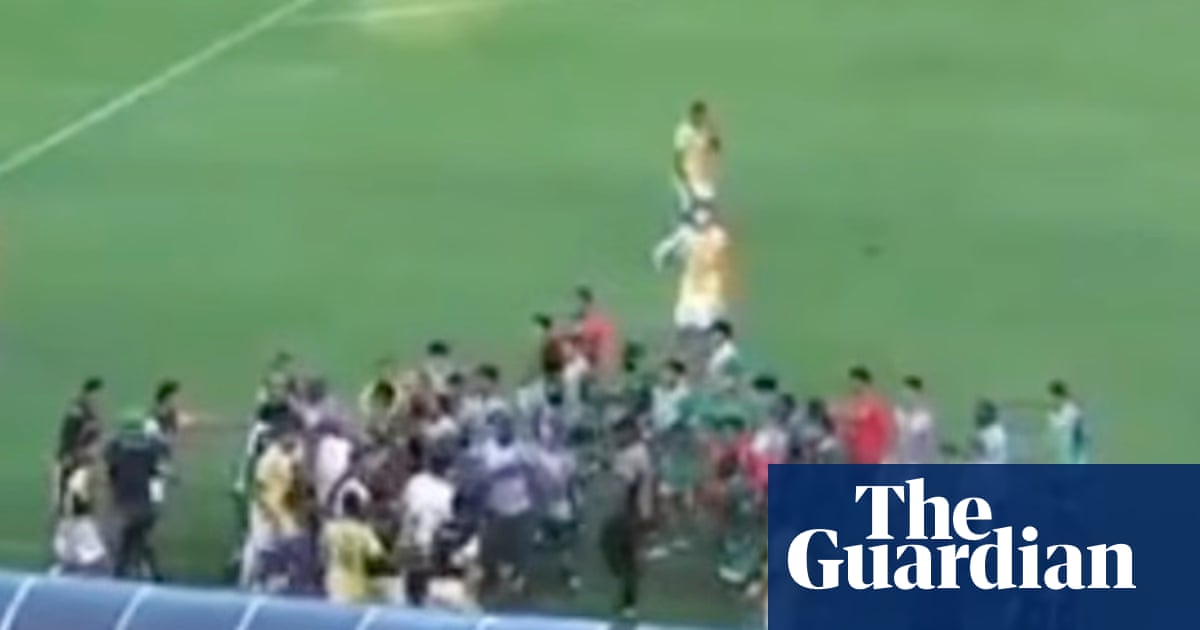
For the first 50 minutes, the match followed a standard disciplinary pattern. The entire statistical collapse occurred across two specific flashpoints: the pitch invasion early in the second half and the 99th-minute goal celebration.
When numbers skew this violently, they point to procedural failure rather than mere player aggression. The referee lost the game long before the brawl began.
The 40-minute ticking clock: Where game management failed
Match control erodes through poor decisions, and Modesto's timeline reveals a catastrophic failure of game management. Trouble started early in the second half when an Uberlandia player was sent off.
Rather than accepting the dismissal, several Uberlandia club officials invaded the field to confront the officiating crew. At that exact moment, the match should have been terminated.
Standard security protocols dictate that if club executives breach the perimeter to intimidate an official, safety is compromised and the fixture must be abandoned. Instead, Modesto halted play for 40 minutes.
That 40-minute delay was disastrous from both a physiological and psychological standpoint. In professional football, half-time is capped at 15 minutes because muscle temperatures drop and concentration wanes beyond that threshold.
Forcing young players to loiter on the pitch for nearly three-quarters of an hour turned the technical areas into pressure cookers. Resentment festered as both benches argued across the touchline.
When play finally resumed, tactical discipline had evaporated entirely. Structure was replaced by spite, played out in an elongated second half that stretched deep into stoppage time.
As The Guardian reported, the decisive spark came in the ninth minute of stoppage time. Davi scored to give Mamore a 3-1 lead, effectively sealing the first leg.
What followed was completely predictable. Davi celebrated directly in front of the Uberlandia bench, taunting opponents who had spent the previous hour waiting to explode.
The collapse at minute 99
Modesto's official match report captures the immediate operational surrender that followed Davi's celebration. The referee had completely lost the ability to enforce order on the pitch.
“In the 54th minute of the second half, a generalised brawl broke out, making it impossible to show the red cards and to carry out the match-closing protocol,” Drosghic Modesto wrote in his report. “Therefore, owing to all the turmoil and the lack of security, I declared the match ended.“
Notice the timestamp recorded by the referee: the 54th minute of the second half. That translates to the 99th minute of real-time play, excluding the earlier 40-minute suspension.
Modesto never raised a single physical red card on the field. He fled directly to the dressing room, filed a police report over threats made against him, and noted that Mamore's squad vandalised their changing quarters.
The 53 dismissals were not brandished under the stadium floodlights. They were entered into an administrative portal hours later, transforming the match report into a forensic catalogue of a riot.
The forfeit paradox: When losing becomes 'fair play'
The administrative aftermath triggered an immediate crisis under IFAB Law 3. The rule states clearly that a match cannot continue if either team has fewer than seven players on the field.
With 43 players suspended across both sides, neither squad could legally field a team for the scheduled second leg. That is where Uberlandia executed a masterclass in cynical public relations.
On Wednesday, Uberlandia announced it would forfeit the second leg in a "gesture of fair play" because Mamore lacked enough eligible players to compete.
“The club has also not remained silent: the appropriate disciplinary measures regarding those involved have already been taken internally, because athletic development is, above all, a matter of personal development,” Uberlandia said.
Strip away the polished rhetoric and check the scoreboard. Uberlandia were already trailing 3-1 from the first leg, with their squad decimated and their board members facing severe sanctions.
By forfeiting under the guise of sportsmanship, Uberlandia conceded a semi-final they had almost certainly lost anyway. It allowed them to frame a catastrophic sporting defeat as an act of noble restraint.
It also deflected attention from their own board members who initiated the pitch invasion in the first place. They turned their own misconduct into a moral high ground.
The tournament vacuum
The forfeit sends Mamore into the state championship final, but their victory is entirely hollow. Youth squads do not have endless reserves of registered talent to absorb 20 or more simultaneous bans.
To play the final, Mamore must somehow assemble an emergency lineup of teenagers who have never played together. That assumes the state federation even allows them to compete after vandalising the facilities and accumulating dozens of expulsions.
Modesto's failure to abandon the match during the initial 40-minute stoppage created this mess. Had he followed basic safety protocols early in the second half, the game would have ended with a standard disciplinary investigation.
Instead, his hesitation produced a global spectacle that broke a fifteen-year-old world record. Fifty-three red cards might look like a funny football quiz answer, but the underlying numbers expose an unmitigated disaster for Brazilian youth football.
Read Next
- Michael Carrick is running out of road before Roma visit Old Trafford
- Man City's £325m midfield overhaul is already stalling
- Arsenal still look haunted by Paris, and David Raya knows it
- Newcastle players are baffled by Matthias Jaissle and nobody can blame them
- 🇧🇷 Brazil World Cup 2026 — A Seleção Hub