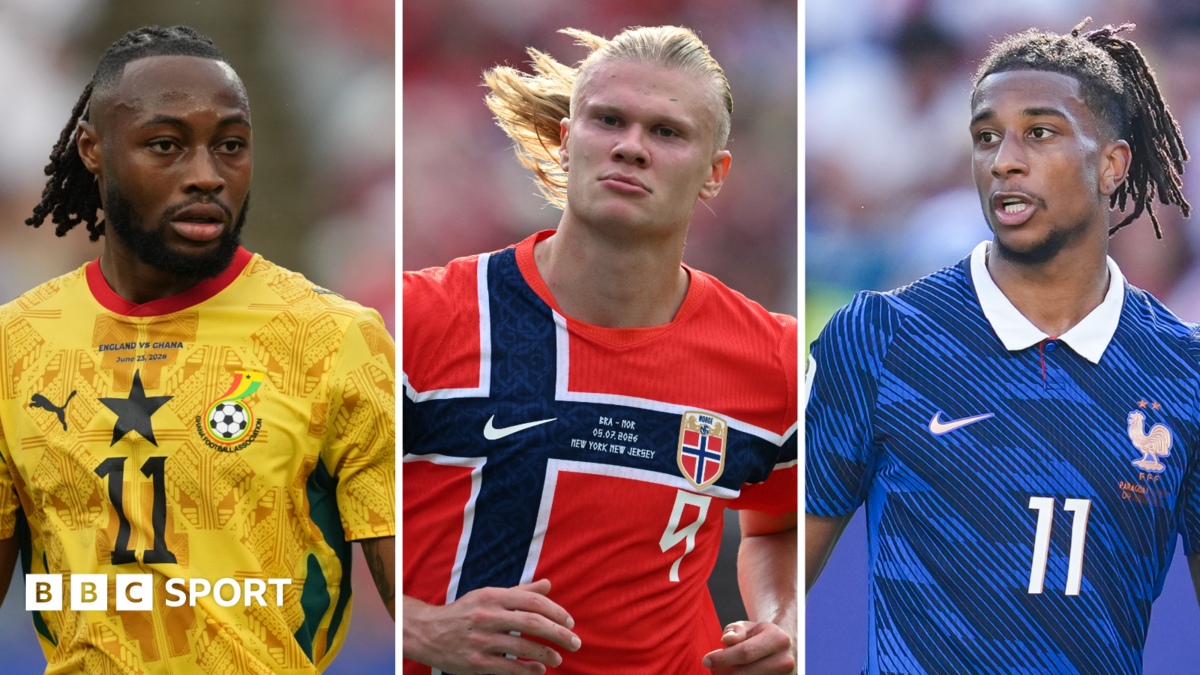
Exactly 20 of the 26 players selected by Thomas Tuchel for England's World Cup squad were eligible to represent other nations. On paper, the Football Association's talent pipeline functions as an aggressive net importer of global footballing potential.
Yet this statistical surplus is countered by a stark deficit on the other side of the ledger. On Saturday at 22:00 BST, England face Norway in the quarter-finals, where they must confront a Leeds-born striker who represents their greatest historical oversight.
Erling Haaland has scored 60 goals in 53 appearances for Norway. His international goalscoring rate stands at a staggering 1.13 goals per game.
During this tournament alone, he has registered 7 goals, spearheading a Norwegian attack that operates with ruthless vertical efficiency. Haaland's eligibility for England is not a hypothetical stretch; he was born in Yorkshire during his father Alf-Inge's tenure at Elland Road.
England's modern system of talent preservation is highly effective at the youth level, but it struggles to manage the transition to senior commitment. According to BBC Sport's tracking of international eligibility, the list of players who qualified for England but opted for other flags constitutes a formidable tactical lineup.
The loss is not merely quantitative. It represents a structural drain of specific profiles that Tuchel's side currently lacks: elite vertical ball-progression and high-volume, dynamic box presence.
The Half-Space Dilemma and the Musiala Deficit
England's structural issues under Tuchel center on slow, lateral possession. They average 5.8 passes per sequence in the middle third, yet their translation into high-value central shots remains inefficient. This is where the absence of Jamal Musiala hurts most.
The 23-year-old Bayern Munich midfielder spent his developmental years at Chelsea's academy and represented England up to under-21 level. Musiala's data profile reveals what England missed when he committed to Germany in 2021.
He averages 5.2 progressive carries and 3.8 successful take-ons per 90 minutes in central areas. In tight defensive blocks, he operates with a turning circle that allows him to bypass central midfields without requiring lateral support.
England's current squad relies on players who prefer to receive the ball to feet in front of the defensive line, rather than turning and driving between the lines. Tuchel's tactical plan requires rapid combinations in the final third.
Yet England’s current attacking midfielders frequently crowd the same zones, slowing down transition speeds. Musiala, playing alongside Jude Bellingham, would have offered a direct counter to the low block.
Instead, Nagelsmann's Germany benefits from a player who ranks in the 99th percentile for shot-creating actions from dribbles. The loss is felt in every slow, sideways sequence.
Olise and Asymmetrical Playmaking
On the right wing, the loss of Michael Olise represents another major profile mismatch. Olise was born and raised in London, navigating the academies of Arsenal, Chelsea, and Manchester City.
Despite interest from the FA, the 24-year-old committed to France, making his senior debut shortly after his £50m transfer from Crystal Palace to Bayern Munich in 2024. Olise provides a specific tactical tool that England struggle to replicate: high-velocity inside-channel crossing.
He averages 0.38 expected assists (xA) per 90, primarily driven by his ability to curl balls behind defensive lines from the right half-space. Bukayo Saka offers elite ball-retention and 1v1 isolation value, but Saka prefers to cut inside to shoot or cycle possession.
Olise’s presence would have allowed Tuchel to run an asymmetrical system, balancing a possession-heavy left side with a direct, high-volume creator on the right. The statistical comparison between Saka and Olise is instructive.
Saka averages 2.1 cross attempts per 90, while Olise attempts 5.4, completing them at a 34% rate. In games against deep defensive structures, England's lack of crossing variation makes them predictable.
Olise's delivery would have unlocked central forwards who currently starve for service in the six-yard box. At the club level, the sheer volume of English-academy-developed talent moving through transfer portals, as monitored on Sky Sports' transfer live blog, indicates that the domestic system is producing elite assets at unprecedented scale.
Haaland, Balogun, and the Cost of Striker Stagnation
The striker position exposes England's ultimate tactical vulnerability. Beyond Harry Kane, the depth chart drops off significantly in terms of international-grade vertical threats. Folarin Balogun's decision to represent the United States in June 2023 deprived England of a highly functional transition striker.
Balogun, who scored 3 goals at this World Cup before the US was eliminated in the round of 16, provides a running threat in behind that Kane no longer offers. He scored 7 goals in 13 games for England's under-21 side under Lee Carsley.
His movements stretch defensive lines, creating space for ten-style midfielders. Kane's tendency to drop deep to collect the ball often leaves England without a focal point in the box.
With Balogun or Haaland in the pool, England would possess the tactical flexibility to rotate between a dropping playmaker and a line-stretcher. Haaland's numbers for Norway are terrifying for a reason.
He does not participate in the build-up, averaging just 14.2 touches per 90 minutes. However, his shot conversion rate stands at a clinical 26.8% from an average shot distance of 11.4 yards.
He occupies center-backs, pinning them deep and creating a five-yard cushion for midfielders. When England face Norway on Saturday, Tuchel's center-backs will have to defend large spaces against a player who requires only half a yard to convert.
The tactical match-up is clear. Ståle Solbakken's Norway will cede possession, averaging just 42% in their games, and look to transition via Haaland. England, conversely, will control 60% of the ball but must prevent the counter-press from breaking.
Midfield Anchors and the Physical Deficit
The midfield is another area where eligibility decisions have shaped England's tactical limitations. Scott McTominay is a prime example. The 29-year-old Lancaster-born midfielder switched to Napoli in 2024, where he was named Serie A player of the year in a title-winning debut season.
His 15 goals in 73 appearances for Scotland demonstrate a late-box-arrival threat that England's central midfielders do not possess. Tuchel's double-pivot lacks physical presence and vertical ball-carrying.
Declan Rice is an elite defensive destroyer, but his forward progression is limited. McTominay's Napoli data shows a player who excels at third-man runs, averaging 3.2 box entries per 90. Had he chosen England, he would have provided a tactical alternative to Conor Gallagher or Kobbie Mainoo.
Similarly, Felix Nmecha's choice to represent Germany further thinned England's midfield options. The 25-year-old Borussia Dortmund midfielder moved to England in 2007 and was developed at Manchester City's academy.
He represents a physical progression profile—standing 6ft 3in with a 84% pass completion rate under pressure. England's midfield choices remain homogeneous, lacking the physical diversity that Nmecha or McTominay provide.
The Structural Failure of the FA Pathway
This talent drain is not accidental; it is a structural byproduct of the FA's selection timeline. The FA has historically prioritized early developers who fit a specific possession-oriented profile.
Players who do not fit this mold, or who mature later, are often ignored until they make high-profile senior transfers. Aaron Wan-Bissaka's international career is a case in point.
The West Ham defender was born in London and represented England at youth levels. He was called up to the senior squad in September 2019 but withdrew due to injury. He never received another call-up.
In 2025, at age 28, he switched allegiance to the Democratic Republic of Congo, helping them reach this World Cup. The FA's failure to cap Wan-Bissaka during his peak years at Manchester United reflects a rigid selection philosophy.
This rigidity is England's biggest flaw. While the FA celebrates the fact that 20 of Tuchel’s 26 squad members chose England over other eligible nations, they must reckon with the specific quality of the players they lost.
The players who left were not squad depth; they were tactical outliers. Haaland, Musiala, and Olise represent the absolute peak of modern attacking profiles.
On Saturday, England will try to control the tempo at the quarter-final stage. But they will do so with the knowledge that Norway’s primary weapon was born in Leeds. The statistics show that England's talent pipeline is a global powerhouse; the tactical reality suggests they are still vulnerable to the very profiles they let walk away.
Read Next
- Can Thomas Tuchel's ten-man solutions stop Erling Haaland in Miami?
- Jordan Henderson's freak injury creates a World Cup crisis for England
- Why Jude Bellingham will carry England past Norway despite the Quansah red card
- Why England's open midfield could derail their World Cup run
- 🏆 World Cup 2026 — Full Coverage Hub
- 🏴 England World Cup 2026 — Three Lions Hub
- 🇳🇴 Norway World Cup 2026 — Can Haaland Lead the Vikings?

.jpg)