The shadow of the spidercam looms over Oslo
England just clawed their way into the World Cup semi-finals, but the post-match discourse is saltier than a bag of pre-game pretzels. Jude Bellingham buried that equalizer in the 74th minute, saving Gareth Southgate’s bacon after a sluggish start. If you check the replay, the ball takes a weird, twitchy trajectory right as it zips past the center-field rig. Thousands are screaming that it brushed the spidercam cable.
The match officials ruled it a goal immediately, and VAR opted for a quick glance before signaling play-on. FIFA officials released a statement post-match, citing their internal Snicko audio data, which they claim showed no vibrational spike upon impact. Norway fans are rightfully losing their minds. They feel the technology is being used as a shield to protect a favored side from a colossal screw-up.
The war of the forums: Tech vs. Eyeball test
The online forums are currently a dumpster fire of conflicting physics theories. You have the enthusiasts who swear by the high-speed data. One user on the main match thread argued that if the ball had actually clipped a steel wire at that velocity, the deformation of the leather would have been visible on the 4K feed. They have a point, strictly speaking, because pixel-peeping suggests the ball never even touched the wire's proximity zone.
Then you have the cynics who think the whole system is rigged. The contrarian take gaining the most traction is that the spidercam shouldn't even be hanging that low during live play. If a camera is sitting low enough that a trajectory debate is even possible, the setup is fundamentally incompetent.
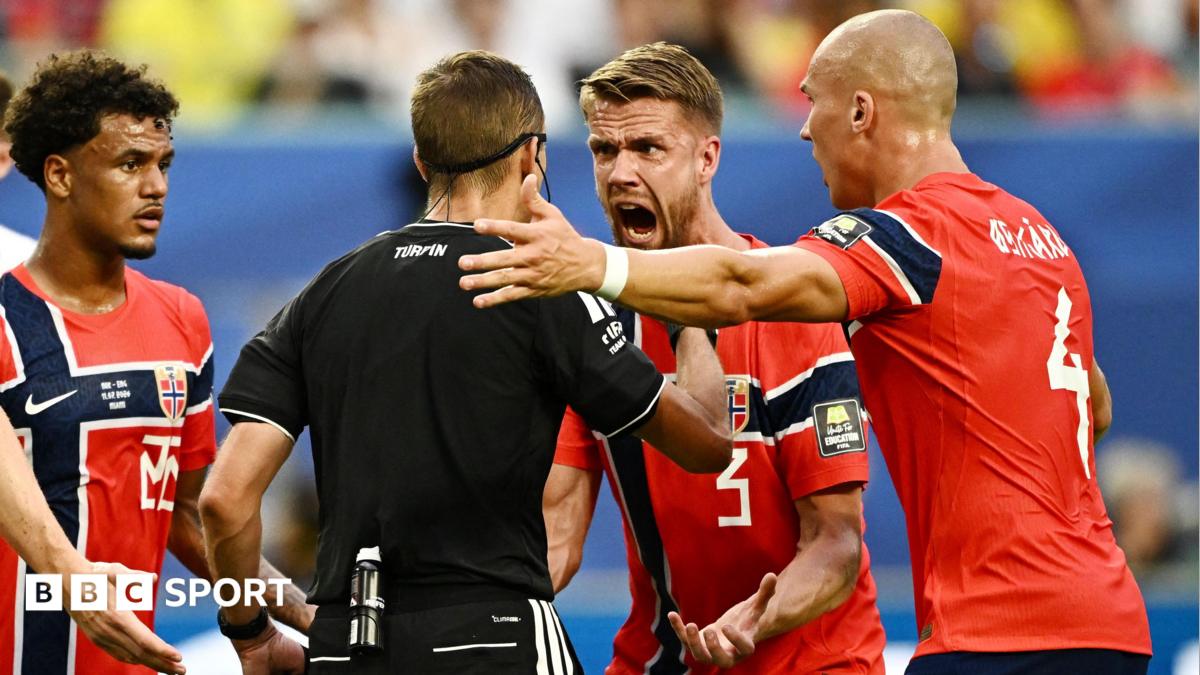
Norway's campaign ends in a quarter-final defeat by England, but they leave frustrated, arguing that Jude Bellingham's equaliser should not have counted.
It is genuinely hard to argue against the visual evidence provided by the wide-angle camera. The ball dips, hits a turbulence pocket, and curls into the net. It never deviates from the projected arc. England fans are calling it a masterclass in finishing. Norwegian supporters are citing the 0-1 scoreline being overturned as the moment the tournament lost its integrity.
Why this matters beyond the goal
This isn't just about one goal. It’s about the creeping dependency on tech that players and fans don't actually understand. We have seen recent reports suggesting that FIFA wants to integrate more sensor-based tracking into ball flight algorithms. The irony is that the more sensors they add, the less transparent the process feels to the average supporter in the bleachers.
The verdict: Tech parity or officiating failure?
My take? The goal stands because the officiating crew followed the protocol, but the protocol itself is built on ego. Executives love to talk about precision, yet we are left arguing over whether a swinging piece of metal interfered with a flight path. When your primary argument for a goal being legitimate relies on a proprietary "Snicko" sound signature that nobody outside of a bunker can verify, you have fundamentally broken the game's social contract.
England were clearly the better side for the final 20 minutes, but that doesn't excuse a potential technical interference. If the sport wants to maintain its relevance, it needs to stop treating technology as an infallible god. The officials were scared to overturn a goal after the 70th minute because the PR blowback would be massive. It is the same kind of cowardice that ruins leagues worldwide.
Ultimately, Norway is going home with a sour taste, and England moves forward with an asterisk by their name. Was the goal fair? Probably based on the rules. Was the decision-making process transparent? Not in the slightest. The organizers need to admit that putting a camera in the field of play is a giant, dangling liability. Until they raise the rig, we can expect this nonsense to happen again on the biggest stage.
The margin of victory was razor-thin, and the controversy was massive. We are looking at a 1-1 result that shifted to a 2-1 win, leaving Norway with nothing but questions. If the sport cannot reconcile physical reality with sensor data, the fans will eventually stop trusting the results entirely. Get that camera out of the sky or start accepting that sometimes, the machine just gets it wrong.
Read Next
- England fans are losing it over the Harry Kane yellow card disaster
- Thomas Tuchel's England are walking straight into a Norwegian trap
- Why Erling Haaland's Norway shirt has the internet spiraling
- Kane versus Haaland is the World Cup quarter-final we deserve
- 🏆 World Cup 2026 — Full Coverage Hub
- 🏴 England World Cup 2026 — Three Lions Hub
- 🇳🇴 Norway World Cup 2026 — Can Haaland Lead the Vikings?