International break friendlies are supposed to be sleepy, glorified training sessions where managers hand out caps to fringe players and everyone leaves without breaking a sweat. Instead, South America's two undisputed royalty clubs just served up a Friday night of pure, unadulterated comedic chaos across two separate continents. If you had Carlo Ancelotti getting tossed in Singapore and Argentina looking completely lost in Buenos Aires on your weekend bingo card, go buy a lottery ticket immediately.
Both giants managed to turn routine international tune-ups into full-blown existential crises inside a twelve-hour window. Between red cards flying from dugouts in Southeast Asia and an eerie, half-empty cathedral in Argentina, Friday was a rude awakening for everyone involved. Welcome to the new reality of South American football, where nobody is safe and the old scripts have been tossed straight into the paper shredder.
Singapore Sling: Brazil and Ancelotti Lose the Plot Against Japan
Let's begin in Singapore, where Brazil traveled halfway across the globe only to stumble into a wild 3-2 upset against Japan. You truly could not script a more baffling opening twenty minutes for the five-time world champions. Japan did not just compete with the Seleção; they sliced through them like a hot blade through room-temperature butter.
Takefusa Kubo opened the scoring with surgical precision before Keito Nakamura doubled Japan's lead before twenty minutes had even ticked off the clock. Brazil's backline looked completely disorganized, resembling four strangers who met in the stadium parking lot fifteen minutes prior to kickoff. Every time Japan broke into transition, Brazil's defenders were caught ball-watching and chasing shadows.
When your tactical setup falls apart, having world-class individual brilliance is usually Brazil's get-out-of-jail-free card. Vinicius Junior decided to drag his country back into the fight almost entirely on his own terms. The Real Madrid superstar pulled one back in the 33rd minute with a ruthless strike, cutting the deficit and breathing life into an otherwise lifeless squad.
Vinicius kept buzzing and finally hauled Brazil level at 2-2 in the 75th minute with another clinical finish. At that exact moment, you expected Brazil to smell blood in the water, tighten up the midfield, and hunt down a trademark winner. Instead, their collective composure dissolved the second Japan showed they were not afraid of the yellow shirts.
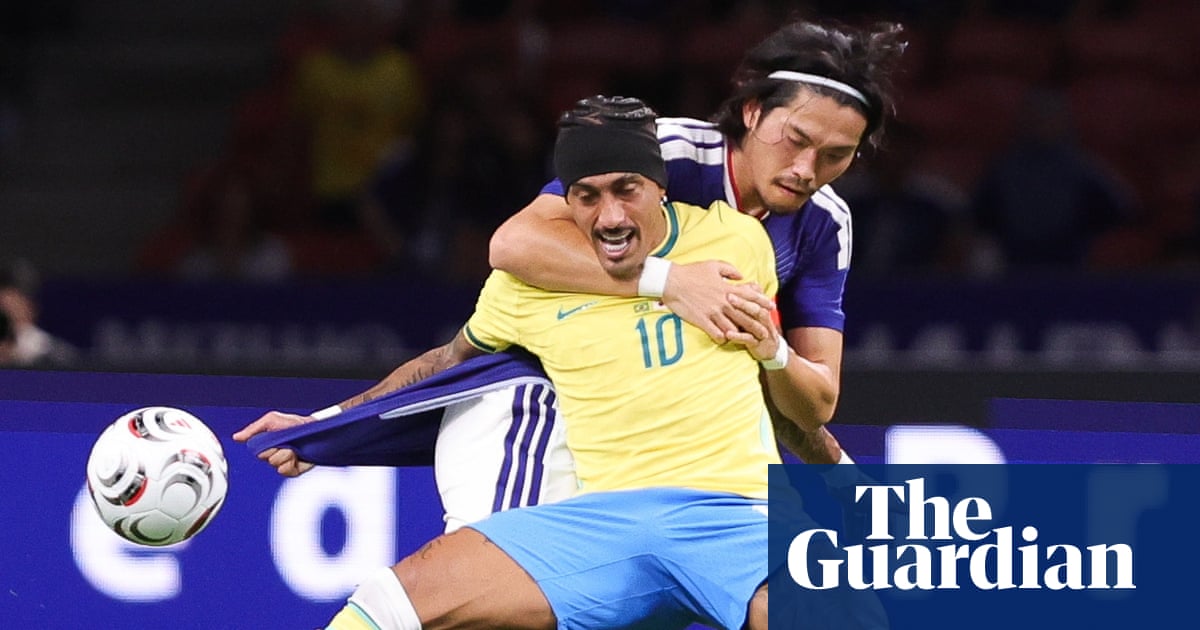
Stoppage time rolled around, and Brazil completely switched off on a defensive sequence. Tatsuhiro Sakamoto reacted first in the box, stabbing home a controversial late winner to send the Japanese bench into pure pandemonium. What followed next on the sideline was an absolute masterclass in blowing a gasket during a game that awards zero competitive points.
Raphinha, who had already been taken off the pitch after 71 minutes, turned completely incandescent with rage on the touchline. The Barcelona captain charged the fourth official to protest the legitimacy of Sakamoto's goal with such fury that the referee flashed him a straight red card. Seeing a substituted player get tossed while wearing an oversized training bib on the bench remains peak sports comedy.
Carlo Ancelotti decided he could not let his winger take all the disciplinary glory alone. The veteran manager joined the shouting match, lost his trademark cool, and promptly earned a red card of his own in the fractious aftermath. As The Guardian reported, the wild ending turned a simple exhibition into an embarrassing, chaotic defeat that leaves Ancelotti with a massive defensive headache.
The Ghost of Number Ten: Argentina Stumbles in Buenos Aires
While Brazil was busy self-destructing in Singapore, Argentina was hosting Uruguay in Buenos Aires for their first match since Lionel Messi officially retired from international football in early October. Walking into this new era was always going to be emotionally bruising for the reigning World Cup finalists. Yet nobody expected the post-Messi reality to hit this fast, this hard, or with this much awkward silence.
The weird vibes started well before kickoff inside the historic La Bombonera stadium. In an astonishing departure from the norm for a classic derby against Uruguay, the match actually failed to sell out. Think about that for a second: an iconic South American rivalry match featured visible patches of empty blue and yellow seats because the public is still nursing an open wound over their 39-year-old icon hanging up his boots.
Thousands of fans in the stands wore their beloved sky-blue and white jerseys with Messi's famous name and number proudly stitched across their backs. On the pitch, however, the legendary jersey was nowhere to be found. Manager Lionel Scaloni, who signed a major contract extension through 2030 earlier this week, made the deliberate choice to leave the No. 10 completely unassigned.
Scaloni explained that he has not selected an heir to the shirt yet, and since friendly regulations do not require squad numbers one through eleven, he preferred keeping it vacant. It was meant as a gesture of reverence, but on the field, it felt like an anchor dragging the team down. You cannot build a fresh identity when the ghost of your past is literally hovering over an empty locker stall.
Uruguay smelled blood immediately, and their game plan executed by new head coach Diego Forlán was an absolute tactical triumph. Forlán set up his squad to choke off central passing lanes, press aggressively in midfield, and pounce on Argentine arrogance. For forty-five minutes, Argentina passed sideways harmlessly, creating virtually zero threat in the penalty area.
Things turned from boring to catastrophic just three minutes into the second half. Argentine defender Leonardo Balerdi suffered an absolute nightmare moment, turning the ball into his own net in the 48th minute to gift Uruguay the lead. Before Argentina could even process the self-inflicted wound, Maximiliano Araújo struck in the 53rd minute to double Uruguay's advantage to 2-0.
Argentina finally found a pulse in the 73rd minute when Julián Álvarez scored with a sharp finish to cut the scoreline to 2-1. It was a brilliant snapshot of Álvarez's ruthless finishing instincts inside a congested penalty box. Unfortunately for the home crowd, that momentary flash of brilliance was the only real attacking threat Argentina mustered all night.
The Creative Void and the Road to Tuesday
The biggest takeaway from the defeat in Buenos Aires was the total lack of explosive incision in the final third. For over fifteen years, whenever Argentina hit a creative wall, Messi would drop into the half-space, attract three defenders, and slip a millimeter-perfect pass through a keyhole. Without that cheat code available, the entire attacking structure looked hopelessly lost.
Scaloni handed starting keys to both Nicolás Paz and Thiago Almada, hoping the youngsters could supply that missing creative electricity against Uruguay's stubborn low block. Instead, both players struggled under the weight of expectations and failed to stamp their authority on the contest. You could see the hesitation in their decision-making every time they received the ball between the lines.
Blaming Almada or Paz entirely would be unfair because nobody on planet Earth can seamlessly replicate what Messi gave this national team. However, international football does not wait for young prospects to figure things out on the job. If Scaloni wants his team to remain at the summit, he needs a tactical overhaul that relies on collective movement rather than hoping a solo magician bails everyone out.
As detailed in The Guardian's international roundup, both teams must now dust themselves off quickly for their next tests on Tuesday. There is zero time for sulking or feeling sorry for themselves.
Here is what the immediate slate looks like as both squads try to stop the bleeding:
- Argentina heads to Córdoba on Tuesday night to face Costa Rica, where anything less than an emphatic, free-flowing victory will trigger massive media alarm bells.
- Uruguay returns home to Montevideo on Tuesday to host the Dominican Republic, riding immense momentum under Diego Forlán's exciting new managerial reign.
- Brazil must pack their bags from Singapore and begin a thorough review of their chaotic defensive collapses before their next competitive fixtures arrive.
Scaloni's new contract might run until 2030, but anyone who knows Argentine sports media knows that honeymoon periods last about forty-eight hours. The fans in Buenos Aires are already anxious, and a clunky showing against Costa Rica in Córdoba will turn mild concern into outright panic. Leaving the No. 10 shirt empty was poetic for one night, but now someone actually has to step forward and play football.
Meanwhile, over in Brazil's camp, Ancelotti needs to remind his squad that international friendlies are meant to build tactical cohesion, not pad red card totals. Getting outworked by a sharp Japan side is a tactical problem, but watching your captain and head coach lose their composure on the touchline is a leadership crisis. Friday was a brutal reality check for South America's twin superpowers, and the rest of the world just got a blueprint on how to beat them.
Read Next
- Brazil and Argentina just proved how fragile their new eras really are
- Argentina are finding out how brutal the post-Messi era will be
- England face Spain in Madrid with everything on the line for Tuchel
- Tare just exposed Milan's mess while Cardinale promises an American empire
- 🇦🇷 Argentina World Cup 2026 — Defending Champions Hub
- 🇧🇷 Brazil World Cup 2026 — A Seleção Hub