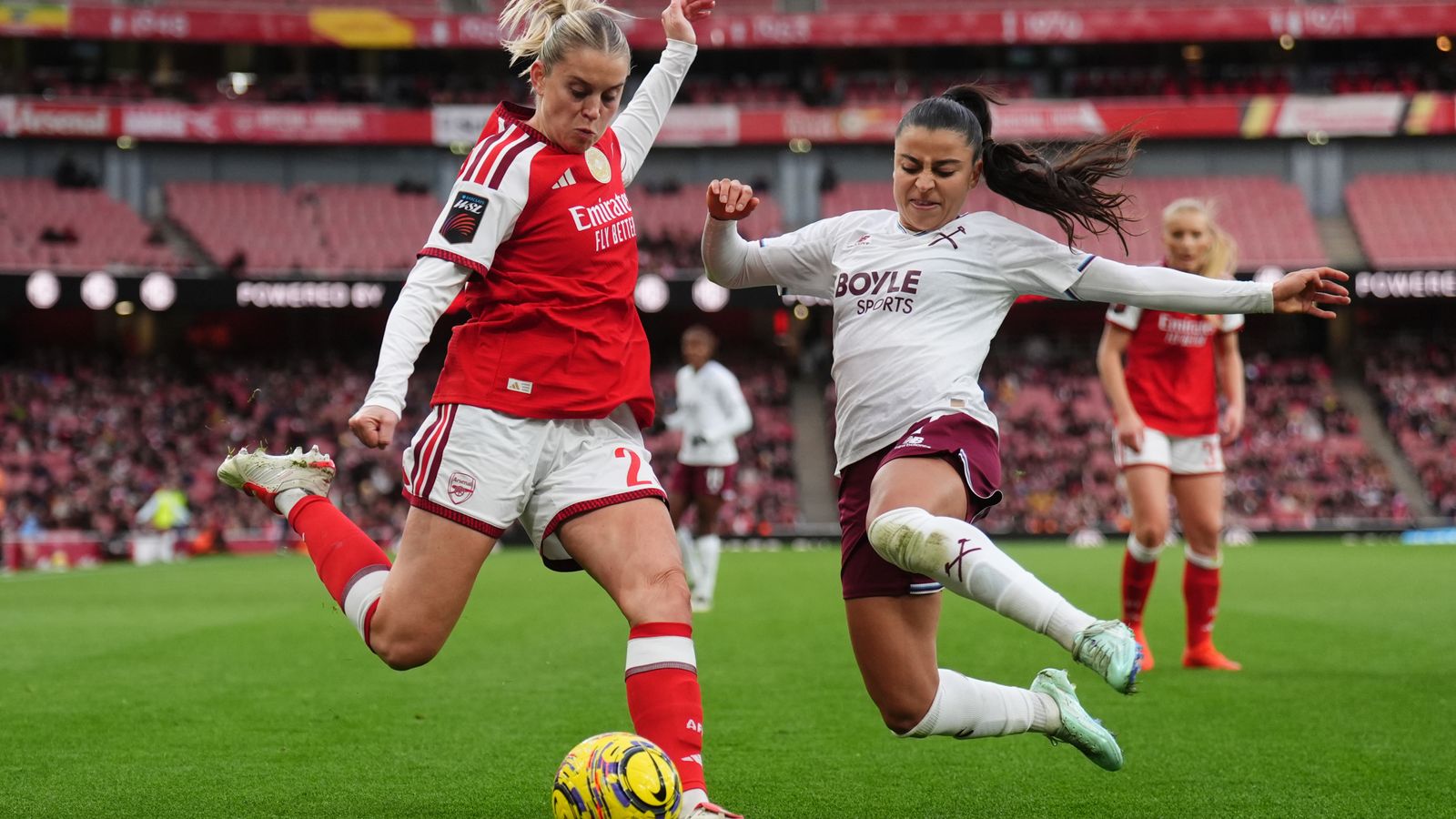
The Math Is Brutal: Arsenal Are Already Broken
Renée Slegers is gone, and the shock in north London is nonexistent. Collecting 15 points from 11 games is not a blip for a club with European ambitions. It is an outright collapse.
Look at the home ledger if you want to understand why the hammer fell today. Arsenal managed six home draws in six games, turning their own ground into a sterile, predictable chore for visiting backlines. Opponents do not even need to gamble to escape with a point.
They sit in possession, recycle the ball through low-tempo sideways lanes, and generate nothing between the lines. Teams simply sit deep in a compact 5-4-1 shell and watch Arsenal run out of ideas. It is slow, mechanical, and painfully easy to defend against.
Slegers was supposed to be the steady hand after stepping up from her interim role in October 2024. Just eighteen months ago, she delivered a stunning 1-0 Champions League final victory over Barcelona. Today, that European triumph looks like an isolated miracle rather than the foundation of an era.
Now Melissa Clarke-Reed takes over as interim boss, having served on the coaching staff since 2004. Long-time assistant Aaron D’Antino walks out the door alongside Slegers after eight years of service. A caretaker who has seen three regimes crumble is not going to suddenly unlock this sluggish attack.
The board wants everyone to believe this reset clears the air. As reported by The Guardian, the decision had become unavoidable after weeks of suffocating stagnation. But firing the coach does not fix the mathematical hole Arsenal dug for themselves.
Consider the structural flaws on the pitch. Arsenal lack vertical runners who can stretch defenses, which leaves their central play congested and predictable. When you cannot get behind the full-back, your central attacking midfielders are forced to operate in phone booths.

A Stacked Squad That Made Zero Tactical Sense
Arsenal’s summer window was celebrated by supporters as a statement of intent. They brought in Élisa de Almeida from Paris Saint-Germain, Georgia Stanway from Bayern Munich, and Ona Batlle from Barcelona. In goal, they added Misa Rodríguez from Real Madrid and Isabella Damm from Brøndby.
On paper, this was an embarrassment of riches. Back on 22 September, HB Køge manager Kristian Mørch faced Arsenal and could not believe the sheer volume of international talent sitting in reserve.
“We laughed when we saw the lineup and started joking that it must be one of the strongest benches ever in the Women’s Champions League.”
Yet that comical depth produced zero tactical cohesion. Slegers seemed completely bewildered by the options at her disposal. Instead of creating dynamic attacking patterns, she froze high-profile signings out of the matchday rotation entirely.
The treatment of Géraldine Reuteler and Selina Cerci bordered on coaching malpractice. Reuteler arrived from Eintracht Frankfurt as one of the sharpest pressers in the Bundesliga, while Cerci offered clinical box movement from TSG Hoffenheim. Slegers gave them scrap minutes while her preferred starting XI banged their heads against mid-block walls.
Then there is the roster mismanagement at the executive level. The club allowed Beth Mead and Katie McCabe to depart, stripping the squad of its emotional spine and direct wide threat. Trying to reverse McCabe’s exit at the eleventh hour was an amateurish scramble that embarrassed the club internally.
Lisa Baum came in from RB Leipzig with genuine promise, but young attackers need defined patterns to thrive. Without clear positional rotations, Arsenal spent matches passing into blind alleys. Slegers wore an antique silver ring featuring the 1936-49 club crest on her finger, but romantic ties to the past do not generate line-breaking passes.
Look at the spacing between the lines when Arsenal attempt to build out. The center-backs split wide, but the midfield pivot drops too deep, compressing the space rather than opening forward passing lanes. That disconnect isolates the front three, turning every transition into an uphill battle.
The Groundhog Day of Executive Excuses
This is where the real blame belongs. Slegers made undeniable tactical errors, but she is the third manager to walk through this exact meat grinder. Joe Montemurro hit the same wall, Jonas Eidevall hit the same wall, and now Slegers has crashed into it.
Every single time results deteriorate, the hierarchy executes the identical playbook. They leak word of internal reviews, promise financial backing, announce a strategic reset, and wait for the storm to blow over. Detailed analysis from Suzanne Wrack highlights how little has actually changed across these successive managerial tenures.
The names linked to the vacancy already sound like a desperate roll call. Nick Cushing is vocally positioning himself for the role after his 2016 league title with Manchester City. Former Manchester United manager Marc Skinner is lurking on the market, as is former Bayern Munich and Angel City boss Alexander Straus.
Whispers about poaching active managers from abroad are equally unconvincing. Chasing Casey Stoney from Canada, Laura Harvey from Seattle Reign, or Juan Carlos Amorós from Gotham FC reads like wishful thinking. Elite coaches working in stable environments do not abandon their posts mid-cycle to inherit a fractured front office.
None of those candidates can paper over the rot above them. When three consecutive managers with completely different tactical philosophies suffer identical systemic failures, the manager is merely a symptom. Arsenal’s football leadership keeps buying parts that do not fit together and expects the dugout to build an engine.
The executive committee continues to duck accountability. Slegers took the fall today, just as Eidevall and Montemurro did before her. But the decision-makers who botched the McCabe contract and assembled a bloated, unbalanced roster remain untouched in their offices.
The Verdict: Arsenal Will Miss the Champions League
Let us stop entertaining fairy tales about a mid-season bounce. Arsenal will not win the Women’s Super League this season. In fact, they are going to miss out on the top three entirely, failing to qualify for the Champions League for the first time in modern history.
Do the math on what qualification requires. In a 22-match WSL season, finishing third consistently demands at least 47 to 50 points. With 15 points on the board through 11 fixtures, Arsenal need roughly 33 points from their final 11 games.
That requires an immaculate run of 11 consecutive victories. They would need to go away to Chelsea and Manchester City and take maximum points with an interim manager. A squad that could not beat mid-table sides at home is not running the table in the spring.
Clarke-Reed will steady the dressing room temperature, but she cannot magically reconstruct the midfield balance overnight. Stanway needs defensive cover that De Almeida cannot provide while tracking wide runners. Batlle cannot defend isolated transitions while simultaneously providing Arsenal's only width on the overlap.
The board thought sacking Slegers would wipe the slate clean and silence the discontent in the stands. Instead, as the post-mortem on Slegers’ exit reveals, it merely exposes how hollow the operation looks beneath the surface. Arsenal are heading for a fourth-place finish, and the real reckoning has barely started.
Read Next
- Renee Slegers is out at Arsenal and the silverware could not save her
- Arsenal are sleepwalking into crisis and the Emirates crowd has turned
- Chelsea have an attacking crisis and London City Lionesses know it
- London City Lionesses will break Chelsea's unbeaten run in December
- ⭐ UCL 2026 — Champions League Quarter-Finals Hub