Manchester City opened their campaign with eight straight victories, but that streak masked tactical fractures that have now blown wide open. Over their last ten matches in all competitions, Enzo Maresca's side have managed only three victories in regulation time. In the Premier League, the collapse is stark: they have taken one point from four matches.
The decline arrived immediately after what seemed like a statement moment. Following guilty verdicts regarding Premier League financial rule breaches, City dismantled Andoni Iraola's Liverpool 3-0 at Anfield. Six days later, they edged Ipswich 3-2 at the Etihad Stadium.
That emotional high proved deceptive. Since overcoming Ipswich, City have managed just a single victory in their last seven matches across all competitions, alongside a penalty shootout triumph over Brighton in the Carabao Cup. The initial momentum evaporated completely.
The £707m rebuild with an alarming hit rate
Behind the slide lies an unprecedented recruitment bill overseen by Hugo Viana. After working alongside Txiki Begiristain from April 2025, Viana assumed full control as director of football that summer. He has since sanctioned 18 signings totaling £707.55m before performance add-ons.
The efficiency of that spending is historically poor. Among those 18 arrivals, only Elliot Anderson, Rayan Cherki, and Iliman Ndiaye have established themselves as unquestioned successes. That leaves City operating with a dismal 16.7 percent hit rate from over £700m invested.
As The Guardian reported, ten of Viana's acquisitions have already departed, struggled for form, or failed to secure regular starting berths. The gross fees spent across key signings illustrate the sheer scale of the gamble:
- Enzo Fernández: £125m
- Elliot Anderson: £116m
- Ayyoub Bouaddi: £81.3m
- Antoine Semenyo: £62.5m
- Iliman Ndiaye: £60m
- Tijjani Reijnders: £46.3m
- Gianluigi Donnarumma: £26m
- Marc Guéhi: £20m
The counterintuitive reality of City's splurge is that spending more has made them significantly less stable. Enzo Fernández commanded £125m from Chelsea, yet his performances have trended downward for weeks. Antoine Semenyo has faded after a bright start, while Marc Guéhi looks hesitant in central defence.
The goalkeeping carousel
Nowhere is Viana's questionable market strategy more obvious than between the posts. City spent £27m to recruit James Trafford, only to sell him to Leeds in the very next window for that same £27m figure. The move stripped the squad of legitimate competition for the number one shirt.
That left Gianluigi Donnarumma as the undisputed starter following his £26m arrival. The Italian has turned into an active liability. Costly errors against RB Leipzig, Aston Villa, and Paris Saint-Germain leaked valuable goals, and he conceded Rasmus Højlund's soft near-post strike in Tuesday's 2-2 draw with Napoli.
Maresca has defended his goalkeeper publicly, stating he is unconcerned despite acknowledging the sequence of mistakes. But backing Donnarumma with reserve options like Gerónimo Rulli (£1m), Marcus Bettinelli (£2m), and Pierce Charles (£3m) gives the manager no tactical room to drop an underperforming star.
Defensive collapse and the Nico O'Reilly metric
City's back four has deteriorated into a defensive liability. Opponents slice through them with basic vertical passes into the channels. The central pairing of Rúben Dias and Marc Guéhi lacks both recovery speed and positional discipline.
Dias struggles when isolated in transition. His lack of straight-line speed forces City deeper, conceding territory. Beside him, Guéhi has produced erratic displays, misjudging aerial duels and tracking runners poorly.
This instability coincides directly with Nico O'Reilly's interrupted campaign. The academy graduate has been restricted by fitness issues, missing four matches and making three brief substitute appearances. Without his presence, City lose both defensive recovery pace and an essential passing conduit into the attacking third.
The statistical impact of O'Reilly's absence was laid bare in the 3-1 defeat at Nottingham Forest. Without O'Reilly on the pitch, City conceded twice before half-time under sustained counter-attacking pressure. Maresca introduced him after the interval, but the match had already slipped away.
O'Reilly's value stems from his youth background as a number ten before converting into a defender. That pedigree allows him to invert into midfield, unlock deep blocks, and recover quickly against transitions.
Midfield stagnation and tactical dogma
Maresca's midfield selections have introduced tactical friction rather than control. In Tuesday's 2-2 draw against Napoli, the Italian fielded a trio of Enzo Fernández, Ayyoub Bouaddi, and Elliot Anderson. While Anderson provides relentless running power, he cannot replicate the spatial command that Rodri once provided.
Fernández presents an even deeper tactical puzzle. Signed at an astronomical £125m fee to serve as Maresca's on-field general, the Argentine operates as a hybrid between an eight and a ten. Yet he lacks the explosive agility and dribbling craft that Rayan Cherki delivers in the same zone.
That leaves the 19-year-old Bouaddi shouldering enormous positional responsibility. The teenager was signed from Lille for £81.3m and clearly possesses rare technical composure. However, asking an adolescent prospect to anchor an unbalanced midfield alongside two high-cost runners exposes him to harsh transitional pressure.
Meanwhile, experienced controllers like Mateo Kovacic have been sidelined into peripheral bit-part roles. City dominate sterile possession, exchanging predictable horizontal passes along the halfway line while generating virtually zero central penetration. The rhythm has become painfully sluggish, lacking tempo and surprise.
Direct attacking sequences have become rare anomalies. City's September victory over Coventry arrived via a rapid vertical pattern: Fernández clipped an incisive pass to Semenyo, whose delivery was finished by Erling Haaland. Yet rather than building on that directness, City have doubled down on slow, mechanical circulation.
When questioned on Friday about whether he would consider tweaking his system to suit his squad's strengths, Maresca offered an unyielding response: "No." He refuses to deviate from his positional script, attributing recent failures entirely to the squad's ongoing bedding-in phase.
As documented by The Guardian's analysis, Maresca pleaded for patience, pointing out that integrating eight or nine new signings under a new coaching staff cannot happen overnight.
"Transition requires time. Probably because we won eight games in a row people were thinking here there is no transition, but I’m not a magician. We have eight or nine new players, the manager is new – you need time. No panic at all. I understand we need to win games because it is a business."
Transition takes time, certainly. But transition backed by a £700m outlay usually demonstrates incremental tactical growth, not regression. Winning eight straight matches proved that the raw talent exists. Crumbling to one point from four league games proves that the system is breaking down under pressure.
Haaland's frustration and the existential shadow
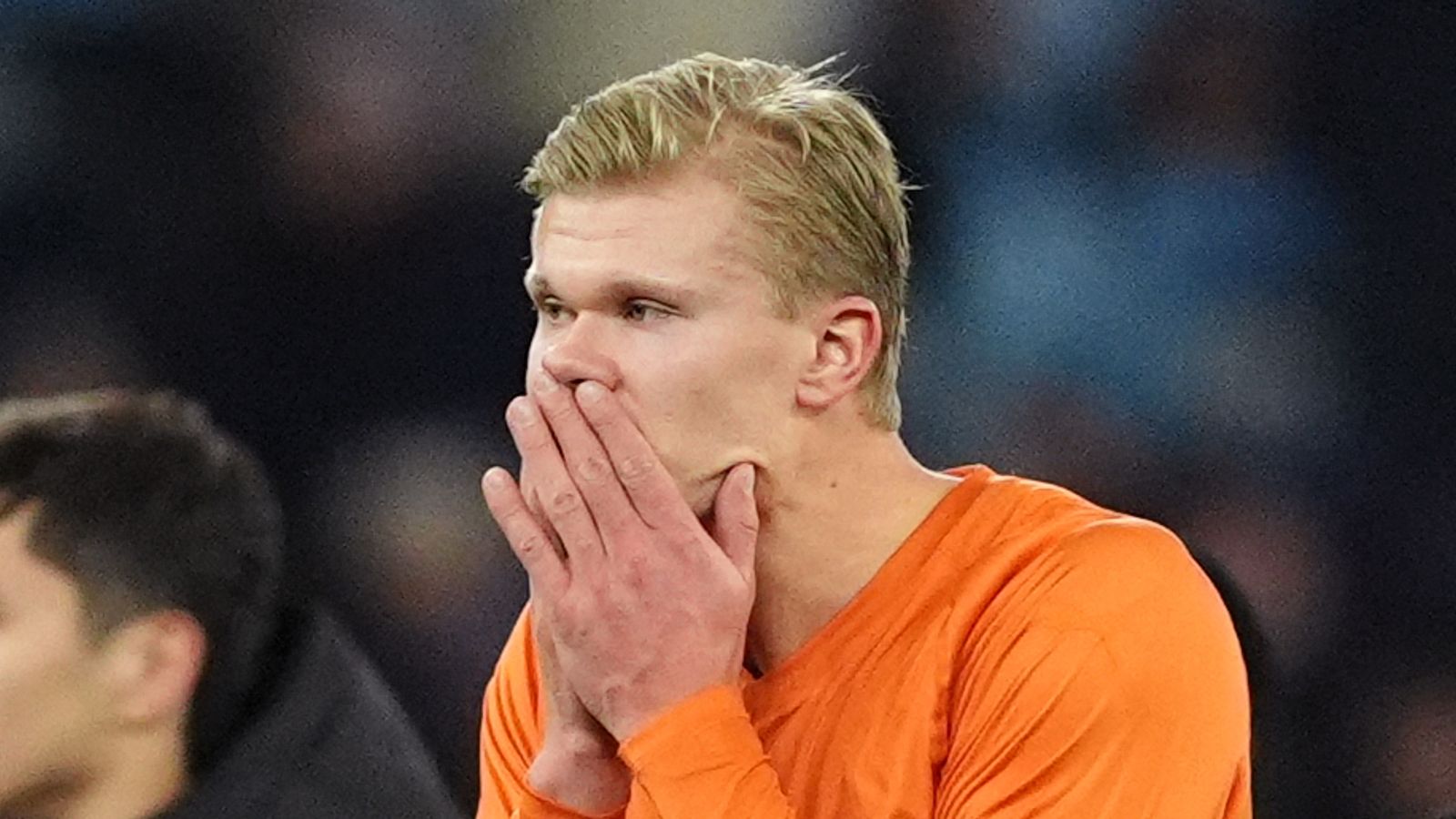
Nowhere is the prevailing stagnation more apparent than in Erling Haaland's mounting agitation. Following the 2-2 draw with Napoli on Tuesday, the Norwegian striker walked off the pitch visibly dejected. Throughout recent fixtures, cameras have captured him gesticulating angrily as teammates ignore his runs.
Maresca attempted to brush aside concerns about his talisman's happiness, noting that Haaland celebrated ecstatically after the Carabao Cup penalty shootout against Brighton just weeks ago.
"Erling is a winner. It’s normal that he’s not happy when he’s not winning games but don’t forget a few weeks ago he was dancing inside the pitch. Erling is upset just like I am upset."
Haaland committed his future to the Etihad by signing a 10-year contract in January 2025. Yet contracts offer zero protection against institutional turmoil. If City lose their appeal against the Premier League verdict and face demotion, that deal will mean nothing.
The club maintains it is "innocent of the accusations" and has appealed the ruling. But the psychological toll on the dressing room is evident. The initial rush of defiance carried City through Anfield and Ipswich, but reality has set in with chilling effect.
Maresca was hired to construct a cohesive system alongside Hugo Viana. Instead, Manchester City have assembled an expensive, disjointed squad that cannot keep clean sheets or break down structured blocks. If Maresca cannot fix this slump quickly, the fallout will be severe.