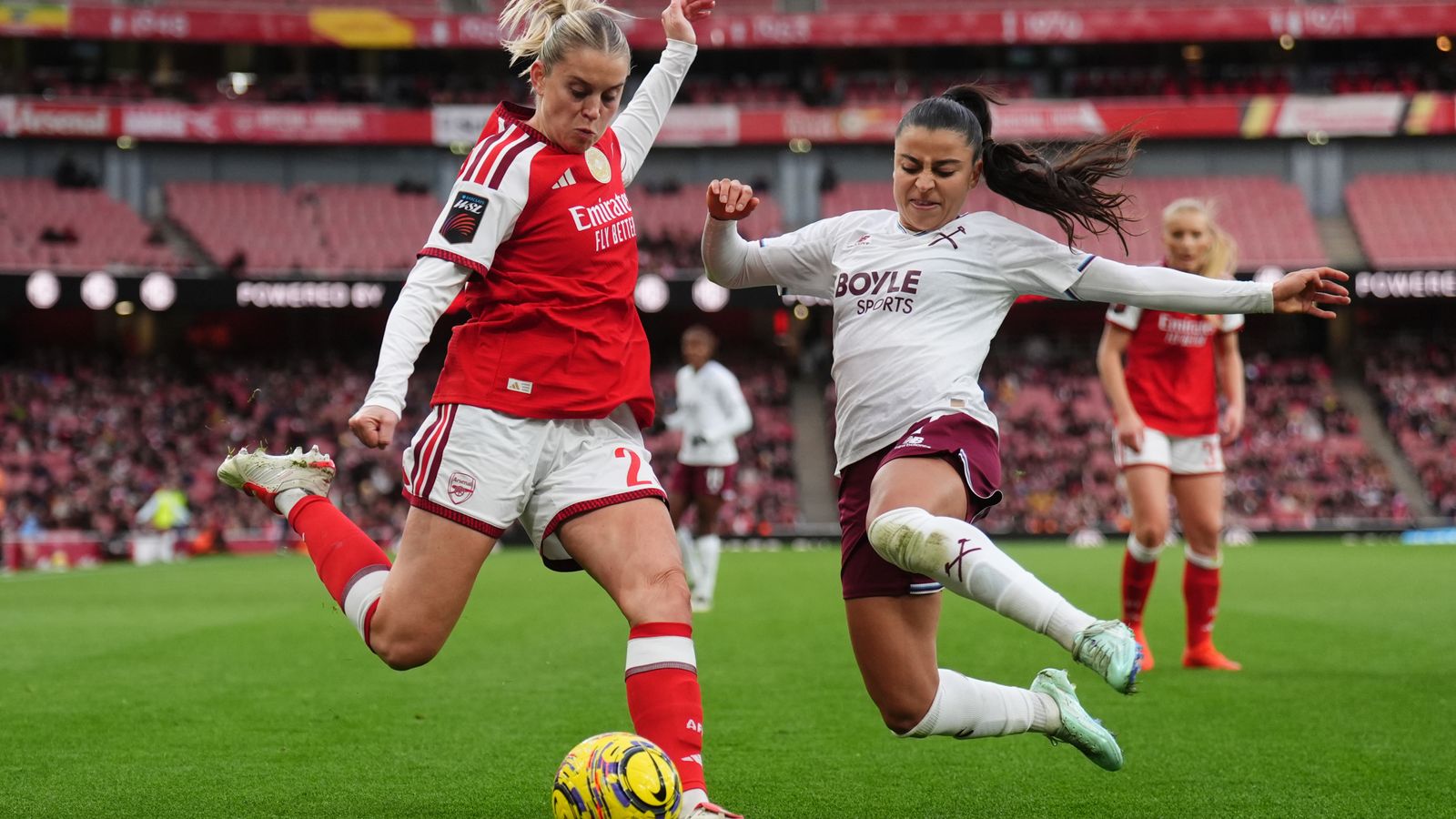
Pull up a chair and pour something strong, because watching Arsenal right now feels like being trapped in an elevator listening to smooth jazz on repeat while the cables slowly fray. Just eighteen months ago, this club conquered Europe, lifting the Champions League trophy in front of ecstatic traveling supporters. On Sunday afternoon, sections of the Emirates faithful serenaded their own players with a chorus of boos.
West Ham came to North London, absorbed ninety minutes of predictable sideways passing, and walked away with a comfortable point. That result marked Arsenal's sixth consecutive home stalemate in the league. The Gunners now sit sixth in the Women's Super League, looking less like continental royalty and more like an uninspired mid-table side wondering where the spark went.
If you want to understand how deep the rot runs, look no further than the Sky Sports analysis from Laura Hunter. Arsenal currently rank 11th in the WSL home form table. Almost every visiting team treats Ashburton Grove as an open house rather than a fortress.
The Historic WSL Weekend Nobody Capitalized On
Context makes this collapse even harder to swallow. Round six of the Women's Super League produced a bizarre anomaly that had never happened before in league history. Arsenal, Chelsea, and Manchester City all failed to win on the exact same matchday.
For years, the traditional big three treated dropped points like a solar eclipse. If one stumbled, the other two ruthlessly widened the gap. This past weekend, the rest of the division caught the scent of opportunity because the penthouse slipped on the same patch of ice.
Over in Manchester, Andree Jeglertz pulled no punches after Tottenham stunned his side with a 3-1 victory. It was City's first home league defeat under his watch and their first taste of back-to-back league losses since January 2025. Jeglertz openly labeled the performance a "wake-up call" for his squad.
Chelsea also dropped points, prompting both title contenders to speak about the need for better balance. Yet while Chelsea and City can treat their slips as rare stumbles, Arsenal are sinking into wet cement. Instead of capitalizing on a golden opportunity to climb back into contention, Arsenal limped to another draw against a bottom-half opponent that arrived with zero fear.
The Emirates Has Lost Its Fear Factor
Ashburton Grove used to be the crown jewel of English women's football. Arsenal built a vibrant, record-breaking matchday culture that rival executives openly envied. On Sunday, that fortress felt like an uneasy theater where supporters were slowly losing their patience.
Visiting teams used to arrive at the Emirates braced for an avalanche. Now, opponents set up a compact block, sit off, and watch Arsenal pass sideways until everyone gets tired. Arsenal have won zero home league games this season, scoring four goals and conceding four.
Let that sink in: four goals scored at home in six matches. Arsenal are a net-neutral team in front of their own fans, inviting opponents to dictate terms instead of imposing their own will. Attendances have plummeted as a result, and every backward pass from a central midfielder now triggers groans from the stands.
Booing your own team is always uncomfortable, but the Emirates crowd did not turn toxic by accident. Fans have watched six straight home draws, spending hard-earned money to witness sterile possession drills masquerading as football. The connection between the pitch and the terrace is breaking down in real time.
The Toothless Possession Trap and Conversion Rot
Statistically, you could fool an executive who only looks at raw box scores into thinking Arsenal are dominating. The Londoners have completed more passes into the final third than any other side in the division. They also boast the second-most touches inside the opposition box across the entire league.
Yet they are averaging barely a goal a game. Newly promoted Crystal Palace and Birmingham have both scored more goals than this expensively assembled roster. That is a massive indictment of Arsenal's tactical approach.
The problem is not getting the ball forward; it is what happens once they arrive. Territorially, Arsenal are sitting deeper and hesitating to commit numbers forward, leaving central midfielders with far less influence in possession. Their patterns are slow and safe, rooted in keeping the ball rather than risking a pass that cuts opponents open.
Arsenal's build-up phase remains tidy, but that tidiness is killing them. Without risk-takers who see the picture before opponents can react, their possession just hits a wall. Safe passes allow defenders to reset, leaving Arsenal recycling possession without ever threatening the penalty area.
When Arsenal finally shoot, the return is downright catastrophic. At the Emirates, the attack has generated an alarmingly poor return of four goals from 141 shots taken. That works out to a miserable home conversion rate of just 2.8 per cent.
You could give amateur players that many chances and they would accidentally stumble into more goals through sheer luck. Arsenal make finishing look like an administrative chore. Shots are rushed, scuffed into shins, or taken from impossible angles because nobody makes decoy runs.
Alessia Russo is fighting a lonely war up front. She works tirelessly, chasing lost causes and battling defenders, but she cannot play the through-ball to herself. Carrying an entire malfunctioning frontline every weekend will exhaust any striker.
Arsenal apologists will point to the injury to Mariona Caldentey as the primary cause of this slump. Caldentey's creative vision is certainly missed, but losing one player cannot justify an entire squad forgetting how to score. Relying on an injured playmaker to mask systemic flaws is managerial negligence.
The Ghost of Alexia Putellas Haunting North London
To understand how Arsenal ended up in this dreary mess, you have to rewind to the summer transfer window. The club conducted solid business to bolster squad depth, but they hesitated when the biggest opportunity in world football surfaced. That opportunity was Alexia Putellas.
As detailed in the WSL round six breakdown, Arsenal's hierarchy explored pursuing a deal for Putellas over the summer. Conversations took place behind closed doors, but nothing ever got off the ground. Arsenal backed away from the table.
Putellas ended up signing for London City instead, joining up with manager Eder Maestre. Her arrival upgraded London City beyond recognition. She offers a level of control and creativity in the final third that Arsenal can only dream about right now.
London City now carry the elevated status and presence that Arsenal carelessly discarded. While Putellas dictates games across town, Arsenal pass sideways across the halfway line. London City have effectively replaced Arsenal among the league's true elite.
Boardroom defenders will argue that signing Putellas was never realistic given Caldentey's presence and the club's stricter wage structures. Those are tidy corporate justifications, but elite football rewards ruthlessness over accounting caution. Arsenal were simply not bold enough, and the misstep is glaringly obvious.
Renee Slegers Is Running Out of Time
Following Sunday's stalemate, Slegers admitted the exact problem everyone in the stadium had already identified weeks ago.
"We don't inspire enough. We don't bring enough energy."
Spotting the issue is fine, but proposing a working solution is the manager's actual job. Slegers has offered plenty of post-match regret, but zero tactical answers. If the coaching staff cannot motivate an elite dressing room to beat West Ham at home, who can?
Arsenal have already tumbled down the table and sit well out of the running for a European spot. For a club that won the Champions League eighteen months ago, reducing the season to a desperate fight for third place is a massive failure. The tactical priorities for Slegers are obvious if she wants to break this doom cycle:
- Push central midfielders further up the pitch to support Alessia Russo instead of protecting defenders who face no pressure.
- Encourage forwards to take direct risks in the final third rather than endlessly cycling the ball backward.
- Stop treating home draws as acceptable results against clubs that arrive with zero attacking ambition.
Arsenal fans are not demanding perfection; they are demanding a pulse. They want aggressive pressing, daring through-balls, and players who look offended by dropped points. Sterile possession designed to produce five hundred passes and zero goals is not Arsenal football.
The patience in the stands has completely evaporated. If Slegers cannot fix this blunt attack and turn the Emirates back into a winning venue immediately, the board will have to make a tough decision. Trophies in the cabinet from eighteen months ago cannot save a manager who is actively running out of road.
Read Next
- Chelsea's blunt attack faces a massive test against London City Lionesses
- London City Lionesses will break Chelsea's unbeaten run in December
- Arsenal fans are booing and the WSL title race just got chaotic
- Arsenal desperately need Lisa Baum's spark against West Ham
- ⭐ UCL 2026 — Champions League Quarter-Finals Hub