The Miami Formula and the Death of Low Blocks
Cape Verde did not travel to North America to entertain you. They came to build a fortress, lock the gates, and throw the key into the Atlantic.
By executing three consecutive draws in Group H, the tournament debutants secured a historic berth in the Round of 32. Now they face the ultimate test in Miami against a side that has shown no mercy during their group-stage run.
Argentina finished at the top of Group J with a perfect nine points. Their campaign has been a relentless demonstration of control, punctuated by Lionel Messi's inevitable brilliance.
Yet, underneath the narrative of Messi's history-making campaign, there are tactical cracks that Cape Verde will attempt to widen. If Scaloni's men expect a simple walkover in Florida on July 3, they are in for a long evening.
This match will be defined by a clash of tactical extremes. One side wants to strangle the game with possession; the other wants to starve it of space. Let's look at the numbers to see how this battlefield will take shape.
Decoding the Cape Verde Fortress
Cape Verde's progression was not pretty, but it was incredibly disciplined. They finished as runners-up in Group H after recording three consecutive draws. The headlines focused on their historic achievement, but the underlying numbers tell a story of extreme defensive concentration.
They held Spain to a 0-0 draw and repeated the feat against Saudi Arabia. They conceded goals only in their 2-2 draw with Uruguay. Their defensive setup relies on a low-block 4-5-1 formation that collapses into a 6-3-1 under heavy pressure.
Against Spain, their defensive line averaged a depth of just 22 meters from their own goal line. They surrendered possession willingly, registering a meager twenty-eight percent ball retention. Yet, Spain managed only three shots on target from eighteen attempts, frustrated by a compact central defensive pairing that blocked nine shots in the box.
Cape Verde's midblock is designed to prevent passes into the half-spaces. They allow opponents to circulate the ball laterally, wait for a trigger pass into the central zone, and then swarm the receiver with a three-man midfield screen. This passive defensive style resulted in a Pass Per Defensive Action rate of 24.6 against Spain.
They do not press high; they simply wait for you to make a mistake in their territory. However, this defensive focus has cost them dearly in attack.
In their scoreless draw against Saudi Arabia on June 26, they generated a pathetic 0.18 expected goals. They managed only one shot on target during the entire match. They are entirely dependent on rare transition moments, hoping that their defensive shape can hold out long enough to sneak a goal.
The Rotation Warning and Messi's Gravitational Pull
Argentina's final group match against Jordan showed that the defending champions are not invincible. Scaloni made nine changes to his starting lineup, resting key players after securing qualification. The rotated side struggled to find their rhythm, allowing Jordan to stay competitive for long stretches.
Argentina took the lead through Giovani Lo Celso in the 19th minute, followed by a Lautaro Martinez penalty in the 31st minute. But Jordan refused to capitulate and pulled a goal back in the 55th minute through Mousa Al-Tamari. As the Sky Sports match report detailed, the match became an unexpected tactical battle.
The goal exposed Argentina's defensive vulnerability during transitions. Gonzalo Montiel was caught too high up the pitch, leaving the center-backs exposed to a quick counter-attack. Scaloni had seen enough and introduced Messi in the 60th minute to restore order.
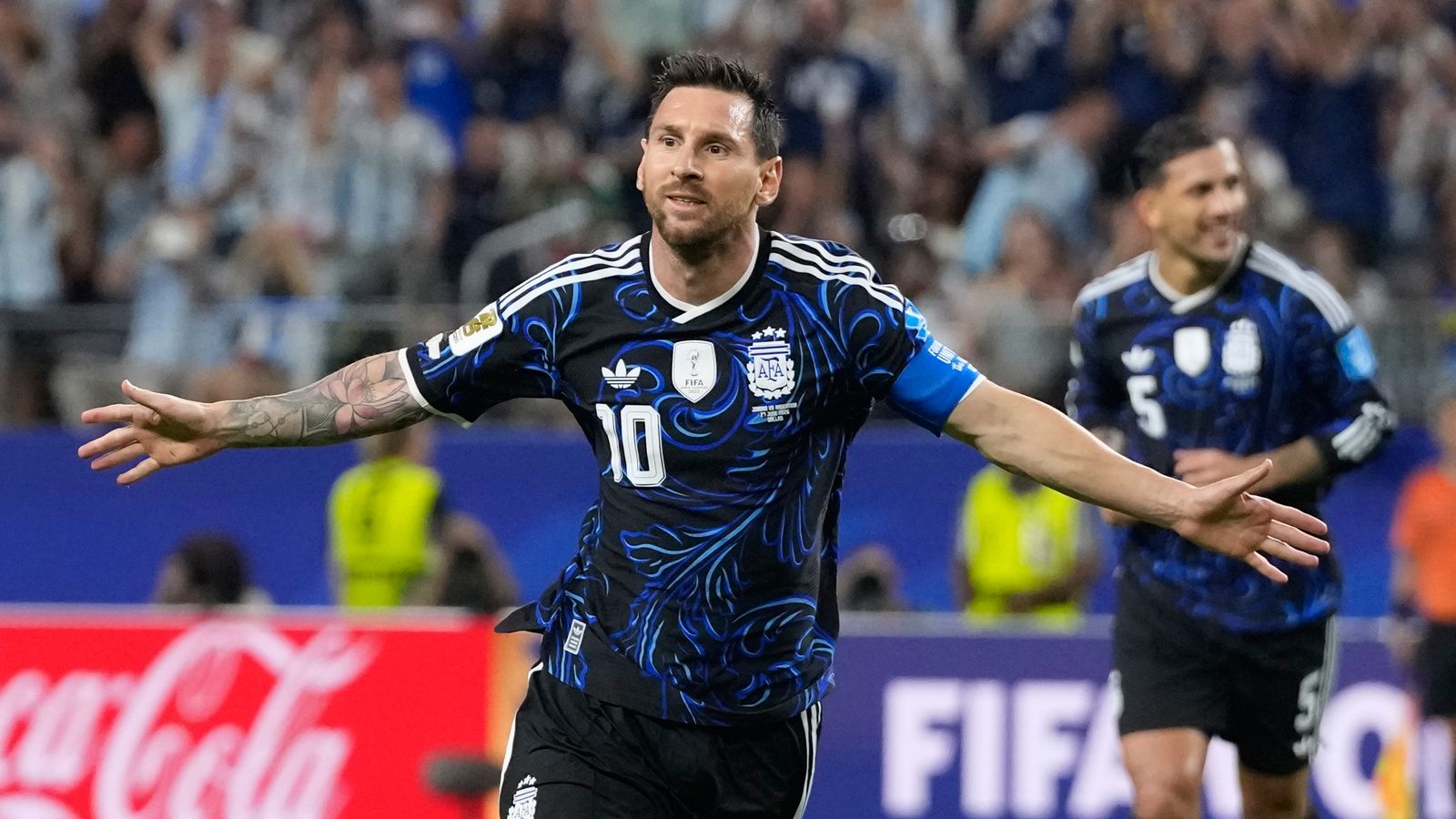
Messi's presence immediately altered the tactical dynamics of the match. He drifted between the lines, drawing two midfielders toward him and opening space for Lo Celso and Martinez. Messi secured the victory in the 80th minute, curling a brilliant free-kick into the top corner to complete a 3-1 win.
That goal was not just a match-winner; it was a historic milestone. With that strike, Messi became the first player to score in seven consecutive World Cup matches. He had already broken Miroslav Klose's all-time tournament scoring record during Argentina's 3-0 win over Algeria and the subsequent 2-0 victory against Austria.
Even at thirty-eight, Messi remains the tactical focal point of this team. The full match details can be found in the official Sky Sports report. Scaloni's reliance on his captain was once again clear to everyone in Dallas.
Why the Defensive Wall Will Crumble in Miami
Despite Cape Verde's defensive resilience, their World Cup adventure will end in Miami. Scaloni will discard the experimental lineup used against Jordan and revert to his preferred starting XI. This means the return of Alexis Mac Allister, Rodrigo De Paul, and Enzo Fernandez to the midfield.
This trio provides the ball circulation speed necessary to unlock a deep defensive block. Against Jordan, Argentina's reserve midfield was too static, playing slow lateral passes that allowed the defense to shift. The returning starters play with much higher intensity, using vertical third-man runs to break lines.
De Paul's relentless energy will be vital in winning second balls, preventing Cape Verde from launching counter-attacks. Fernandez will dictate the tempo, shifting the point of attack to stretch Cape Verde's five-man midfield line.
Furthermore, Cape Verde's defensive block will struggle with Argentina's dynamic rotations. Scaloni's side does not rely on static positioning. Messi will drop deep, dragging a center-back out of the defensive line, while Julian Alvarez runs into the vacated space.
This constant movement creates defensive confusion, forcing defenders to make split-second decisions under pressure. Against Spain, Cape Verde could defend statically because Spain lacked vertical runs, but Argentina will offer plenty.
We must also consider the physical toll on Cape Verde's squad. Defending in a low block for ninety minutes requires immense physical and mental concentration. Cape Verde's players have covered significant distances in their three group matches, defending under constant pressure.
Argentina's ability to retain possession will tire Cape Verde's players, leading to defensive lapses in the second half. My prediction is a comfortable victory for the champions.
Cape Verde will hold out for the first half-hour, maintaining their defensive shape and frustrating Argentina's initial attacks. But Argentina's quality and depth will eventually tell. Once the first goal goes in, Cape Verde will be forced to push forward, exposing spaces that Argentina will ruthlessly exploit.
Expect a professional performance from the title holders as they march into the round of 16. The blue and white shirt has too many weapons for a debutant to contain.
Read Next
- Jesse Marsch is actually cooking with Canada and US Soccer looks very silly
- Stop pretending Brazil can win this World Cup
- Why Christian Fuchs was right to walk away from Newport County
- Why Newcastle are fighting a losing battle to keep their midfield together
- 🇦🇷 Argentina World Cup 2026 — Defending Champions Hub