The mathematical inevitability of the eight-match World Cup
For 68 years, Just Fontaine’s single-tournament record of 13 goals in 1958 has stood as an untouchable monument of international football, but the expansion of the 2026 World Cup is about to dismantle it. With the introduction of the Round of 32, a team reaching the final now plays 8 matches instead of the traditional seven. That single extra fixture represents a 14.3 percent increase in playing time, and when combined with the dilution of defensive quality in a 48-team field, the statistical threshold for historical greatness has plummeted.
The numbers from the group stage and the first knockout round support this reality. At the current rate of scoring, we are on track to see three or more players hit double figures in a single tournament for the first time in history. Previously, only Fontaine, Gerd Muller in 1970, and Sandor Kocsis in 1954 had ever breached the ten-goal barrier. Now, a cluster of modern elite goalscorers is capitalizing on a tournament architecture designed for volume.
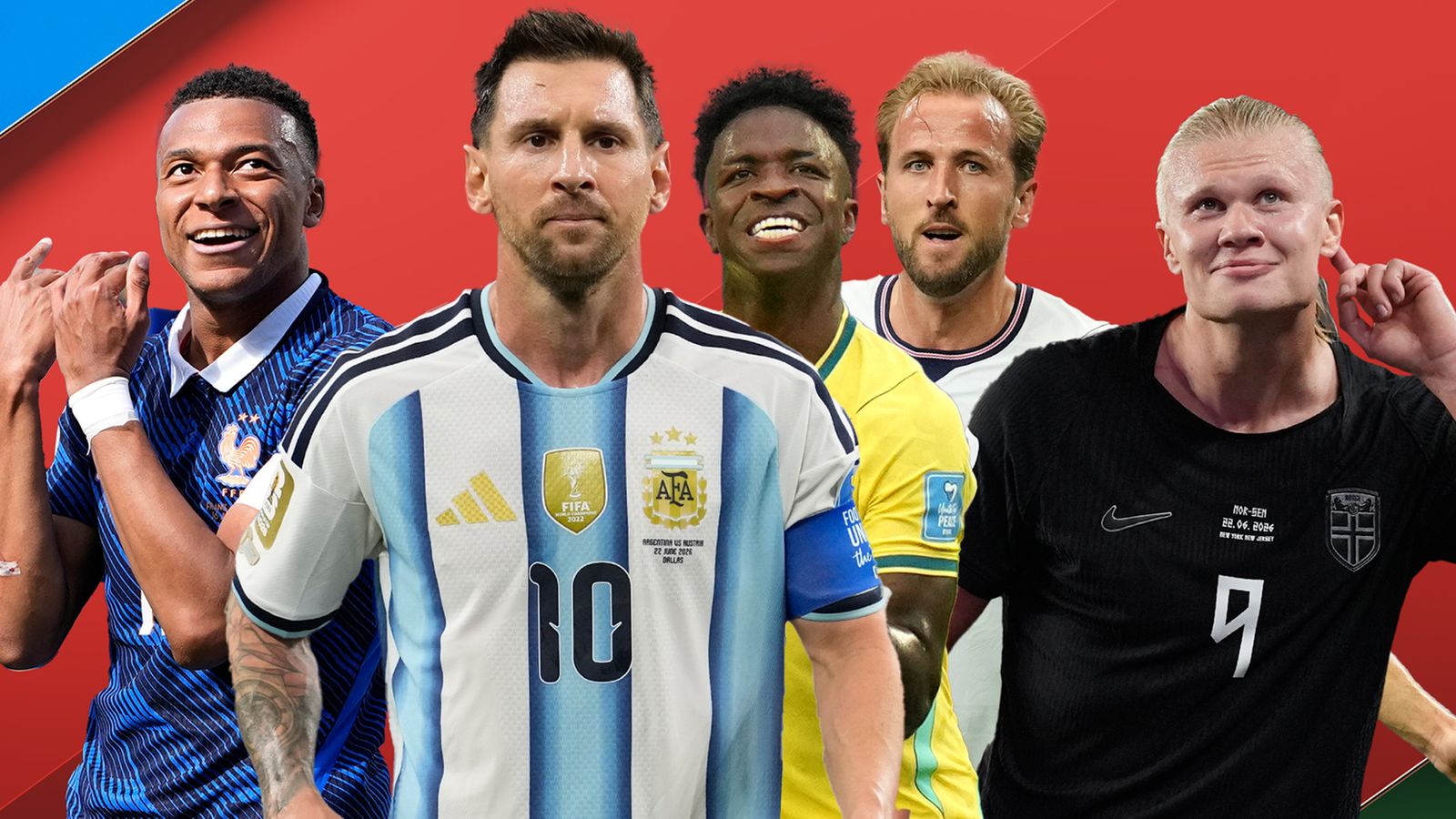
Lionel Messi leads the field with six goals, closely chased by Erling Haaland and Kylian Mbappe on five each. The chasing pack is compact, with Vinicius Jr and Ousmane Dembele sitting on four, and a broader group including Harry Kane on three. This is not a standard Golden Boot race; it is a high-velocity shootout fueled by an unprecedented tournament format of 104 matches.
Messi’s space optimization vs Haaland’s vertical efficiency
The statistical profile of Lionel Messi at 39 years old is an exercise in extreme economy. Across his 28 career World Cup matches, Messi has now accumulated 18 victories and scored 18 goals, overtaking Miroslav Klose’s long-standing record of 16. In this tournament, Messi is averaging just 6.2 kilometers of running per 90 minutes, yet his output remains peerless. He has registered six goals from an expected goals (xG) value of just 4.1, indicating a sustained overperformance driven by shot placement rather than physical dominance.
Instead of leading presses, Messi occupies the space between the opposition midfield and defensive lines. He waits for transitional moments to exploit the gaps created by his teammates' decoy runs. For opponents, the pressing trigger is almost impossible to define because Messi rarely touches the ball more than twice in succession in the middle third. He simply exists in zones of maximum danger, waiting for passing lanes to open.
In contrast, Erling Haaland's five goals have been scored through sheer verticality and physical intimidation. As Sky Sports reported, Haaland hit his fifth of the tournament in Norway's last-32 win over Ivory Coast. Haaland is operating in a system that bypasses the midfield entirely. Norway averages just 38% possession in the opposition half, yet Haaland is averaging 1.45 goals per 90 minutes. He requires only 18.4 touches per goal, a statistic that highlights his role as a pure transition finisher.
While Messi operates in the half-spaces, Haaland attacks the depth. He uses his physical profile to pin opposition center-backs, creating a vertical stretch that allows Norway's wingers to exploit second balls. Haaland’s movement is highly structured; he runs almost exclusively in straight lines from the blind side of the fullback to the near post. This makes him predictable in theory but unstoppable in practice, especially against fatigued low-blocks in the latter stages of matches.
The French paradox and Dembele's quiet efficiency
Kylian Mbappe's path to five goals has been far more labor-intensive than his rivals. As French coverage detailed, Mbappe pulled level with Haaland by breaking the deadlock for France against Sweden in a tense encounter. Despite his five goals, Mbappe has taken 28 shots, with a conversion rate of just 17.8%. France's possession play has been sluggish, forcing Mbappe to drop deep into the left channel to carry the ball himself, which increases his physical load and reduces his efficiency inside the eighteen-yard box.
This sluggishness highlights a significant structural issue in Didier Deschamps' setup. By forcing Mbappe to act as both progressor and finisher, France is failing to exploit the spacing advantages created by their mid-block. The contrast with his teammate Ousmane Dembele is striking. Dembele has scored four goals from just nine shots on target, operating on the right wing with a directness that France often lacks on the left. Dembele is averaging 5.2 progressive carries per 90, yet his shot selection has been far more disciplined than Mbappe's.
The negative observation here is that France's attacking structure is fundamentally unbalanced. While Mbappe receives the majority of defensive attention, he is also taking low-value shots from acute angles. If opposition defensive lines shift their horizontal compacting to block the left channel, France struggles to create central breakthroughs. This leaves them vulnerable to disciplined mid-blocks that can isolate Mbappe and force Dembele into low-percentage crosses.
The casualty list and the survival of the transitional threat
The introduction of the Round of 32 has already claimed several major casualties, altering the Golden Boot race. Germany's exit, which included the end of their historic 50-year penalty shootout streak against Paraguay, means Kai Havertz and Deniz Undav cannot add to their tallies. Similarly, the Netherlands' elimination has frozen Cody Gakpo and Brian Brobbey on their respective numbers. These early exits have cleared the field, leaving the race to those who can navigate the increasingly tactical knockout rounds.
Yet, several dark horses remain in the mix to challenge the elite trio. Brazil's Matheus Cunha and Senegal's Ismaila Sarr, who has scored three goals, are benefiting from direct, transitional systems. Canada’s Jonathan David is also demonstrating high efficiency, averaging 0.82 xG per 90 minutes. These players are thriving because the tournament's physical demands are beginning to take a toll on defensive structures. Teams that rely on high-pressing systems are finding it difficult to maintain intensity across the expanded schedule, leading to late-game defensive collapses.
We saw this physical decline in the group stages, most notably in the opening match between Mexico and South Africa, which featured three red cards as fatigue led to reckless challenges. Even smaller nations like Curacao, despite their defensive limitations, have shown that a compact low-block can frustrate elite sides for long periods before physical exhaustion sets in. The teams that survive the upcoming rounds will be those that can control the tempo of matches without exhausting their key offensive assets.
The historical threshold in sight
To understand the magnitude of what Messi, Mbappe, and Haaland are chasing, one must look at the historical context. Since Gerd Muller scored ten goals in 1970, no player has reached double figures in a single World Cup. Ronaldo Nazario came closest in 2002 with eight goals, but the modern game's tactical sophistication has generally suppressed individual scoring spikes. The eight-match format changes this dynamic completely, providing the additional minutes necessary to overcome variance.
If Messi maintains his current rate of 1.2 goals per game, he will finish the tournament with nine or ten goals, assuming Argentina reaches the final weekend. If Haaland or Mbappe can produce a multi-goal performance in the quarter-finals, Fontaine's record of 13 goals is well within reach. The path to the final, detailed in the official knockout bracket, suggests that the defensive structures in the upcoming rounds will be far more robust than those encountered in the group stages.
The winner of the Golden Boot will not necessarily be the most talented finisher, but the player whose team can best manage the physical and tactical demands of this expanded tournament. In a World Cup of unprecedented scale, the numbers suggest that the old boundaries of goalscoring are about to be rewritten.
Read Next
- Haaland is hunting Messi, and Mbappe is running out of time
- Norway survived an Ivorian onslaught to set up a clash with Brazil
- Why Norway can actually beat Brazil in the Round of 16
- Can Sweden's star strikers shock Mbappe's France in East Rutherford?
- 🏆 World Cup 2026 — Full Coverage Hub
- 🇦🇷 Argentina World Cup 2026 — Defending Champions Hub