The Illusion of Belgian Control
Exactly ten years ago today, a Welsh side that completed just 78% of its passes and had 48% possession dismantled the number-two ranked team in the world. The Euro 2016 quarter-final in Lille saw Belgium enter the match with a squad boasting the tournament's most potent offensive line. By the final whistle, Chris Coleman’s Wales had secured a historic 3-1 victory, exposing structural decay within Marc Wilmots' side.
The raw match statistics suggest a contest that was close, perhaps even tilted toward the Belgians. Wilmots’ men controlled 52% of the ball and completed 88% of their passes, a full ten percentage points higher than their opponents. Yet, the final scoreline was no fluke, but rather the logical result of superior space creation and transition efficiency.
Wales took 15 shots, forcing seven on target, while Belgium registered 14 attempts but managed just three on target. After Radja Nainggolan’s 13th-minute thunderbolt from 25 yards put Belgium ahead, the Red Devils collapsed into sterile play. They circulated the ball slowly across their backline, unable to penetrate Coleman’s compact low block.
The Seven-Minute Storm
Before Nainggolan's strike, Belgium should have been out of sight. In the 7th minute, the Red Devils launched a devastating counter-attack that resulted in three consecutive shots within six seconds. Hennessey denied Carrasco, Taylor blocked Hazard's rebound on the line, and Chester blocked Meunier's follow-up.
The defensive desperation began even earlier in the match. In the 5th minute, Ben Davies committed a tactical foul on De Bruyne to stop a dangerous break. The resulting yellow card ruled Davies out of the semi-final, matching the suspension Ramsey would receive later.
These two disciplinary lapses showed that Wales played on the absolute limit of their physical capabilities. While their structural discipline was admirable, it came at a massive cost to their tournament longevity. This willingness to trade tomorrow's personnel for today's survival defined their defensive effort.
The Systematic Exploitation of Jordan Lukaku
A Makeshift Backline Exposed
Belgium’s defensive preparation was a disaster before the game even kicked off. Vincent Kompany was out of the tournament, Nicolas Lombaerts was injured, Jan Vertonghen suffered ankle ligament damage in training, and Thomas Vermaelen was suspended. Wilmots was forced to field a back four featuring Jordan Lukaku, then 21, and Jason Denayer, then 20.
Coleman identified this weakness immediately, targeting the space behind Jordan Lukaku. The plan was simple: draw Belgium’s midfield press to the left, then quickly switch play to the right wing-back, Chris Gunter. This movement isolated the young Belgian left-back and stretched the Belgian defense horizontally, forcing Denayer to leave the center to cover wide spaces.
This systematic targeting bore fruit in the 30th minute. Ashley Williams’ equalizer was a direct consequence of defensive disorganization. Aaron Ramsey delivered a corner to the penalty spot, where Denayer and Lukaku both failed to track the Welsh captain, allowing a free header.
The marking was amateurish, exposing a complete lack of defensive cohesion. Williams was left completely unmarked to head past Thibaut Courtois. This goal shifted the momentum, as Belgium's fragile backline began to panic under sustained pressure.
The Free Agent Who Stunned the World
The Geometry of the Cruyff Turn
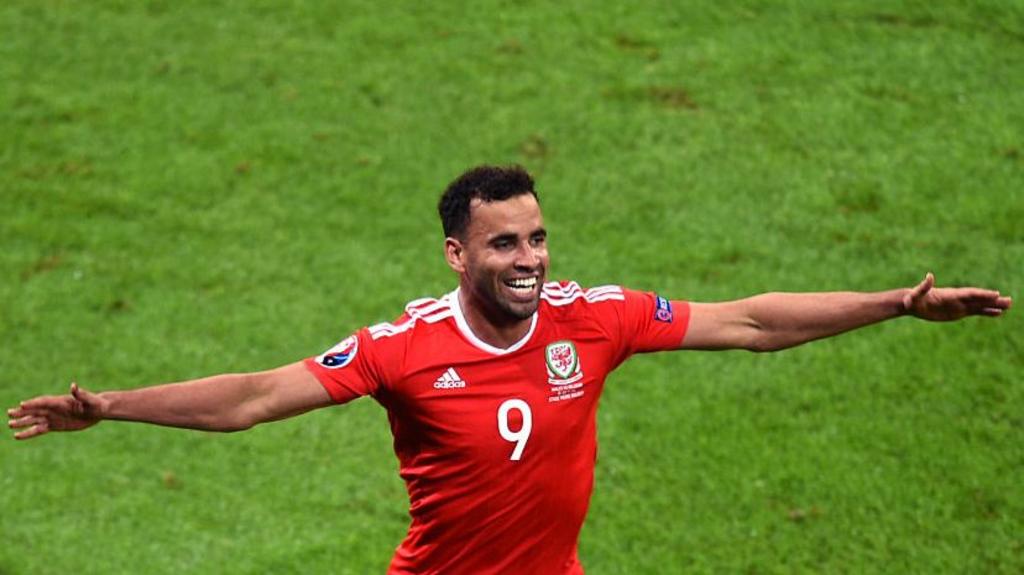
The game’s defining moment arrived in the 55th minute, creating one of the most famous goals in European Championship history. Aaron Ramsey received a pass on the right flank and whipped a low cross into the box. Hal Robson-Kanu controlled it with his back to goal, surrounded by Thomas Meunier, Marouane Fellaini, and Jason Denayer.
What followed was a moment of sheer composure. Robson-Kanu executed a perfect Cruyff turn, causing all three Belgian defenders to slide past him, completely out of the play. He was left with only Courtois to beat, slotting the ball calmly into the bottom corner.
A decade later, Hal Robson-Kanu reflected on the moment, remembering the triumph in Lille with absolute clarity. The former Welsh international spoke of the emotion that still surrounds that summer run.
"I remember like it was yesterday"
The statistical context of the goalscorer is staggering. Robson-Kanu was a free agent, with Reading FC having announced his release on May 9, 2016, after he scored just three goals in the Championship. In a single moment, a striker with three club goals all season outwitted a defense of Champions League regulars.
His role in Coleman's team was rarely about volume scoring. Robson-Kanu averaged just 1.2 shots per 90 minutes during the tournament. His primary function was defensive workload and structural distraction, running the channels to occupy the center-backs and create pockets of space for Gareth Bale.
Ramsey’s Brilliance and His Costly Indiscretion
The Metronome of the Red Wall
While Bale drew the headlines, Aaron Ramsey was the actual engine of the Welsh team. The midfielder covered 11.5 kilometers against Belgium, acting as the transition link between defense and attack. He registered two assists in the match, taking his tournament total to four assists and one goal.
Ramsey’s heat map from that night shows a player operating in every zone of the pitch. He pressed high to disrupt Axel Witsel, dropped deep to assist Joe Allen, and drifted wide to create overloads. When Wales won the ball, Ramsey was the outlet, completing 84% of his passes in the final third.
Yet, this masterclass was marred by a costly error. In the 74th minute, with Wales leading 2-1, Ramsey committed a careless handball in midfield. The referee showed him a yellow card, which triggered a semi-final suspension due to an earlier booking against Northern Ireland.
Without Ramsey’s energy and progressive passing, Wales looked toothless in Lyon, losing 2-0 to Portugal. His suspension highlights the fragile nature of Coleman's squad depth. The booking was a moment of poor discipline that cost Wales a potential final appearance.
Vokes’ Header Seals the Masterclass
The Final Nail in the Golden Generation
Belgium tried to salvage the match by throwing Fellaini and Christian Benteke forward. Wilmots abandoned all tactical structure, sending long balls into the Welsh box in desperate, uninspired fashion. Coleman reacted by subbing on Sam Vokes in the 80th minute to provide fresh legs and defensive height.
Six minutes later, the tactical victory was complete. Gunter raced down the right wing once more, exploiting the space left by Belgium's desperate search for an equalizer. He delivered a looping cross to the near post, where Vokes got ahead of Denayer to execute a brilliant glancing header.
The efficiency of the Welsh attack was remarkable. They scored three goals from an expected goals (xG) value of just 1.15. In contrast, Belgium accumulated 1.62 xG but failed to score after Nainggolan's early strike, proving that Wales gave a masterclass in modern tournament football.
The Legacy of Coleman's Blueprint
Ten years later, the tactical lessons of Lille remain highly relevant. A team with a clear plan, defensive organization, and vertical transition speed can overcome a collection of expensive individuals. Wilmots’ Belgium had the stars, but Coleman’s Wales had the system.
Read Next
- Tactical rigidity broke England long before Rooney saw red in 2006
- Belgium's numbers show they are far from safe against Senegal
- Mbappe is playing like R9, but France's midfield is still a problem
- Why Mexico's altitude trap at the Azteca is England's ultimate nightmare
- 🇧🇪 Belgium World Cup 2026 — Red Devils Hub
- 🏴 Wales at the 2026 World Cup — Full Coverage Hub