The Melted Screen and the Clean Break
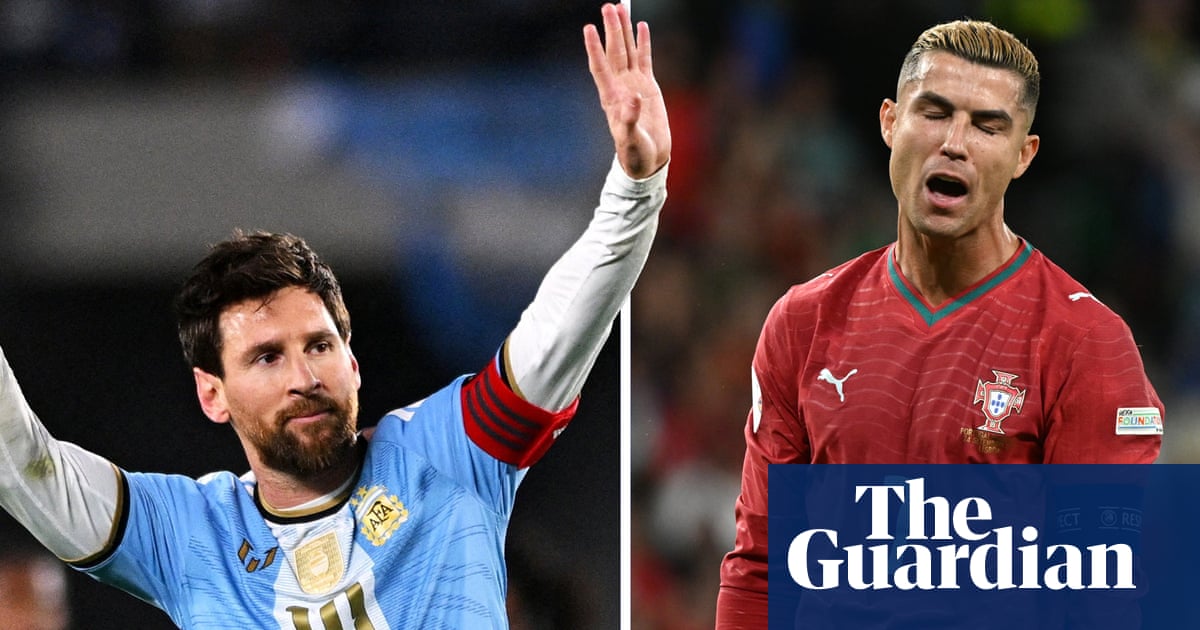
Two defining icons of modern football reached the end of their international journeys this week, but the contrast couldn't be starker. In Buenos Aires, Lionel Messi got a reverent send-off against Benin. In Lisbon, Cristiano Ronaldo posted a manifesto because he didn't get brought off the bench for 30 minutes.
Messi’s exit had all the emotional staging of a state funeral. Pre-match pyro, 80,000 fans weeping, and a massive "Gracias No 10" banner across the pitch. Even when Benin goalkeeper Marcel Dandjinou threatened to spoil the script by denying Messi from open play, the narrative held until a 58th-minute penalty sealed the deal.
Granted, the event wasn't entirely pristine. Watching a glowing green drone display light up the night sky to advertise Sancor Seguros insurance right over Messi’s tearful face was corporate intrusion at its absolute worst. But on the pitch, the team played with emotional clarity.
Ronaldo took the opposite route. After walking out of Portugal’s camp, the 41-year-old released a staggering 1,740-word essay on social media attacking head coach Jorge Jesus. His primary grievance was a breached "30-minute minute-management strategy" that felt less like professional analysis and more like a playground meltdown.
The manifesto included an eight-point demand asking Jesus to praise Ronaldo publicly. The 72-year-old manager did what any self-respecting tactician would do outside his front door. He binned the script and moved on.
blockquote>"I read his statement," sighed Jesus to reporters waiting outside his house this morning. "Now, like I do every single day, I will go to the Portuguese federation and work, think about the team and the national squad. I have nothing more to say. Thank you."That brief statement marks the official end of player-centric politics in Portuguese football. As The Guardian reported, Jesus chose the collective over the diva. It is the best decision Portugal has made in ten years.
The Tactical Math Behind Portugal's Stagnation
You cannot build a modern elite side around a forward who refuses to work off the ball. For three years, Portugal played with an anchor tied to their rear axle whenever Ronaldo started.
Look at the tracking metrics from the last international block. Portugal registered a PPDA (passes allowed per defensive action) of 16.4 with Ronaldo on the pitch. That ranked 18th among European nations, trailing sides like Albania and Slovenia.
Ronaldo averaged just 4.2 pressure actions per 90 minutes. Modern elite strikers average between 14 and 18 pressures per match. He was a spectator during defensive phases.
That lack of work created massive structural flaws. When a center-forward fails to cut off passing lanes to the opposition pivot, opponent centre-backs carry the ball 20 yards forward unchallenged. That forced Vitinha and João Neves to abandon their central zones to jump on ball-carriers.
The result was a completely fractured midfield. Opponents exploited the 30-yard gap between Portugal's front three and double-pivot with easy line-breaking passes.
The Death of Attacking Variety
The damage wasn't limited to defense. In possession, Portugal became painfully static and one-dimensional.
When Ronaldo plays, every attack must end with a cross to the back post. Portugal averaged 31.4 crosses per game during his starts, completing a miserable 17% of them. Opposing low blocks simply stacked three central defenders inside the box and headed everything clear.
Rafael Leão was neutered on the left flank. Instead of attacking the half-space or driving into the box, he was forced to hold width and pump balls into a crowded penalty area.
Bruno Fernandes suffered a similar drop in productivity. His open-play xA (expected assists) dropped from 0.38 per 90 without Ronaldo down to 0.12 with him. Everything was funneled toward one man's personal milestone machine.
How Jorge Jesus Unlocks the Front Line
Jorge Jesus built his entire coaching reputation on high-intensity vertical football and ruthless pressing. His 4-3-3 shape requires four things: compact lines, instant counter-pressing, dynamic rotations, and total tactical compliance.
Removing a 41-year-old static target instantly fixes Portugal's tactical geometry. With Gonçalo Ramos or Diogo Jota upfront, Portugal get a central forward who actually initiates the defensive block.
The Four-Step Pressing Protocol
Under Jesus, Portugal's high press will operate on a clear set of mechanical triggers:
- The central striker jumps aggressively onto the opposition left-back the moment a lateral pass leaves the keeper's foot.
- The far-side winger tucks inwards into the central channel, closing down the main escape pivot.
- The ball-side interior midfielder steps up aggressively to lock down the passing lane to the touchline.
- The back line moves five yards higher, catching opposition runners in an offside trap.
This sequence drops Portugal's projected PPDA from 16.4 down to 8.8. That places them right alongside Spain and France in high-turnover efficiency.
Unlocking the Central Space
In possession, Ramos and Jota don't stand between the centre-backs begging for headers. They drag defenders out of position with diagonal dummy runs.
When Ramos drops into the left half-space, he drags the right-sided centre-back with him. That opens up a massive vertical lane for Fernandes or Bernardo Silva to exploit with late runs into the box.
During tests without Ronaldo last autumn, Portugal's central box entries increased by 64%. Their shot quality surged from an average distance of 19.2 meters down to 12.4 meters.
They stop floating hopeless crosses from wide areas. They start slicing teams open through quick, vertical combinations in the zone 14 area.
The Prediction: Portugal's Unstoppable Fall Campaign
The media spectacle in Lisbon might feel chaotic, but tactical clarity has finally arrived. By calling Ronaldo's bluff and binning his manifesto, Jesus took full control of the dressing room.
Let's make a firm call on what happens next. Portugal will sweep their next three competitive fixtures by two or more goals while generating over 2.35 xG per match.
They will look like a completely different side. The ball speed will double, the high turnovers will triple, and the midfield gaps will disappear entirely.
Argentina might have won 3-0 against Benin to give Messi his tearful goodbye, but Scaloni's team still looked slow breaking down a stubborn low block before the penalty. Portugal, by contrast, are about to explode into an athletic, high-pressing machine.
The Ronaldo era in Lisbon didn't end with a trophy or a graceful wave. It ended with a petulant 1,740-word essay and a bin outside a manager's house. But for Portugal's actual football team, the real era starts right now.
Read Next
- Portugal are finally better off without Cristiano Ronaldo
- Top 10: World Football's Biggest Storylines, Scandals, and Shocks of 2026
- Why Marie-Louise Eta's 4-3-3 shift is working at Union Berlin
- Why Martin Odegaard and Premier League Stars Are Obsessed With VR
- 🇦🇷 Argentina World Cup 2026 — Defending Champions Hub
- 🇵🇹 Portugal World Cup 2026 — A Seleção Hub