The MKM Disaster Exposes Old Fault Lines
If you want to know how a Premier League match gets lost in twenty minutes, look at the spatial gap between Manchester United’s two central midfielders when Matt Crooks turned into open field. Hull City did not need sophisticated positional play to dismantle United at the MKM Stadium. They simply exploited a side running around with no central spine and zero rest defense.
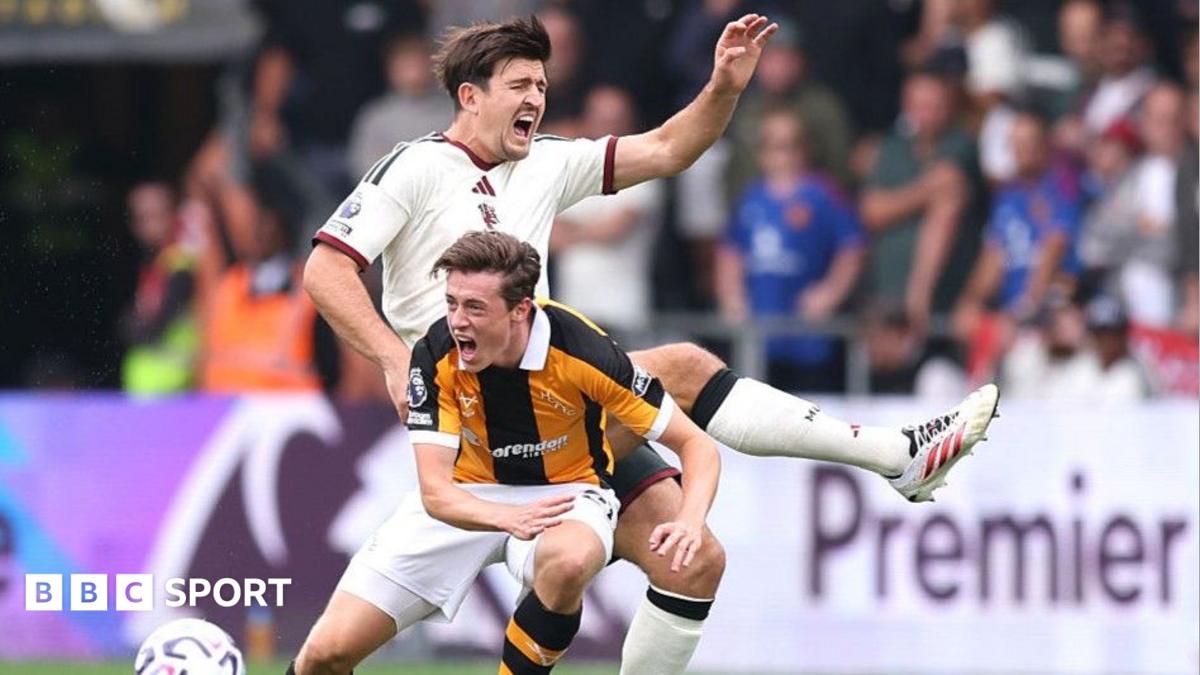
The 2-0 loss to a newly-promoted side on opening weekend was not a fluke result born of bad luck. It was a structural collapse that exposed every tactical defect left untreated during pre-season. Hull took control early, played with physical authority, and held their lead with minimal friction.
Look closely at the sequence leading to Hull’s opener in the first half. Oli McBurnie pinned nineteen-year-old Ayden Heaven on the right channel, using his body to shield a long vertical pass before turning to fire toward Senne Lammens. Lammens produced a sharp initial save, but Semi Ajayi beat three static white shirts to smash home the loose rebound.
That was Ajayi’s first Premier League goal since January 2021, when he scored for West Bromwich Albion against Wolverhampton Wanderers. It highlighted how painfully slow United’s defensive line reacted to second-phase balls. Heaven was outmuscled, Noussair Mazraoui drifted too far inside, and Harry Maguire was left covering empty air.
The second goal was even more damning from an organizational standpoint. Regan Slater floated a curling free-kick into the heart of the six-yard box, targeting the exact seam between United's zonal markers. Debutant Nobel Mendy attacked the trajectory completely unchecked to head home Hull's second goal.
By the time the teams walked off at half-time, Heaven and McBurnie were exchanging heated words near the tunnel. The teenager was exposed, but the real failure occurred thirty yards further up the pitch. United’s midfield double pivot had completely abandoned their defensive duties.
Why Crooks and Egan Destroyed United’s Rest Defense
Andrey Santos made his full competitive debut in central midfield, and the game completely bypassed him. He attempted nine duels in the central third and won just two. Beside him, Youri Tielemans spent forty-five minutes floating high diagonal balls into a box filled exclusively with tall Hull defenders.
When your central pairing offers neither defensive resistance nor vertical penetration, your entire system breaks down. Regan Slater and Matt Crooks outran and out-thought Santos and Tielemans at every transition. Crooks even found time to charge downfield and force Lammens into a desperate clearance outside his area.
The fundamental flaw in United's possession structure was Matheus Cunha’s positioning. Starting as the nominal center-forward, Cunha spent eighty minutes dropping deep into the number ten space to demand the ball at his feet. That spatial drift left United without any physical presence inside the eighteen-yard box.
With Cunha constantly occupying Bruno Fernandes’ natural operational zones, United became ridiculously narrow in central areas. Luke Shaw attempted to overlap on the left touchline, but he was left covering vast tracts of grass whenever Hull launched quick counter-attacks. Lewie Coyle and Ryan Giles repeatedly doubled up on United’s unprotected flanks.
John Egan delivered a masterclass in how to play as the central defender in a back three. When Hull possessed the ball, Egan regularly stepped up into midfield to form a temporary diamond. That subtle movement snuffed out Bruno Fernandes before the Portuguese playmaker could turn into the half-spaces.
Bryan Mbeumo was United’s only dangerous outlet during a miserable first half. He forced Konstantinos Tzolakis into a brilliant one-handed save from an angled drive, then saw an acrobatic volley deflected wide. Beyond Mbeumo’s individual efforts, United generated almost nothing of genuine quality.
The Substitution Dilemma and Marcus Rashford's Return
The player ratings from the MKM Stadium paint a brutal picture of United’s attacking futility. Patrick Dorgu picked up an early yellow card and failed to provide width before being hooked at the break. His replacement, Marcus Rashford, made his first Manchester United appearance since December 2024.
Rashford tried to drive directly at Elliot Stroud and Cody Drameh on the left flank. Yet despite several energetic carries, his final actions lacked precise execution. He generated zero key passes and failed to complete a single cross during his forty-five-minute appearance.
At the sixty-six-minute mark, United made a double substitution, introducing Kobbie Mainoo and Benjamin Sesko. Sesko’s physical stature immediately offered a proper target inside the penalty box. However, Hull’s low block was already firmly established and comfortably organized.
Paddy McNair entered off the bench against his former club to reinforce Hull's backline alongside Lucas Herrington and Drameh. Drameh notably nipped in ahead of Shaw to stop a late cross as United's pressure mounted. Hull’s substitute wing-backs defended their penalty box with total discipline.
Liam Millar led a late breakaway that nearly produced a third goal for the hosts. Hull did not just defend their lead; they managed the closing stages with veteran composure. Mohamed Belloumi’s calm short-passing game kept the ball moving and starved United of late momentum.
What to Watch for in the Next 10 Days
The early-season warning signs for Manchester United are glaring. You cannot play a high pressing line if your front four refuses to sprint back when the first line is bypassed. When United lost possession, their back four dropped deep while the midfield stayed high, creating a massive canyon in the center.
Looking ahead to their next fixture, United’s coaching staff faces severe tactical dilemmas. Does Tielemans drop out for Mainoo to restore passing control? Starting Cunha as a lone striker without a fixed runner beside him proved to be absolute tactical suicide against compact defenses.
If United continue to float aimless crosses against three-center-back formations, opposing defenders will head them away all afternoon. Egan, Ajayi, and Mendy cleared twenty-four aerial balls combined. United must find quick central combinations or suffer identical outcomes in the coming weeks.
Hull City, meanwhile, have established a blueprint for their campaign. Timely wide delivery from Giles and Coyle, physical dominance from McBurnie, and industrious midfield work from Crooks will win them points at home. They played with absolute tactical clarity and relentless physical intensity.
For United, the pre-season optimism has evaporated into harsh reality. Facing a critical ten-day stretch, they look vulnerable, disjointed, and structurally naive. Unless the distance between their defensive line and midfield is compressed, every well-drilled side in the Premier League will slice through them.
Bold Prediction
United will panic-adjust their starting lineup for the next match, restoring Mainoo to central midfield and starting Sesko as the focal point. Expect a nervy 1-0 victory, but the underlying structural flaws will remain glaringly visible until the coaching staff fixes their rest defense.