
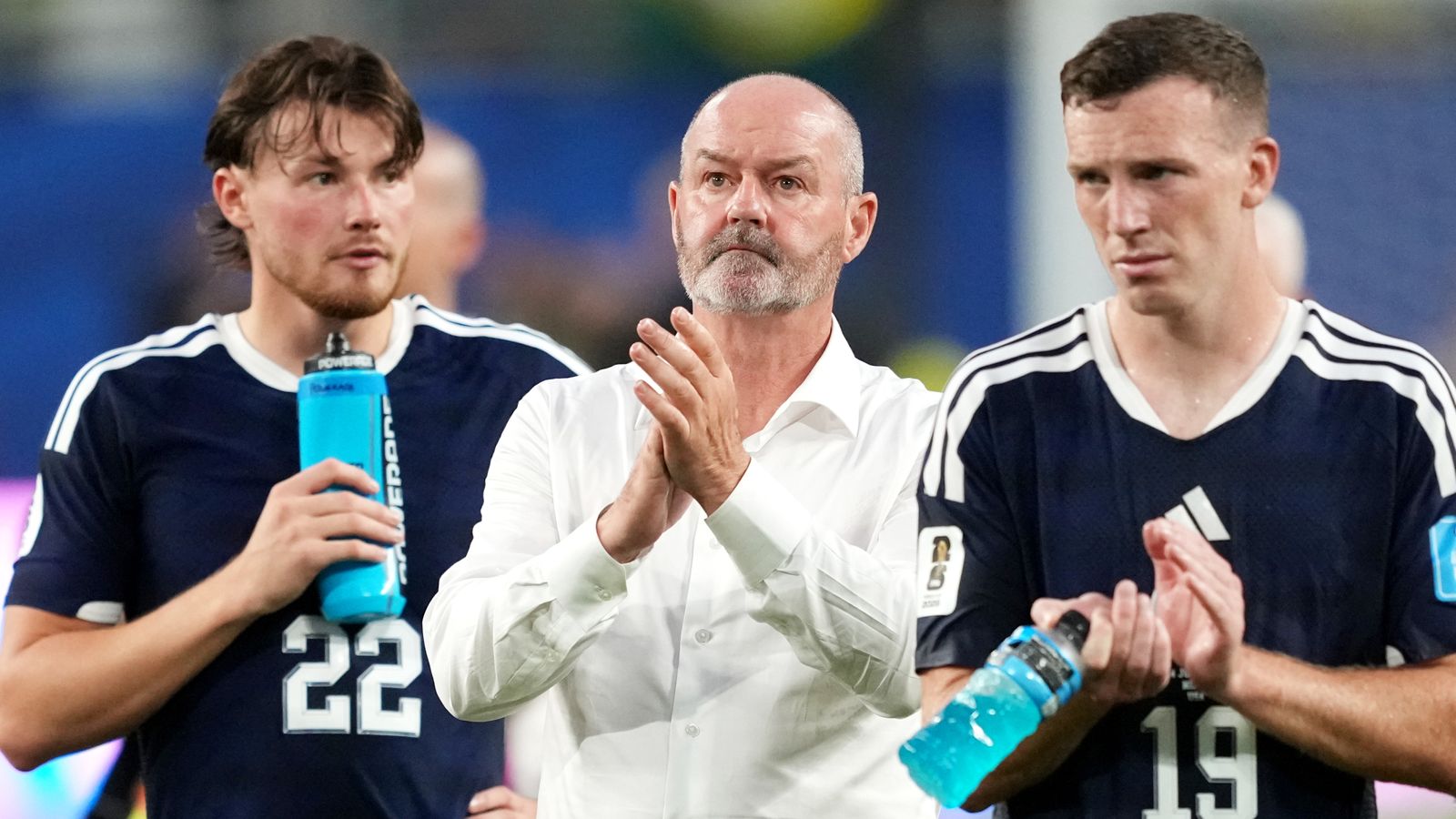
Steve Clarke is out. The Scotland manager resigned on Saturday night, bringing a sudden end to his seven-year tenure after the national team's World Cup exit was confirmed. Former Scotland forward Kris Boyd did not hold back in his reaction, as he told Sky Sports News that the wave of public and media criticism directed at Clarke was an "absolute disgrace."
Clarke's departure came hours after Ghana defeated Croatia on Saturday, June 27, 2026. That result officially eliminated Scotland from the tournament. The Tartan Army's campaign in the United States yielded just three points, courtesy of a 1-0 victory against Haiti.
Consecutive defeats to Morocco and Brazil left them short of qualifying as one of the best third-placed teams. For a nation that had not reached a World Cup since 1998, the tournament was a landmark. Yet the reaction back home was swift and hostile.
Clarke, who had signed a contract extension just before the tournament, became the focal point of fan anger. Boyd, however, believes the public has lost its collective memory. He argues that the anger ignores where Scottish football was before Clarke arrived.
Clarke's Legacy and the World Cup Exit
The Night and Day Transformation
The national team had spent over two decades in the international wilderness. Under Clarke, Scotland reached three major tournaments. The former Rangers striker insists that the criticism is entirely decoupled from historical context.
The "night and day" comparison is hard to argue against on paper. As Scotland's fixtures and results show, getting to these stages is a major shift from the past. They consistently punched above their weight in qualifying groups.
"There's a lot of criticism flying around. When you put yourself in managerial shoes and things don't go to plan, you're always going to be criticised. But I think a lot of people need to step back, realise where they've been, and realise where they are now. It's been night and day since Steve Clarke took charge of the national team."
Yet, the tournament itself exposed familiar flaws. Scotland looked passive and tactically rigid in their games against elite opposition. The defeat to Morocco was a particularly bitter pill to swallow.
Scotland failed to generate any real attacking momentum during that match. Against Brazil, they were completely outclassed by a superior side. Critics argued that Clarke's defensive setup lacked the ambition required to progress.
Boyd, however, points to the calibre of the opposition. He believes that the expectations were set far too high for this squad. He argued that the difficulty of the group was underestimated by the fans.
The Tactical Failure and Fan Backlash
The Brazil and Morocco Reality Check
Boyd's defense highlights a major debate in Scottish football. Should fans be happy just to be at the table? Or should they demand a higher standard of performance once they get there?
The traveling fans spent thousands of pounds to watch their team in North America. They expected more than a single goal and a solitary win over Haiti. The performance against Brazil was a harsh reality check.
"Ultimately, they came up against a team ranked sixth in the world in Brazil. Morocco were ranked seventh in the world. There are other groups where the highest-ranked teams were 17th and 19th, but we had two of the top-seven teams in our group. It was always going to be difficult. The win against Haiti was only our fifth victory at a World Cup."
Scotland's midfield was chased in circles for ninety minutes. The lack of tactical flexibility was a major talking point. Clarke stuck to his preferred five-back system, even when chasing the game.
It was a stubborn approach that ultimately cost him his job. Yet, Boyd is right to highlight the disparity in resources. Scotland's squad lacks the depth of Brazil or Morocco.
Most of Clarke's players operate in the English Championship or the lower half of the Premier League. Expecting them to dominate top-ten nations is unrealistic. Still, the passive nature of the defeats is what rankles most.
The SFA's Contract Mess and Search for a Successor
The Moyes and Postecoglou Speculation
The SFA now finds itself in a difficult position. The decision to hand Clarke a new four-year deal before the tournament looks incredibly short-sighted. That contract has now been ripped up after just a few weeks.
It represents a massive failure of planning by the governing body. They tied themselves to a manager without waiting to see how the tournament played out. Speculation has already begun regarding Clarke's successor.
"I've not really given it a thought and I'm not sure the SFA will have either because they thought Steve Clarke was the man to take them forward which is why they agreed a new four-year deal with him a few weeks ago. Now that's been ripped up and they have to go again. You imagine there will be a shortlist drawn up pretty soon but I don't see any outstanding candidate."
Names like David Moyes and Ange Postecoglou have been floated by fans and media alike. Moyes is currently managing Everton in the Premier League. Postecoglou has also commanded massive wages in his recent roles.
Boyd believes these links are completely unrealistic. The financial reality of the SFA is the biggest hurdle. Scottish football simply cannot compete with Premier League salaries.
Moyes is on a massive contract at Goodison Park. Postecoglou's wage demands would likely break the SFA's pay structure. Boyd was blunt about the likelihood of either man taking the job.
"I think in the future David Moyes will be a Scotland manager, but right now he's the manager of Everton Football Club and will be on a big salary. The SFA won't be able to compete with that. Ange Postecoglou is another one, but he's been on big salaries for his last two or three jobs as well. So, unless he wants to come down to the level of what the SFA are paying, it's never going to happen."
The SFA must now find a manager who fits their wage structure. This rules out almost every high-profile candidate on the market. The next manager will inherit a squad that has reached its ceiling under the previous regime.
The core of the team is aging, and there are few elite youngsters breaking through. The search for a new head coach begins immediately. The SFA needs to find someone who can build on Clarke's defensive solidity while adding some attacking threat.
It is a difficult balancing act. The next coach will also have to deal with the pressure of a fan base that has tasted major tournaments and now wants more. If they cannot, the dark days of the early 2000s could easily return.
As fans track the latest developments on the SFA search via Sky Sports' latest Scotland news feed, the scale of the challenge is obvious. The next manager must find a way to get Scotland back to the big stage without the financial backing that rivals enjoy. For now, the post-mortem of the Clarke era will continue to divide opinion.
Read Next
- Steve Clarke is gone and Scottish football fans are tearing each other apart
- Why Scotland's 0.07 percent World Cup survival math is peak comedy
- Steve Clarke has turned Scotland into the ultimate tournament buzzkill
- Thomas Tuchel's tactical rigidity is dragging England down to Scotland's level
- 🏴 Scotland World Cup 2026 — Tartan Army Hub
- 🇧🇷 WC 2026 Group C — Brazil, Morocco, Scotland, Haiti


