England's Right-Back Crisis and Bukayo Saka's Red Flags
England’s World Cup campaign faces a sudden back-line emergency ahead of Wednesday’s Round of 32 clash with DR Congo in Atlanta. Manager Thomas Tuchel is down to his last specialist right-back. The squad’s defensive planning has collapsed under three consecutive injuries in a single position, forcing the coaching staff into immediate survival mode.
First, Reece James suffered a hamstring injury against Ghana. Then, Liverpool’s Jarell Quansah—who replaced James against Panama—went down with a badly-twisted ankle in the final group match. With Newcastle’s Tino Livramento already ruled out before the tournament with a calf issue, Tuchel’s defensive depth is completely wiped out.
The numbers are bleak. Djed Spence is the only natural right-back left standing. Trevoh Chalobah is the emergency backup, despite having played zero minutes of tournament football since his late call-up. Behind them sits versatile centre-back Ezri Konsa, who will likely be needed in his primary central role alongside John Stones, leaving Spence with a massive weight on his shoulders.
Spence’s preparation has been bizarre, having played left-back against Croatia and Ghana before being rested against Panama. Resting him was a clear sign of Tuchel’s desperation to protect his last remaining right-back option, as Sky Sports reported in their tactical preview.
The right-back slot is not the only fitness fire Tuchel is trying to put out. Arsenal winger Bukayo Saka continues to play through a persistent Achilles issue. While the medical team has managed his load, former England defender Gary Neville publicly warned that the winger looks far from his usual self.
“He’s usually the boy that’s bubbling and smiling, he’s got that competitive edge to him, but he’s not right and that’s a concern to us,” Neville told Stick to Football.
Saka was restricted to substitute appearances against Croatia and Ghana before playing 62 minutes against Panama. Despite the manager’s public insistence that Saka’s condition is not a problem, his physical limitations have clearly affected England’s ability to stretch opponents. When Saka is unable to drive at full-backs with his usual velocity, England’s attacking options become predictably narrow.
Further down the team sheet, Elliot Anderson remains a concern after playing 84 minutes against Panama despite acute muscle tightness. The midfielder has been asked to carry a heavy physical load, but his durability is being tested to its absolute limit. Fortunately, the return of Declan Rice offers Tuchel some tactical relief in Atlanta.
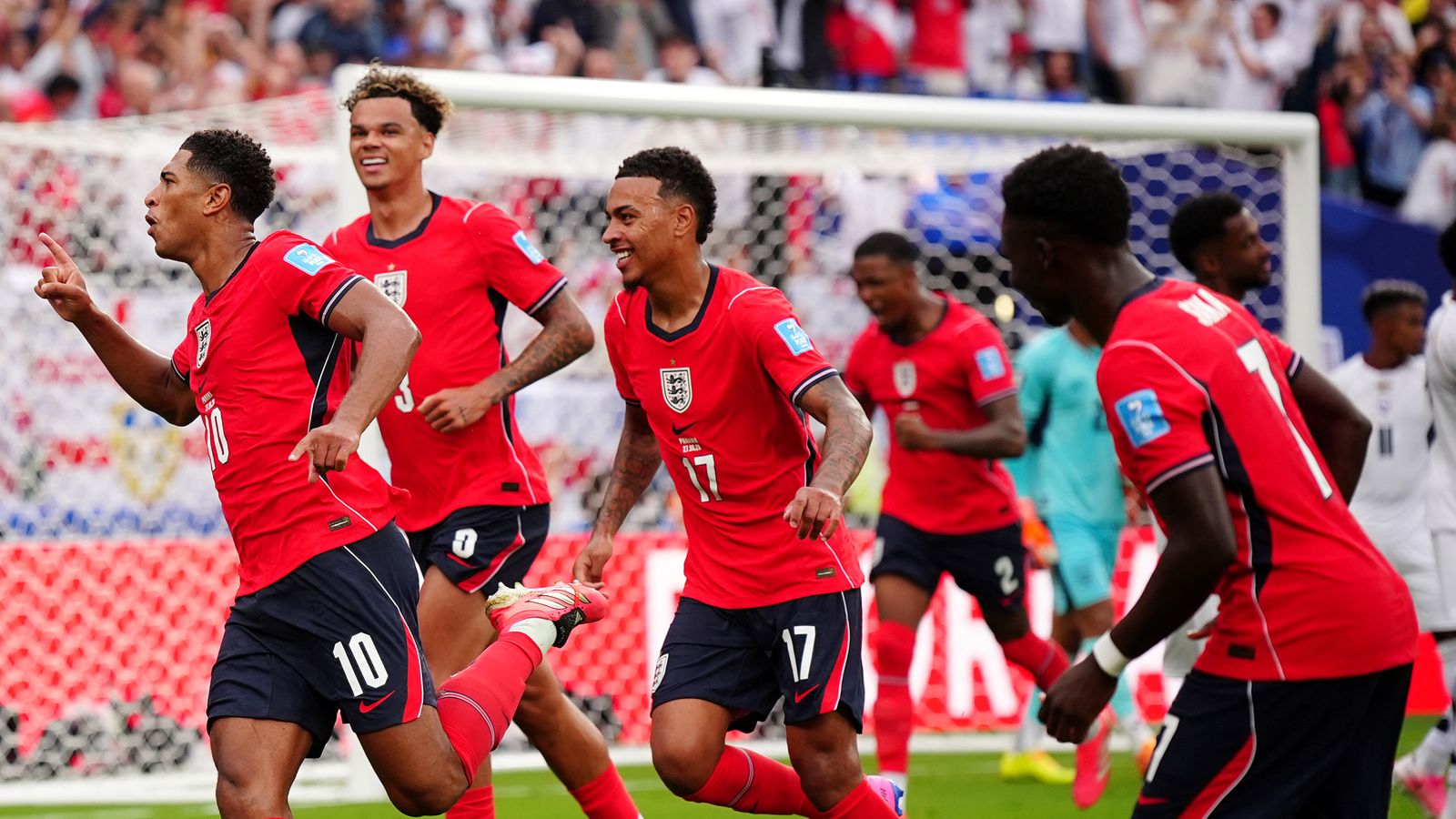
Rice has not touched a pitch in eight days after sitting out the Panama game with a calf complaint. His return to the starting XI will allow Jude Bellingham to push back into the advanced areas where he excelled against Panama, scoring once and assisting another. Having Rice back to anchor the midfield is a massive boost, but it does not fully hide the physical wear and tear running through this starting XI.
The Pickford Problem and Winger Woes
Behind this fractured defense lies a goalkeeper whose current form is raising serious alarms. Jordan Pickford has credit in the bank from three major tournaments, but his performances in the group stage were Rent-a-Kepa levels of shaky. Conceding two goals to Croatia set a nervous tone, and his decision-making against Ghana almost derailed the tournament entirely.
Pickford’s wild rush out of his penalty area against Ghana, which resulted in a collision with Prince Adu, could have easily resulted in a red card. The metrics back up the visual panic. Pickford currently ranks 39th among tournament goalkeepers in goals prevented, sitting at a negative -1.39 rating. If England are to survive the knockout stages, they cannot afford a goalkeeper who is actively costing them goals relative to the shots faced.
Further forward, Marcus Rashford and Bukayo Saka are expected to keep their starting spots out wide after replacing Noni Madueke and Anthony Gordon against Panama. However, Rashford’s performance in that final group game was incredibly erratic. He hit the target with just one of his five shots and failed to complete any of his six crosses, showing a worrying lack of end product.
Despite Rashford’s wastefulness, Tuchel is banking on the forward’s tournament experience. Rashford and Saka average more than twice as many shots per 90 minutes as Madueke and Gordon, making them the preferred options to unlock defensive lines. The concern is whether that shot volume can finally translate into goals when the stakes are raised in Atlanta.
Club vs Country Tension and the Industry Impact
This injury pile-up is causing major headaches back in the Premier League. Chelsea and Liverpool are watching their multi-million pound assets, Reece James and Jarell Quansah, break down in real-time. For Chelsea, James’ hamstring recurrence is a familiar nightmare that threatens their upcoming pre-season plans and long-term squad value.
Arsenal are similarly holding their breath over Bukayo Saka. If his Achilles issue worsens during the knockout matches, the club’s sporting director and medical staff will be furious at the management of his minutes. The club vs country tension is at all-time high as managers prioritize short-term tournament success over long-term player health.
For DR Congo, England’s defensive vulnerability is an absolute gift. They will look to exploit Spence’s lack of natural rhythm on the right side by targeting that flank with quick transitions. If England’s makeshift defense cannot hold, the strategic fallout will be felt far beyond the national team’s training base.
Cracking the DR Congo Low Block
DR Congo presents a tactical challenge that will test England’s physical and mental stamina. They are happy to retreat into a deep defensive shape, having spent more than half of their out-of-possession time in a low-to-mid block. The challenge for England is not getting shots off, but creating high-quality opportunities inside the penalty area, as detailed in the Sky Sports analysis.
FIFA data shows that England’s shot volume against deep defenses is comparable to France and Senegal, who have each scored twice against low blocks. However, England have scored zero goals from these situations in the group stage. The build-up play has been too slow, allowing defenders to get into position and block shots before they can threaten the goalkeeper.
Tuchel’s plan to beat this setup relies heavily on Harry Kane remaining in the penalty box rather than dropping deep to playmaker. While Kane’s passing range is an asset, England desperately need him to occupy the central defenders and convert crosses. In a game where space will be at an absolute premium, Kane must be the focal point of the attack.
If England fail to move the ball quickly through midfield, they risk falling into the same trap as Spain and Belgium, who struggled to break down disciplined opponents. With a compromised right-back, an injured winger, and a goalkeeper struggling for form, England’s path to the quarter-finals looks much steeper than it did a week ago.
Read Next
- Djed Spence starting is the ultimate Thomas Tuchel chaos move
- Liverpool selling Bajcetic and England's weird tactics have fans fuming
- Why England should dread DR Congo's low block in the last-32
- Why Bukayo Saka at right-back is England's best option against DR Congo
- 🏴 England World Cup 2026 — Three Lions Hub