The battle of Hampden on August 13
The Old Firm derby is rarely contained within ninety minutes. The latest installment is scheduled not for Celtic Park or Ibrox, but inside the committee rooms of Hampden Park. On Thursday, August 13, Celtic and Rangers will stand before an SFA disciplinary panel.
Both clubs face identical charges under Disciplinary Rule 37. This covers security failures and unacceptable conduct. The fallout from the March 8 Scottish Cup game has finally landed in the hands of the regulators.
As Sky Sports reported, the publication triggered an immediate war of words. The 37-page independent report, led by sports event consultant Mark Blackbourne, painted a grim picture of the security operations. The review detailed near-miss incidents that could have resulted in crushing or mass violence, as reported by the BBC.
Both Celtic and Rangers responded by launching defensive statements, which the Daily Mail characterized as returning fire. This is not a standard regulatory slap on the wrist. The SFA has recommended sturdier sanctions, including partial stadium closures and six-figure fines.
The hearing will test whether the governing body has the spine to enforce its own guidelines. For years, the two Glasgow giants have dictated the terms of their rivalry. Now, they are forced to defend their operational failures in front of an independent tribunal.
What actually happened at Ibrox
The match on March 8, 2026, was always going to be volatile. Celtic had been handed an away allocation of 8,042 tickets. This was the largest away support at Ibrox since 2018.
The return of large away allocations was supposed to restore the derby's atmosphere. Instead, it exposed a complete failure of logistical preparation. The clubs were simply unprepared for the volume of supporters.
The tactical setup on the pitch was standard. Celtic set up in a 4-3-3, while Rangers looked to exploit transitions in a mid-block. The match itself was a tense, messy affair that ended in a penalty shootout. Celtic won 4-2 on penalties.
But the real action occurred off the ball, in the stands and on the pitch margins. The security mechanics disintegrated rapidly. The Blackbourne report highlights two specific near-miss events.
The breakdown of the gate
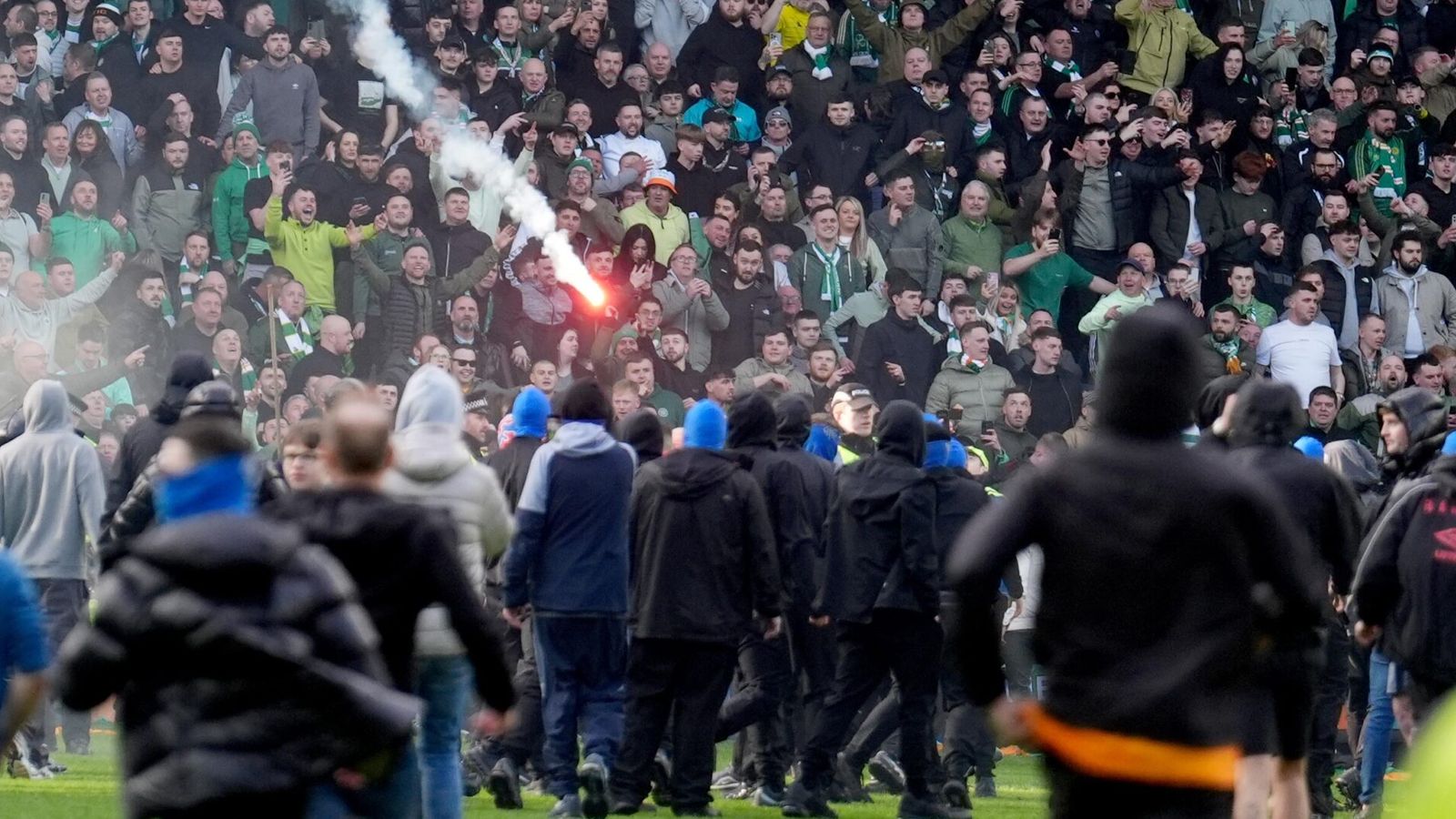
The first incident occurred at the away turnstiles, where overcrowding created a severe crushing hazard. The second was a potential confrontation between masked factions of both supports. The separation barrier, designed to keep the fans apart, failed under pressure.
This led to a mass pitch invasion and the detonation of multiple pyrotechnics. The numbers from the day speak for themselves. Police made 37 arrests during and after the match.
Multiple stewards and officers suffered injuries. The report also notes the bizarre detail of Broxi Bear, the Rangers mascot, being warned for provoking Celtic fans. While that detail provides some dark humor, the reality of the situation was perilous.
The rise of the mask
Modern football policing has struggled to adapt to the evolution of ultra culture. The Blackbourne report devotes significant space to the Union Bears and the Green Brigade. These groups have moved away from traditional flag-waving into organized, masked actions.
The report explicitly criticizes the placement of these groups in the lower stands. This placement gives them direct, unimpeded access to the pitch when tensions boil over. The security planning did not account for this tactical shift.
Police Scotland's decision to deploy fewer officers inside the stadium was a major tactical error. They relied on physical barriers that ended up isolating their own units. When the pitch invasion occurred, stewards were left exposed without adequate police support.
It was a failure of risk assessment from all involved parties. The SFA sat on this report for months before releasing it, showing a distinct lack of administrative urgency. The SFA's own security guidelines were exposed as outdated.
The tactical deflection from the boardrooms
In the aftermath of the report, both clubs immediately retreated to their traditional defensive shapes. This is boardroom deflection at its finest. Rather than addressing the systemic failures highlighted by Blackbourne, the clubs chose to point fingers.
The blame-shifting is as predictable as a back-pass under pressure. Celtic's interim chairman, Brian Wilson, led the charge. He released a statement arguing that the Celtic pitch invasion was non-violent.
He claimed only a small number of away fans entered the pitch. Wilson then shifted the spotlight to the home support, noting the presence of masked fans carrying weapons. He also questioned the senior leadership of Police Scotland, suggesting their advice was flawed.
Wilson's defensive screen
By framing the Celtic fans' actions as non-violent, Wilson is attempting to mitigate the disciplinary damage. This is a classic legal defense mechanism, but it ignores the physical reality of the day. A pitch invasion, regardless of intent, is a breach of security rules.
It forces the stadium operators to lose control of the playing surface. Wilson's attempt to draw a distinction between violent and non-violent incursions will likely fail at the hearing. His criticism of Police Scotland feels like a tactical deflection.
The police are an easy target when operations go wrong. While the senior officers made errors, the clubs themselves are responsible for safety inside the turnstiles. Wilson's statement serves to protect Celtic's position ahead of the August 13 tribunal.
The battle over the away allocations
Rangers took a similarly combative stance. The Ibrox club reportedly disputed several findings in the review. They claimed their operational plan was severely tested but did not accept full culpability.
While they agreed to implement safety recommendations, their statement carried a tone of aggrieved defense. Neither club seems willing to admit that their own fan groups have become unmanageable. The recommendations will be a key battleground.
The recommendation to install safety netting in front of the ultra groups will be fought fiercely. Netting is common in continental Europe but is resisted in Scotland. The clubs fear it will hurt ticket sales and broadcast aesthetics.
But the alternative is continued disorder and the threat of stadium closures. The boardroom resistance to this recommendation shows where their priorities lie. The business of football continues to override public safety concerns.
An administrative failure by the SFA
The SFA is not blameless in this debacle. The governing body took over four months to publish the Blackbourne report. The match occurred on March 8, yet the report was only released on July 21. This administrative delay allowed the tension to fester.
It also gave the clubs ample time to coordinate their legal defenses. The SFA's disciplinary record on fan behavior is notoriously weak. Historically, they have preferred quiet agreements over public sanctions.
By charging both clubs under Rule 37, the SFA is attempting to project strength. But the late publication suggests a reluctance to confront the Glasgow duopoly. The timing of the hearing, just as the new season begins, guarantees maximum distraction.
The policing strategy also requires scrutiny. Police Scotland deployed fewer officers inside the stadium than in previous high-risk derbies. They relied heavily on external barriers that actually delayed emergency response times.
The report details how officers were trapped behind their own barricades while fans clashed on the track. It was a failure of modern crowd management. The tactical deployment was flawed from the first whistle.
The prediction for the August 13 verdict
So, what happens when these two forces clash at Hampden? The clubs will arrive with expensive legal teams ready to dissect every line of the Blackbourne report. Celtic will argue that they were visitors and could not control Ibrox's stadium architecture.
Rangers will counter that Celtic's fans initiated the pitch invasion. The SFA will sit in the middle, trying to maintain order. The panel will likely try to split the difference.
A full stadium closure is highly unlikely due to commercial pressures. The SFA relies on the Old Firm's television revenue too much to lock out fans completely. However, the severity of the near-miss incidents means that simple fines will not suffice.
The tribunal must make an example of both clubs to salvage its credibility. Expect a compromised ruling that satisfies no one. The SFA will issue substantial six-figure fines to both clubs.
They will also order partial stadium closures, targeting the areas housing the Union Bears and the Green Brigade. The away ticket allocations for the upcoming season will be slashed once again. The progress made in opening up the derby to away fans has been destroyed in a single afternoon.
Ultimately, this hearing will not solve the underlying issues. Until Celtic and Rangers take real responsibility for their ultras, the risk remains. The next derby on September 20 at Celtic Park will be played under a cloud of administrative tension.
The boardroom war of words has set the tone for the entire season. The real battle has just begun. The regulators have the ball, but they will likely kick it into the long grass.
Read Next
- Ipswich Town are betting their Premier League survival on Celtic's wings
- Hearts are betting the house on Europe this season
- Ipswich are gambling on Daizen Maeda to survive the Premier League
- Arsenal and United are managing their summer crises in opposite ways
- ⚽ Scottish Premiership 2025-26 — Celtic vs Rangers Hub