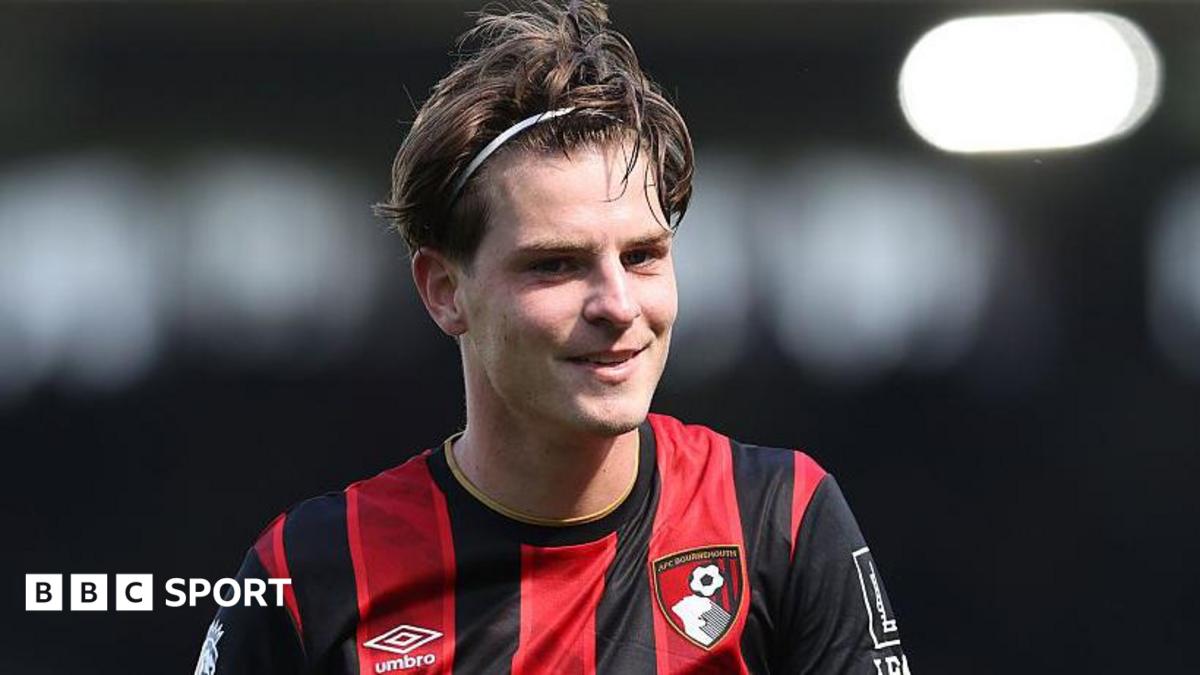
Alex Scott completed only 2.94 progressive passes per 90 minutes in the 2025/26 Premier League season. For a player billed as the future of England's midfield, that is a jarringly low figure, ranking in the bottom 30% of central midfielders in Europe’s top five leagues. Yet, as BBC Sport reported on June 29, 2026, Arsenal have made a formal enquiry to Bournemouth for the 22-year-old.
Bournemouth rejected the approach immediately, declaring the player not for sale. But Arsenal's interest is a calculated move to address the final structural weakness in Mikel Arteta's midfield. Scott is a carrier-creator, an archetype Arteta needs to evolve his side.
To understand why the newly crowned Premier League champions are chasing a midfielder with such modest passing numbers, we have to look past the surface. Scott is not a traditional playmaker. He is a modern transition engine.
The Illusion of the Passing Playmaker
Modern analysis overvalues high-volume passing. We look at midfielders through possession retention, demanding completion rates in the high eighties. Under this framework, Scott's statistical profile looks ordinary. He played 2,849 minutes across 37 matches in the 2025/26 campaign, but his pass completion rate sat at a modest 79.4%.
Scott does not play the safe, sideways passes that inflate stats. His first instinct is vertical, attempting high-risk passes into the final third. This explains why he is in the 29th percentile for progressive passes completed, but it makes him highly disruptive.
Instead of passing through lines, Scott runs through them. He averages 2.45 progressive carries per 90 minutes, putting him in the 71st percentile of central midfielders. This carrying ability shifts opposition defensive structures, forcing defenders to break rank.
Carrying Under Pressure
Scott's carrying is even more impressive under pressure. In the 2025/26 season, he was fouled 2.41 times per 90 minutes, placing him in the top 10% of midfielders. By drawing fouls, Scott relieves pressure and wins set-pieces in the middle third.
He drives diagonally toward the half-spaces. In Bournemouth's 2-1 win over Chelsea in February, Scott completed four carries over 15 yards, with three leading to shot involvements. His close control makes him nearly impossible to dispossess cleanly.
However, this style has a dark side. Scott can be caught in possession in dangerous areas when he over-dribbles. In Bournemouth's 3-1 defeat to Manchester City in April, he was dispossessed in his own half three times in the opening 30 minutes, leading directly to a goal.
The Iraola Blueprint and Marco Rose's Inheritance
Bournemouth's tactical setup under Andoni Iraola was built on transition speed. Their 6th-place finish in the 2025/26 season, securing European qualification, was a product of this vertical philosophy. Scott was the hub of that transition engine, acting as the bridge from the defensive block.
Iraola demanded that his midfielders verticalize play immediately. Scott's low completion rate is a consequence of this system. He was instructed to take risks and carry the ball forward even when surrounded.
Incoming head coach Marco Rose inherits a squad tailored for rapid transitions. Rose's tactical history at RB Leipzig suggests he will double down on this vertical style. Selling Scott now would leave a massive void before their Europa League campaign begins.
The Defensive Deficit
While Scott's offensive progression is clear, his defensive output is a major concern. He is not a natural ball-winner, and his positioning in transition can be erratic. In the 2025/26 season, he averaged just 1.25 tackles and 0.81 interceptions per 90 minutes.
During the 2-2 draw against Aston Villa in March, Scott was repeatedly bypassed. In the 43rd minute, he failed to track Morgan Rogers, leaving the center-backs exposed to a counter-attack that resulted in a goal. He tends to watch the ball rather than tracking runners from deep.
Furthermore, his aerial duel success rate is a dismal 34.2%. This weakness makes him a target for teams that play direct football. If Scott is to play for a team with title ambitions, his defensive work rate must improve.
Why Mikel Arteta Needs a Ball Carrier
Arsenal's title-winning campaign was built on structured possession. But Arteta knows his midfield can become predictable against low blocks. With Thomas Partey having departed, Arsenal's midfield has lost verticality. The signings of Martin Zubimendi and Christian Norgaard have provided stability, but not dynamism.
Zubimendi completed 6.1 progressive passes per 90 with a 88.5% passing accuracy. He recycles possession beautifully but does not carry the ball. Declan Rice is an athletic monster, but his carries tend to be in wide areas rather than through congested central zones.
This lack of central carrying was painfully evident in Arsenal's late-season matches. In their 1-0 defeat to Newcastle in March, Arsenal controlled 68% of the possession but completed zero progressive carries into the box. They passed the ball in a U-shape, lacking the individual brilliance to commit defenders by dribbling.
The Statistical Comparison
Compare Scott's carrying numbers with Arsenal's midfield options. Here is how they stack up in central ball progression metrics per 90 minutes:
- Alex Scott: 2.45 progressive carries, 2.41 fouls drawn, 1.82 successful take-ons
- Martin Zubimendi: 0.92 progressive carries, 0.74 fouls drawn, 0.45 successful take-ons
- Declan Rice: 1.65 progressive carries, 0.88 fouls drawn, 0.82 successful take-ons
- Martin Ødegaard: 1.98 progressive carries, 1.12 fouls drawn, 1.24 successful take-ons
Scott offers a completely different dimension. He is far more aggressive in his dribbling than any midfielder currently in Arsenal's squad. He gives Arteta the ability to transition from a passing game to a direct attack when defenses refuse to open up.
His versatility is also a major draw. He can play as a number eight on either side of the midfield, or even as a number ten. This flexibility allows him to rotate with Ødegaard or play alongside Rice in a dynamic pairing.
The Valuation Wall
Bournemouth's stance that Scott is not for sale is a smart opening gambit. They bought him from Bristol City for £25 million in 2023, and his contract runs until June 2028. Bournemouth hold all the cards in any negotiation.
Reports suggest it would take an offer in the region of £60 million to get Bournemouth to the table. For Arsenal, that is a massive fee for a player who would not be a guaranteed starter. But in the modern market, press-resistant English midfielders under 23 carry a massive premium.
Whether Arsenal will match that valuation is the question. The enquiry itself proves Arteta is looking to evolve his midfield away from pure possession. If Bournemouth hold onto him for one more season, Scott's value could rise even higher on the European stage.
Read Next
- Mikel Arteta is running a ruthless backroom purge and he is 100 percent right
- Arteta is ready to blow the bank to rebuild Arsenal's attack
- Enzo Maresca’s Manchester City will fall short of Arsenal again
- Why Morocco's Dutch-born stars are about to haunt their creators
- ⭐ UCL 2026 — Champions League Quarter-Finals Hub