The 7.7 Percent Anomaly That Fractured an Empire
Between October and December 2024, Pep Guardiola experienced a statistical crisis that defied his decade of dominance at Manchester City. Across a staggering 13-game sequence in all competitions, City managed 1 win in 13 matches while falling to nine separate defeats. That converted to a 7.7% win rate, a staggering drop for a manager whose baseline win rate at the Etihad Stadium routinely exceeded 70%.
The numbers shattered the structural baseline of a coach who won 20 trophies over his 10-year reign in Manchester. City did not merely drop points; they surrendered control over central zones they had dominated for years. During that six-week slump, City conceded an average of 2.15 goals per game, nearly triple their average of 0.78 from the previous campaign.
The absolute low point of that autumn run came in the Champions League against Feyenoord. City held a commanding 3-0 lead with 14 minutes remaining before suffering a total system breakdown. Conceding three goals between the 76th and 90th minutes to draw 3-3 marked the first time a Guardiola side surrendered a three-goal advantage in European competition.
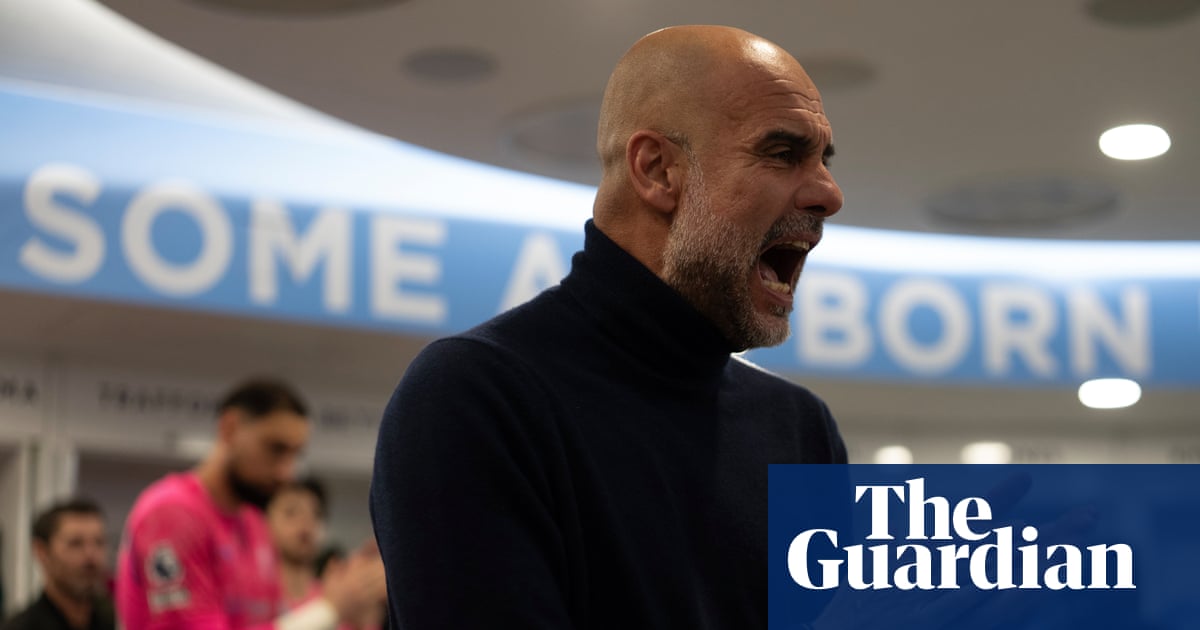
Touchline cameras captured Guardiola scratching his face in visible distress during the Feyenoord collapse. As The Guardian reported, the friction inside the club escalated rapidly behind closed doors. Amazon Prime's four-part documentary A Beautiful Obsession reveals that the tactical decay on the pitch triggered severe dressing room turbulence.
High Lines, Rest-Defense, and the Kyle Walker Fallout
Guardiola's tactical engine relies on aggressive rest-defense positioning to smother opposition counterattacks before they start. When defensive transitions stall, the high line becomes an immediate liability. Opponents exploited City's midfield recovery gaps repeatedly, forcing aging defenders into wide-open footraces.
Following a painful defeat at Liverpool, Guardiola targeted club captain Kyle Walker during team video analysis. Walker had been voted skipper by his team-mates prior to the season, but Guardiola repeatedly highlighted his individual positioning in front of the entire squad. Walker snapped during a post-match meeting, believing he was being scapegoated for broader structural failures.
"You keep saying my name in every meeting. Every fucking meeting it’s my name. You’ve somehow brought my name into it."
Walker accused Guardiola of regretting his captaincy appointment. Guardiola countered that Walker was taking tactical criticism too personally, but the interaction exposed deep cracks in squad harmony. The captain felt singled out while the manager demanded total tactical compliance during their worst run of form.
Contract Extensions Signed in the Crisis
Rather than retreating, Guardiola responded with an emotional declaration to his players. He insisted his loyalty to the dressing room remained absolute despite their record slump.
"If I am a problem you have to tell me. I won’t stay here for the money or just for the fact of staying. I extended my contract because I want to be with you. I want to fight. I don’t want you to feel like I’m leaving or running away."
The timing of that contract extension represents a counterintuitive anomaly in elite football management. Top managers typically execute extensions from positions of maximum strength and silverware momentum. Guardiola signed his extension in the middle of a nine-loss collapse, seeking to anchor a slipping dressing room.
The 10-Change Fallacy Against Bayer Leverkusen
If autumn 2024 exposed structural decay, November 2025 revealed desperate squad management. Facing Bayer Leverkusen in a critical Champions League fixture, Guardiola opted to make 10 changes to his starting lineup. The extreme selection gamble backfired completely in a listless 2-0 defeat.
Rotating ten outfield and goalkeeper positions killed City's spatial familiarity. The side generated zero big chances, completed just 81% of their passes in the final third, and allowed Leverkusen to control transition tempos. It stood out as the most disjointed offensive performance of Guardiola's final two seasons.
Critical analysis reveals a key management flaw in Guardiola's approach that night. By making ten changes, he stripped the team of positional memory, then blamed player passion for the resulting failure. The defeat was primarily a structural failure of radical rotation rather than a lack of player commitment.
Guardiola lashed out in the dressing room after the whistle, threatening to quit on the spot.
"It’s unacceptable this lack of courage, passion and love and desire to win and do it better. I work for you. I leave my life, my divorce and my family is away, and everything for all of you. And what do you give back? The fucking performance you have done. It’s a disgrace guys. I’m really fucking tired. When I see that I’m exhausted, I’m drained. I want to quit."
Boardroom Panic and the 100 Resignation Threats
City chairman Khaldoon Al Mubarak later revealed Guardiola had threatened to walk away "100 times" across his ten years at the club. But the Leverkusen fallout caused genuine alarm in the boardroom. High-level executives recognized that emotional exhaustion was eroding match preparation.
Documentary audio revealed private voice notes exchanged between Al Mubarak and chief executive Ferran Soriano. Al Mubarak admitted he was "so angry" after what he called "probably one of the lowest points we've had." Soriano advised that the club's response should be calibrated carefully, warning that the hierarchy must not act too aggressively nor appear overly accommodating.
Contract Rejections and Squad Transition Metrics
The tension was not confined to results; it extended to roster management. Veteran midfielder Kevin De Bruyne expressed open disappointment after being informed his contract would not be renewed at the end of the season. Managing the departure of legendary figures while trying to stabilize results added immense friction to Guardiola's final year.
City's late-era decline followed distinct statistical markers across their final two campaigns under Guardiola:
- Win rate plummeted from 74.3% during the 2022-23 treble season down to 53.8% during the 2024 autumn slump.
- Conceded goals from fast breaks increased by 140% during the 13-game autumn drop-off.
- Guardiola used 28 different starter combinations across 35 matches in late 2025, reflecting persistent tactical search.
The numbers paint a clear picture of an elite system reaching its natural operational limit. When pressing triggers lose a fraction of a second, the whole defensive setup falls apart. Guardiola's obsession with perfection eventually ran up against squad fatigue and tactical inertia.
The Statistical Legacy of a 10-Year Spell
Guardiola leaves Manchester City having won 20 trophies across a transformative decade. His overall tenure remains one of the most dominant managerial runs in modern football history. Yet the final two seasons demonstrated that even the most refined tactical machinery is subject to decay.
The 9 defeats in 13 games during autumn 2024 and the 2-0 Leverkusen collapse in late 2025 serve as clear historical markers. They illustrate how quickly elite performance margins erode when internal conflict and physical fatigue align. Pep Guardiola built a machine that won everything, but the data shows how hard it was to keep it running at the end.