Disaster Strikes at Ibrox as Chermiti Suffers Knee Trauma
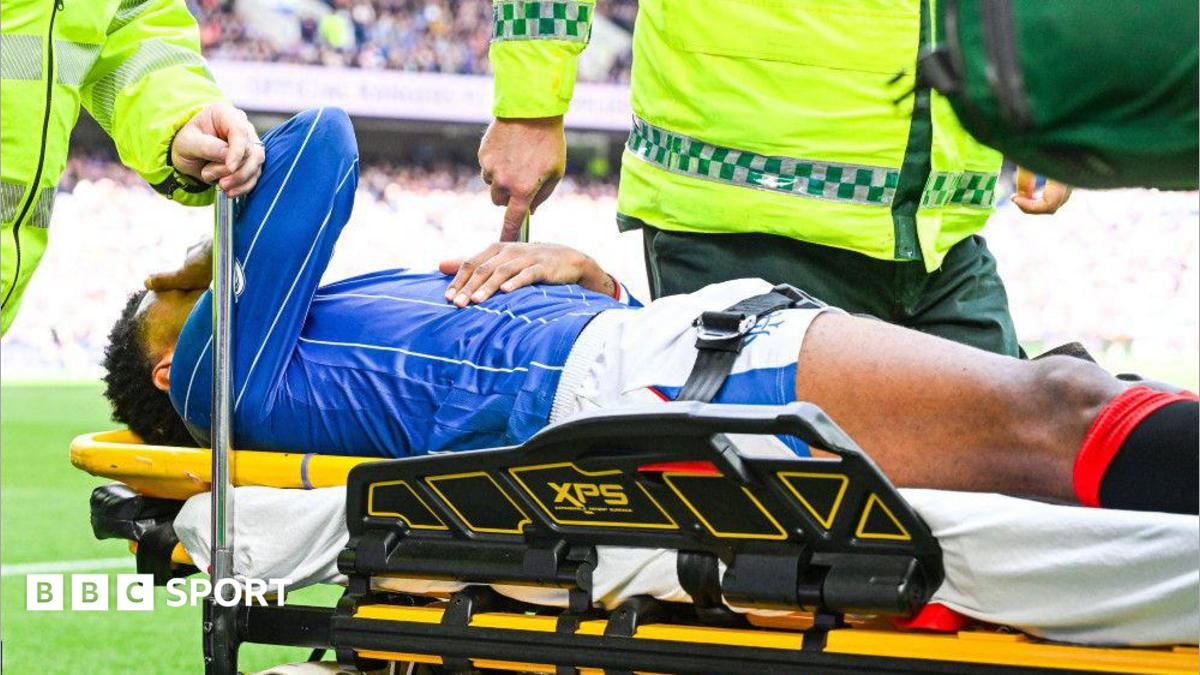
Rangers front-man Youssef Chermiti has suffered anterior cruciate ligament damage that will sideline the Portuguese striker for a massive portion of the 2026-27 campaign. The 22-year-old was stretchered off during Sunday's 2-1 home defeat to Hibernian after a jarring challenge drove him into the pitchside advertising hoardings before half-time.
The timing is brutal for Ibrox brass. Just hours before kickoff on Sunday, manager Derek McInnes confirmed the club had turned down a formal transfer approach from Turkish champions Galatasaray. Now Rangers face losing their star striker for the long haul without receiving a penny in transfer revenue.
According to BBC Sport reporting, Rangers confirmed via social media that Chermiti will be out of action for a significant period of time following diagnostic MRI scans on Monday morning.
Medical Analysis: Anatomy, Mechanism, and Recovery Timeline
An anterior cruciate ligament tear represents one of the most severe traumatic joint injuries in professional sports. The ACL functions as the primary static stabilizer of the knee, controlling rotational stability and preventing the tibia from sliding forward beneath the femur.
Chermiti's injury occurred through a combination of sudden deceleration, high rotational torque, and secondary impact against static stadium barriers. When a player suffers direct lateral contact while planted, the knee joint collapses inward into valgus alignment, tearing the internal ligament fibers.
Modern surgical reconstruction requires replacing the ruptured ligament with an autograft tissue—typically harvested from the patellar tendon, hamstrings, or quadriceps. Following surgery, biological revascularization and graft maturation dictate the physical recovery timeline regardless of an athlete's baseline conditioning.
Rehabilitation unfolds in strict phases, starting with swelling management and quadriceps reactivation before advancing to straight-line running at four months. Multi-directional cutting and sport-specific drills follow between months six and eight, preceding stringent force-plate testing.
Top-flight footballers require an average of 9 to 12 months of postoperative rehabilitation before returning to full-contact match play. Accelerating this timetable risks secondary re-rupture or chronic graft laxity.
For Chermiti, that puts his targeted return window somewhere around late spring or early summer 2027. Rangers must prepare for the forward to miss upwards of 45 matches across domestic and European competitions.
The Galatasaray Transfer Gamble Backfires
The injury transforms a tense transfer saga into a full-blown crisis for the Ibrox board. Chermiti moved to Glasgow from Everton in September 2025 for a marquee fee, becoming the club's most expensive purchase since Tore Andre Flo joined in 2000.
The Portugal U21 international quickly established himself as the focal point of the Rangers attack. He racked up 15 goals in 43 appearances, including 30 starts, providing physical hold-up play and reliable box finishing.
Galatasaray targeted Chermiti to reinforce their front line, submitting a bid that tested Rangers' resolve. Speaking to BBC Scotland prior to Sunday's kickoff, Derek McInnes made it clear the club intended to hold their ground.
"I'm led to believe the club's valuation of the player hasn't been met. It's no surprise that he's a player who's got a big tag on him and he's got high potential, but thankfully he's our player and that will continue to be the case."
Rangers took a calculated financial gamble by keeping their chief goal threat to pursue silverware and group stage qualification. Losing him to a freak physical breakdown within 45 minutes of knocking back a lucrative offer represents a crushing sporting blow.
Perimeter Safety Hoardings Under Scrutiny
Beyond the immediate squad headache, Chermiti's stretchered exit reopens an uncomfortable discussion regarding perimeter safety in modern football stadiums. The collision occurred when physical momentum pushed Chermiti beyond the touchline into rigid electronic advertising boards positioned close to the grass.
While jarring tackles cause joint trauma on their own, hard secondary collisions with unpadded stadium hoardings amplify injury severity. Players sprinting at top velocity need adequate run-off space to decelerate safely without crashing into metal casings or static display walls.
Rangers fans and neutral analysts have questioned whether tight pitch boundaries at historic grounds like Ibrox contribute to preventable impact injuries. When high-value athletic assets get slammed into commercial boards, clubs pay a heavy sporting price for sponsor proximity.
Historical Context: The Pressure of Heavy Expectations
Carrying a record price tag at Ibrox brings relentless scrutiny, a lesson learned two decades ago during the Tore Andre Flo era. Chermiti arrived from Everton burdened with similar expectations, yet showed rapid development under McInnes to become an indispensable piece of the tactical setup.
Heavy minute distribution may have also played a subtle factor. Competing across domestic league fixtures, cup ties, and international youth call-ups creates accumulated neuromuscular fatigue. Fatigued muscles fail to stabilize joints during awkward landings, exposing ligaments to catastrophic tears.
Losing a primary goalscorer early in August leaves a team scrambling. Historical data across European leagues shows teams that lose a 15-goal striker in opening matchweeks suffer a noticeable drop in conversion efficiency over the subsequent ten fixtures.
Strategic Implications for the Transfer Window
The loss leaves McInnes facing an urgent tactical reshuffle ahead of a demanding autumn schedule. Sunday's 2-1 defeat against Hibernian exposed existing defensive vulnerabilities, and now the attacking unit lacks its focal centerpiece.
Only one day prior to the match, the Rangers chairman publicly announced that the club expects up to five more signings before the summer window closes. That recruitment plan now requires complete restructuring.
Instead of supplementing Chermiti with wide support and midfield depth, Rangers must dedicate major funds to sourcing a starting-caliber center forward before deadline day. Opposing clubs know Ibrox executives are desperate, which will inflate asking prices across the market.
McInnes outlined his recruitment ambition shortly before Sunday's disaster unfolded, insisting the club was focused on building momentum rather than selling key pieces.
"We're trying to build a team here at the minute and we're trying to still bring additions to the team that helps us add to the good players that we've got, including Youssef. So it's not something we would encourage at any point."
With Chermiti bound for the operating theater, McInnes must rebuild his attacking philosophy on the fly. The Scottish Premiership title race waits for no one, and Rangers have burned their safety margin before mid-August.
Read Next
- Top 10: Top Moments
- Rangers are spinning into an early season crisis under Derek McInnes
- Rangers are fumbling the bag on the Driouech pursuit
- Arsenal's transfer window is turning into a chaotic game of dominoes
- 🔥 Turkish Süper Lig 2025-26 — Istanbul Derby Hub
- ⚽ Scottish Premiership 2025-26 — Celtic vs Rangers Hub
- 🇹🇷 Turkey at the 2026 World Cup — Full Coverage Hub