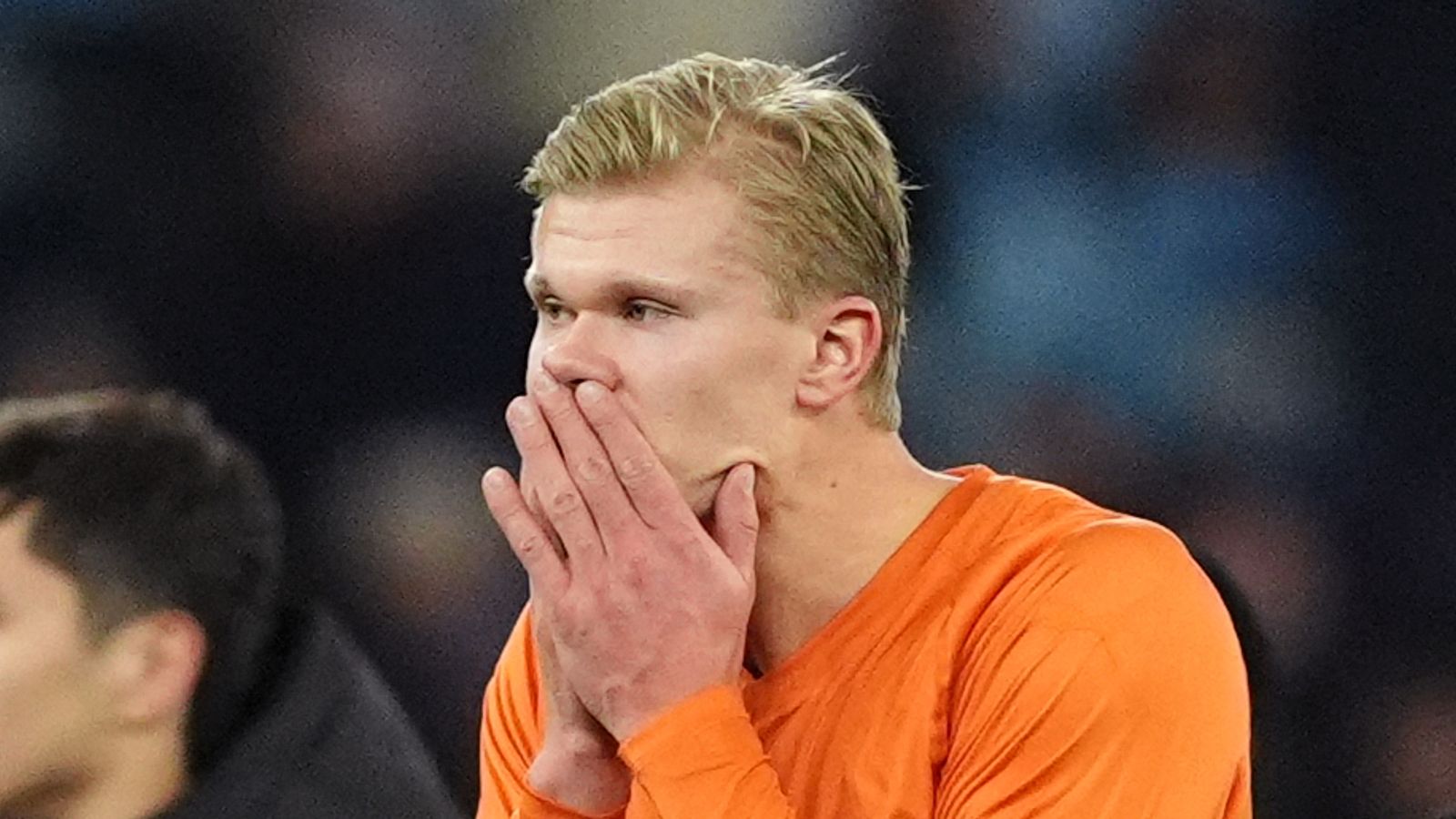
The captain's armband looked unusually heavy on Erling Haaland's left bicep on Tuesday night. Moments after Manchester City stumbled to a 2-2 draw against Napoli at the Etihad, he stood before the television cameras looking hollowed out. There was no theatrical rage or chest-thumping defiance, just a towering striker wearing an unmistakable scowl.
"When you win games everything is easy and you know exactly what to do," Haaland told TNT Sports. "When you don't win you start to question everything."
Hearing those words from football's ultimate finishing machine felt disorienting. Elite goalscorers rarely introspect in public, preferring to rely on instinct and certainty. When a striker of this caliber begins to openly doubt what is happening around him, the alarms across English football ought to ring loud.
This was supposed to be the season City consolidated authority under Enzo Maresca. Instead, late November arrives with the club mired in an unraveling that nobody inside the Etihad seems capable of arresting.
Goals at the Summit, Chaos Beneath
On paper, Haaland remains the standard by which every Premier League forward is judged. He still sits atop the scoring charts and leads the domestic power rankings for 2026/27. Even in a disjointed campaign, his name lingers above surprise contenders and marquee names alike.
As The Guardian noted this week, Everton striker Thierno Barry has mounted a sudden challenge under David Moyes, trailing just behind Haaland and Newcastle's £125m marksman Alexander Isak. It is a strange sight, seeing an unexpected breakout breathing down the Norwegian's neck. Yet nobody doubts Haaland's individual ability to put the ball into the net when an opening appears.
The disconnect is that his goals no longer carry the weight of inevitability. In past years, a Haaland brace meant points banked and opponents broken; today, City can score twice and still walk away feeling entirely defeated.
The dynamic recalls the classic dilemma of the stranded goalscorer whose output cannot compensate for structural decay. Ruud van Nistelrooy once endured a similar fate at Old Trafford, scoring relentlessly while the team around him struggled through midfield transitions. Haaland now finds himself in that exact predicament, producing elite numbers that cannot paper over the cracks.
The Tactical Fracture Under Maresca
Enzo Maresca is learning the unforgiving speed of life at Manchester City. The aura of invincibility that once terrified visiting clubs under Pep Guardiola has vanished. Opponents no longer travel to Manchester hoping merely to keep the scoreline respectable; they arrive expecting to take the ball and dictate terms.
Fulham did it over the weekend, dominating possession in stretches that used to be impossible for visitors at the Etihad. Napoli repeated the trick on Tuesday, pressing boldly and slicing through the home side's defensive transitions with ruthless clarity.
The numbers are damning. City have won just one of their last seven matches across all competitions, surrendering 20 goals during a grim streak of 10 games without a single clean sheet. In the Premier League, they have collected a lone point from their past four outings.
Maresca has shuffled eight different back-four combinations across those ten fixtures, chasing stability that refuses to materialize. Resting Ruben Dias against Napoli meant pairing Marc Guehi with Josko Gvardiol for the very first time. The result was predictable disarray, highlighted when Rasmus Hojlund harassed Guehi and Gianluigi Donnarumma into a costly defensive collapse.
Later, Leonardo Spinazzola's cross found Noa Lang unmarked on the counter-attack, prompting Maresca to spin on his heels and stare helplessly at the sky. Loading the midfield has done nothing to halt the bleed on fast breaks.
New arrivals Elliot Anderson and Enzo Fernandez are still searching for defined roles within Maresca's tactical setup. Supporters shouted from behind the press box for quicker passing and more pressing, venting their frustration at a ponderous display. Only a lively cameo from Jeremy Doku and a late rescue strike by Rayan Cherki spared City an outright defeat against Napoli.
Maresca pleaded for patience after the final whistle, pointing out that he is only months into his tenure rather than years. "We are conceding too many goals. It's quite clear," the manager admitted. "It's something we need to adjust."
The Limits of an Isolated Apex Predator
It would be dishonest to exempt Haaland from criticism during this slide. Against Napoli, he was largely anonymous, floating on the margins of play while the contest raged around him. His physical frame gives him enormous presence, but when service dries up, he can look completely stranded.
There is also a glaring issue in how City press from the front. When Haaland chooses to close down opposing defenders, his teammates rarely step up with him, leaving him chasing shadows in empty space.
Opposing defenders have noticed the disconnect and are adapting accordingly. Earlier this season, David Affengruber put on a defensive clinic against Haaland, demonstrating how tight man-to-man marking can neutralize his explosive runs before they develop. If an opponent cuts off his passing lanes and matches his physicality, he struggles to influence matches as a link-up forward.
Haaland has never claimed to be a roving playmaker who drops deep to orchestrate attacks. He is a specialist finisher whose brilliance relies on precision, timing, and relentless service into the penalty area. Strip away the rhythm of the midfield behind him, and his impact diminishes rapidly.
Gloom, Disallowed Goals, and Spanish Whispers
Frustration has visibly begun to poison his demeanor on the pitch. Against Fulham on Saturday, Rodrigo Muniz shocked the Etihad by handing the visitors an early advantage. Haaland appeared to answer within eight minutes, latching onto a bending delivery from Iliman Ndiaye to bundle the ball into the net.
Then came the whistle that drained the stadium. As detailed by the Daily Mail, officials ruled out the equalizer after deciding Fulham goalkeeper Bernd Leno had both hands on the ball. Maresca was seething on the touchline, and Haaland was left throwing his hands up in sheer disbelief.
The league's match centre offered an explanation that shed little light on the call, leaving supporters and pundits perplexed. Former referee Dermot Gallagher even had to dissect the controversy on television alongside other weekend refereeing incidents. For Haaland, it was simply another afternoon where an equalizer evaporated into bureaucratic confusion.
The toll is becoming obvious away from match action as well. Writing for the Daily Mail, Jack Gaughan observed that Haaland has appeared despondent and morose in front of the cameras, radiating an air of gloom. The joyful swagger of his first seasons in Manchester has been replaced by the weary expression of an overburdened captain.
Naturally, the European transfer rumor mill has kicked into gear. Reports suggest that regular talks are already taking place regarding a potential exit in 2027, with Real Madrid and Barcelona keeping close tabs on the situation. When a superstar striker admits publicly that a dressing room is questioning everything, continental giants inevitably start circling.
The Looming Trip to the Emirates
There is no respite on City's calendar to digest these frustrations. On Sunday, Maresca's stumbling squad travels to the capital to face Premier League champions Arsenal. For a team that recently dropped points to Aston Villa and Brighton, the trip represents the sternest test possible.
Haaland did not attempt to downplay the gravity of the fixture when speaking to Sky Sports. His assessment captured the uneasy mood hanging over the squad.
"We go to the champions next. The most difficult game of the season. We need a top, top performance."
"We tried to push but we couldn't. It's not good enough," Haaland added during his post-match debrief. "We let them in too easily and were unable to control or attack the game as we want."
City enter the weekend sitting sixth in the Champions League table and losing ground domestically. Maresca speaks about patience and the need to adjust, but elite football rarely waits for struggling managers. If Arsenal expose the same defensive fractures that Napoli and Fulham exploited, the murmurs around the club will turn deafening.
Haaland's finishing quality has never been in doubt. What is in doubt is whether this current Manchester City setup can provide him the platform his talent requires.
For years, he looked like a cheat code dropped into a flawless footballing machine. Now the machine is clattering, its gears are grinding, and its primary weapon is looking around wondering where the passes have gone. Sunday in North London will reveal whether the captain can drag his team out of the gloom, or whether the doubts will consume them entirely.
Read Next
- Arsenal are about to tear Manchester City apart on Sunday
- Manchester City are leaking goals and Arsenal cannot finish their chances
- Arsenal and Man City fans are losing their minds right on schedule
- Napoli face Etihad defensive crisis as Man City clear Matheus Nunes
- 🇳🇴 Norway World Cup 2026 — Can Haaland Lead the Vikings?
- ⭐ UCL 2026 — Champions League Quarter-Finals Hub