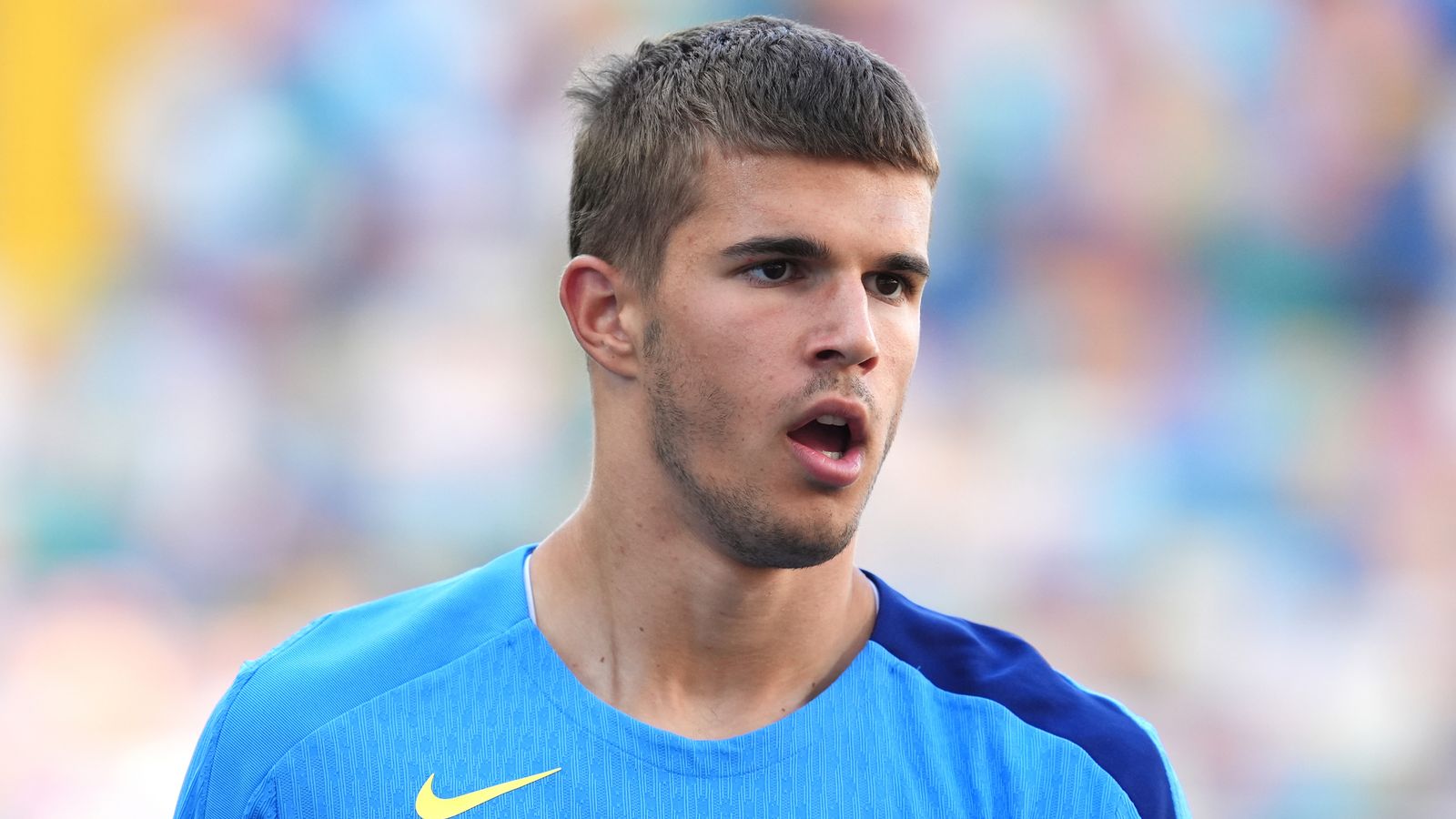
A £50 Million Asset That Never Touched the Pitch
A 426% return on a player who has never kicked a ball in a competitive match for your club is the type of accounting that makes sporting directors sleep well at night. When Brighton & Hove Albion agreed to a £50 million package to sign Luka Vuskovic from Tottenham Hotspur, they did more than just break their own transfer record. They completed a bizarre, high-stakes trade that saw Spurs buy Brighton's standout defender, Jan Paul van Hecke, for £52 million just weeks prior, only for the Seagulls to reinvest that capital back into Tottenham's fifth-choice centre-back.
The fee for the 19-year-old Croatian international is structured as a £46 million guaranteed flat sum with an additional £4 million in achievable add-ons. This eclipses the £40 million Brighton paid Leeds United for Georginio Rutter back in August 2024. For Tottenham, it represents their fourth-most expensive sale in club history, slotting in behind Harry Kane, Gareth Bale, and Kyle Walker.
It is a staggering return on the £9.5 million Spurs paid Hajduk Split in 2023 when Vuskovic was a raw 16-year-old. Yet, the defender departs North London with zero competitive appearances, having only scored in a single pre-season friendly against Reading last summer.
The deal, as reported in the Sky Sports transfer update, represents a calculated gamble by Brighton on elite potential. Vuskovic refused to entertain another temporary loan after his successful stint in Germany last year, demanding permanent first-team football that Tottenham could not guarantee.
With Cristian Romero and Micky van de Ven established as the starting pair, and Spurs signing Marcos Senesi alongside Van Hecke last month, Vuskovic was facing a season as a fifth-choice spectator. Brighton offered a clean break and a guaranteed pathway to the starting eleven.
The Hamburg Crucible: Air Dominance and Rookie Campaigns
Vuskovic spent the 2025/26 campaign on loan at Hamburger SV, where his defensive metrics were among the most dominant in Europe for a teenager. Standing at 1.93 meters, the Croatian international played 28 Bundesliga matches and scored 6 goals.
His aerial dominance was showcased in a single match against Union Berlin last November. In that game, he won 18 individual aerial duels, setting a modern Bundesliga record for a defender in a single fixture.
According to tracking data from last season, Vuskovic won 74.2% of his total aerial battles. That ranked him in the 98th percentile of all centre-backs across Europe’s top five leagues, while Jan Paul van Hecke won just 61.8% of his aerial duels during his final season at the Amex.
Vuskovic's height and timing make him an immediate asset on defensive set-pieces, an area where Brighton conceded 12 goals last season. His offensive contribution is equally significant, with his 6 goals representing a massive upgrade over Van Hecke’s single goal in the same period.
Vuskovic’s performances earned him the Bundesliga Young Player of the Season award. He was also named the division's Rookie of the Month four separate times.
Yet, the jump from a mid-table Bundesliga side to a possession-dominant Premier League team is steep. Brighton’s system demands absolute security on the ball, and while Vuskovic has shown comfort in possession, his passing profile remains a work in progress compared to the man he is replacing.
Comparing the Profiles: Vuskovic vs. Van Hecke
The passing engine vs. the physical driver
To understand what Brighton are getting, one must compare Vuskovic directly to Van Hecke. Under Roberto De Zerbi and his successors, Brighton's build-up play has relied on centre-backs who can invite pressure and break lines.
Van Hecke was a master of this, averaging 91.2% pass completion and 5.6 progressive passes per 90 minutes. Vuskovic, by contrast, recorded a more modest 86.4% pass completion rate at Hamburg, averaging 4.8 progressive passes per 90.
He is less inclined to bait the press, preferring to move the ball quickly or carry it forward himself. This shift will alter how Brighton structure their build-up phase.
Progression through carries
Vuskovic averaged 1.6 progressive carries and 142 meters of carry distance per 90 minutes last season, compared to Van Hecke’s 0.9 progressive carries and 98 meters of carry distance. This contrast highlights a shift in Brighton’s tactical approach.
While Van Hecke used passing combinations to move the block, Vuskovic uses his physical stride to bypass the first line of pressure. When he drives forward, he forces opposing midfielders to step out, opening passing lanes into the half-spaces.
It is a higher-risk style that requires rapid defensive coverage behind him. If Brighton cannot cover these vertical runs, they will leave their defensive partners exposed.
Brighton’s recruitment team has clearly identified Vuskovic’s physical ceiling as worth the drop in passing precision. The club has been active in restructuring their squad, as documented on the Brighton transfer live blog.
The Croatian’s long-range passing accuracy of 68.4% is particularly valuable for launching quick transitions. If Brighton can refine his short-range distribution under pressure, they will have a complete modern defender.
The Risk: Aggression and Positional Gaps
The transitional toll
No 19-year-old defender is a finished product, and Vuskovic’s statistical profile reveals clear vulnerabilities. His front-footed aggression is his greatest strength, but it is also his most significant liability.
He averaged 2.1 tackles and 1.8 interceptions per 90 minutes last season, frequently stepping out of the defensive line to snuff out attacks. However, this tendency to commit forward leaves massive gaps in the space he vacates.
Hamburg conceded 14 goals from transition play last season when Vuskovic was dragged out of position. His tackle success rate against dribblers in open-field transitions was just 52.4%.
Fast Premier League attackers will exploit these defensive lapses. In Brighton’s high defensive line, any failed interception is immediately catastrophic, meaning he must learn when to drop and hold the line.
Disciplinary baggage
His discipline is another area requiring refinement. Vuskovic picked up 8 yellow cards and 1 red card in his 28 appearances last season, often the result of mistimed recovery challenges.
He also committed 1.6 fouls per 90 minutes, ranking him in the bottom 15% of Bundesliga defenders for foul frequency. In the Premier League, where referees are less lenient on physical recovery tackles, this lack of restraint could prove costly.
The Economics of Tottenham's Hedging Strategy
From Tottenham's perspective, this transaction represents a masterclass in risk management and capital accumulation. By flipping a £9.5 million youth signing for £50 million, Spurs have generated immediate profit to fund their own targets.
This is especially useful as they navigate their own squad rebuild, which is tracked on the Tottenham transfer live blog. Yet, Spurs also knew they could be selling a future world-class defender.
To protect themselves, Daniel Levy and the Tottenham board inserted a 20% sell-on clause into the agreement. More importantly, they secured matching rights for any future sale.
If Vuskovic develops into an elite centre-back at Brighton, Tottenham can match any accepted bid to bring him back to North London, minus their 20% cut. It is a double-sided hedge: they receive £50 million today, but retain control over his ultimate destination.
Vuskovic is currently away with the Croatia squad for the World Cup, preparing for a round of 32 match against Portugal on Friday morning. The details of the tournament bracket are available in the Sky Sports World Cup tournament guide.
Once his international duties are completed, he will travel to Brighton for his medical. If he can curb his raw aggression and adapt to the speed of the Premier League, Brighton’s record-breaking outlay will look like a bargain.
For Tottenham, they must hope their £52 million investment in Van Hecke proves to be the immediate upgrade they need. The alternative is that they just sold a generational talent to fund a short-term fix.