The Anatomy of the 500Hz Decision
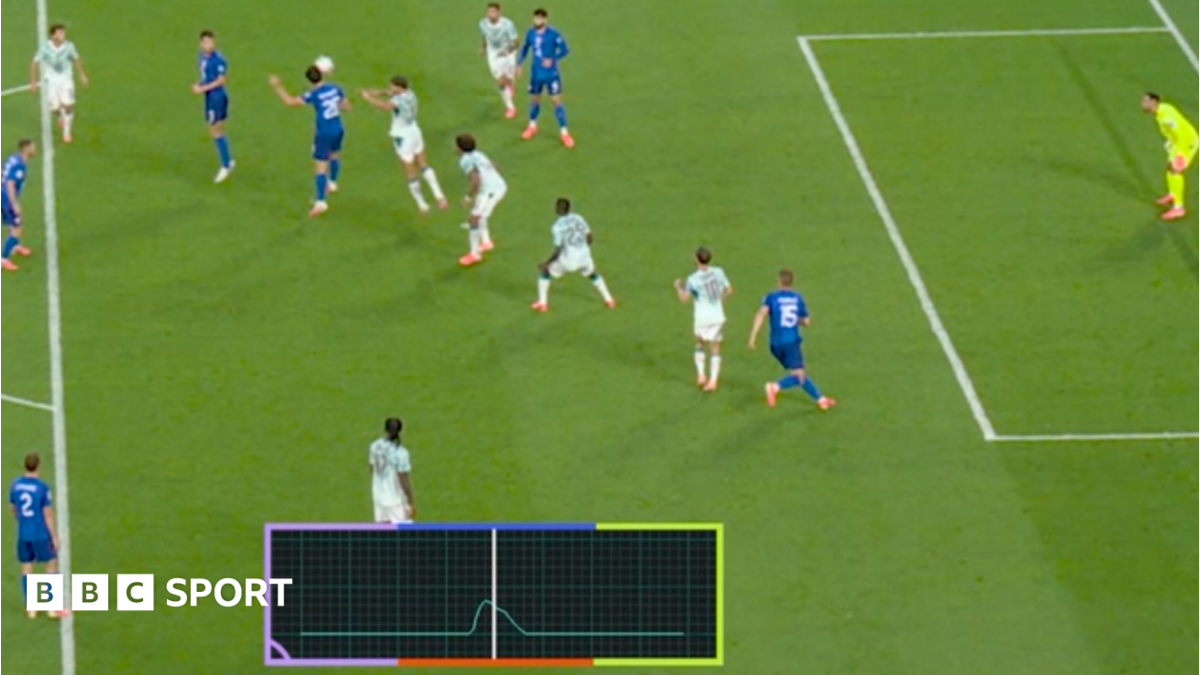
The technology that disallowed the goal relies on an inertial measurement unit sensor inside the Adidas match ball. Suspended by wires in the center of the bladder, the sensor transmits spatial data 500 times per second. This data is synchronized with optical tracking cameras to map every player's skeleton in real-time. When the ball was crossed into the Portuguese box, the VAR team did not just look at video frames. They analyzed the sound-wave diagram generated by the sensor's accelerometer. A sharp spike in the acoustic frequency confirmed the ball had brushed Perisic as it traveled past him. Under FIFA's current guidelines, the contact is considered a touch, freezing the offside frame at that exact millisecond. The automated system drew the line from Perisic's shoulder to the heel of Ruben Inacio. The resulting gap was microscopic, yet legally definitive. Croatia's players argued that the touch did not alter the ball's trajectory. From a physics perspective, they were correct; the deviation was less than half a degree. But the rules of offside are binary, leaving no room for common sense or physical impact.Croatia's Midfield Masterclass and Final Third Failure
Before the late VAR drama, Croatia put on a clinic in possession football. After conceding a 14th-minute goal to Bruno Fernandes, Zlatko Dalic’s side took complete control of the tempo. They ended the match with 64% of the possession, a staggering figure against a midfield featuring Vitinha and Joao Palhinha. Luka Modric was the author of this dominance. The Croatian captain registered 98 touches and completed 84 passes, constantly finding space in the half-channels. At 40 years old, he covered 11.8 kilometers, showing no signs of physical decline. Modric was ably supported by Mateo Kovacic, who completed 93% of his passes under pressure. Together, they bypassed Portugal's mid-block with simple triangular movements. The ball was moved side to side, exhausting Portugal's midfielders and forcing their wing-backs deep. Yet this midfield control did not translate into high-quality chances. Croatia attempted 18 shots during the match, but only four hit the target. Too many attacks ended in hopeful crosses from deep positions that Ruben Dias easily cleared. The expected goals metric reveals their inefficiency. While Croatia racked up an impressive 1.84 to 0.92 expected goals advantage, their average shot distance was 22 meters. They dominated the pitch but failed to penetrate the box when it mattered most.The Ronaldo Passenger Dilemma
While Modric ran the game, Cristiano Ronaldo was a spectator. The 41-year-old Portuguese striker completed only 12 passes in 90 minutes. He had just 22 touches of the ball, the lowest of any starting player on the pitch. Ronaldo's lack of defensive work rate created a massive problem for Roberto Martinez. He did not press the Croatian center-backs, allowing Josko Gvardiol to carry the ball into the midfield unchallenged. This forced Portugal to drop their defensive line deeper and deeper. In the second half, Portugal's average defensive line sat just 32 meters from their own goal. They became a team of defenders, unable to transition into attack. When Portugal won the ball, Ronaldo was too isolated to receive it, leading to immediate turnovers. This passive strategy is a dangerous gamble for Martinez. While they survived this match, Portugal cannot expect to win the tournament with such a static frontline. They look like a team playing with ten men whenever they lose the ball. The lack of movement upfront also neutralized Bruno Fernandes. After scoring the opening goal off a quick counter-attack, the playmaker was forced to spend the rest of the game defending his own box. His creative output dropped to zero in the second half.Midfield Disparity
The contrast between the two veteran captains was stark. While Ronaldo floated on the periphery, Modric was the heartbeat of his side. Their activity numbers tell the entire story.- Modric: 98 touches, 84 passes completed, 3 key passes, 6 recoveries.
- Ronaldo: 22 touches, 12 passes completed, 0 key passes, 0 recoveries.
Comparing the Margins of Victory
To understand Portugal's decline, one only has to compare this performance to their group stage matches. During the group stage, Portugal averaged 58% possession and allowed only 8.4 shots per game. Against Croatia, they surrendered possession and allowed 18 shots. Their passing accuracy in the opposition half also dropped from 86% in the group stage to 71% against Croatia. This decline shows how easily their transition game can be smothered. Only their defensive resilience saved them. Ruben Dias was outstanding, recording nine clearances and winning five aerial duels. Alongside him, Inacio blocked three goal-bound shots in the second half alone. Their individual performances masked a systemic failure in midfield containment. According to the BBC report on the tournament statistics, Portugal has now played three knockout matches under Martinez where they had less than 45% possession. They won all three, suggesting a deliberate, if unattractive, shift in strategy. This pragmatism is a far cry from the free-flowing football Portugal played in qualifying. They scored 36 goals in ten qualifying matches, playing with a high press. Now, they are content to defend their box and pray for a favorable VAR ruling.The Human Cost of Automated Offsides
The frustration surrounding the Snicko decision goes beyond the tactical numbers. It is a question of how we value the flow of the game. When a goal is ruled out because of a touch that had no visual impact on the play, the sport loses its emotional connection. Modric's post-match reaction was one of quiet resignation. He spent the final minutes of his World Cup career watching a referee look at a flatline graph. It was a sterile end to one of the greatest international careers in history. Portugal moves on to the next round, but they do so with major questions marks over their system. They cannot continue to carry Ronaldo if they face teams with more clinical finishers than Croatia. The 500Hz sensor saved them once, but it will not save them twice.Read Next
- Top 10: Top Moments
- Top 10: The Definitive Ranking of Cristiano Ronaldo's Career-Defining Eras and Moments
- Why England's narrow win over DR Congo is a massive red flag
- Spain cruised past Austria, but the real battle is in the medical room
- 🏆 World Cup 2026 — Full Coverage Hub
- 🇵🇹 Portugal World Cup 2026 — A Seleção Hub
- 🇭🇷 Croatia World Cup 2026 — Modrić's Farewell
- 🏴 WC 2026 Group L — England, Croatia, Ghana, Panama