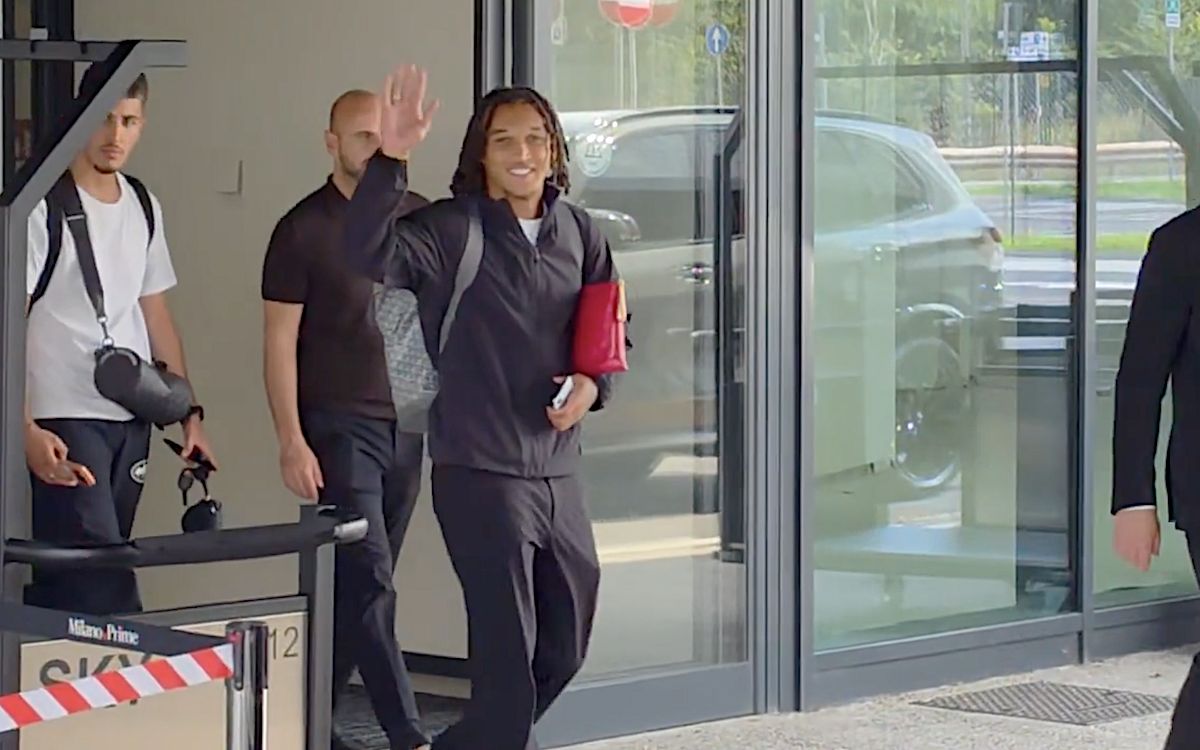
Dropping €50m on a 22-year-old wing-back who managed just five goals in France is either high-level tactical vision or sheer financial recklessness. As Diego Moreira landed at Linate airport to undergo his medical at La Madonnina clinic, AC Milan made their boldest strategic move of the summer transfer window. Ruben Amorim demanded a specific physical engine for his tactical system, and the management handed agent Jorge Mendes a massive blank check to close the deal.
The numbers behind Moreira’s final campaign at Strasbourg present a fascinating statistical breakdown. Across 42 appearances in Ligue 1, the Coupe de France, and the Conference League, the Belgian international recorded five goals and nine assists. That output represents a direct goal involvement every 224 minutes, solid for a wide player but hardly shouting superstar tax.
What makes the transaction controversial among the Rossoneri fanbase is the price inflation. Market estimates valued Moreira at roughly €25m prior to formal negotiations. Milan effectively paid a 100% markup to secure a player who was not even Strasbourg's primary set-piece taker, as SempreMilan reported following his arrival in Lombardy.
Yet Amorim’s pursuit was non-negotiable from a structural standpoint. With Milan opening their Serie A campaign against Ignazio Abate’s Torino on Sunday at 20:45 CEST, the Portuguese coach required a wide outlet capable of sustaining brutal vertical workloads. Moreira’s raw physical profile matches that exact operational requirement.
Deconstructing the €50m Profile: Efficiency vs Inflation
The Strasbourg Production Breakdown
To understand why Milan paid double Moreira's estimated market valuation, you must look beyond basic goal tallies. At Strasbourg, Moreira averaged 4.2 progressive carries and 1.8 successful dribbles per 90 minutes. His ability to break an initial pressing line gave Strasbourg instant tactical relief when defending in deep blocks.
Here lies the surprising analytical finding from his Ligue 1 film. Despite logging nine assists, Moreira was not flooding the penalty box with traditional high-volume crosses. Seven of those nine assists originated from narrow underlapping runs into central half-spaces, operating effectively as an inverted playmaker.
That tactical nuance explains why Amorim prioritized Moreira over alternative market targets like Kerim Alajbegović. While Alajbegović carried a cheaper €30m price tag and greater pure shooting threat, he lacked Moreira’s defensive commitment. Moreira completed 2.1 tackles per 90 minutes last term, placing him in the top 12% among European wingers.
The Cost of Jorge Mendes' Market Influence
We must also address the negative side of this financial ledger. Paying €50m plus performance bonuses for a player with 14 goal contributions in a single French season leaves Milan defensively exposed off the pitch. If Moreira struggles to adjust to Serie A low-block defenses, that transfer capital is locked up indefinitely.
It represents a steep agent premium driven by Mendes' position in negotiations against competing suitors like Borussia Dortmund and Roma. Milan previously attempted to spread their transfer funds across six or seven secondary squad options for £200m total expenditure. That scattergun approach failed to close the gap at the top of the table.
Amorim is now concentrating club resources into four targeted system fits for a €250m total summer spend. Moreira represents the ultimate litmus test for that aggressive, top-heavy recruitment philosophy.
Fitting Moreira into Amorim's 3-4-2-1 Blueprint
The Mechanical Demands on Wide Players
Amorim’s signature 3-4-2-1 architecture places relentless physical demands on its wide outlets. In this tactical setup, wing-backs must cover up to 11.8 kilometers per match while stretching the opposition backline in possession. They are required to sprint back into a five-man defensive block within four seconds of turnover, a benchmark Moreira consistently met in France.
His arrival reshapes Milan's positional hierarchy across the entire squad. Alexis Saelemaekers is being transitioned permanently into one of the dual attacking midfield roles behind the central striker. That move leaves the right wing-back position open for Moreira and Samuel Chukwueze to contest, while Davide Bartesaghi continues to handle left wing-back duties.
Reconfiguring the Attacking Midfield Rotation
With Moreira handling wide ball progression, Christian Pulisic and Ruben Loftus-Cheek gain freedom to operate in tight central spaces. Saelemaekers shifting inside adds another tactical option for Amorim when breaking down organized mid-blocks. Moreira’s dual capability as a wing-back and attacking midfielder provides vital flexibility during dense fixture schedules.
Amorim’s system relies heavily on asymmetric wing mechanics. When play flows down the left flank, the right wing-back must make aggressive back-post runs into the six-yard box. Moreira scored three of his five Strasbourg goals from precisely those far-post arrivals, proving he naturally fits this attacking pattern.
Medical Room Realities and Torino Opener Lineup
Pulisic's Return and Injury Volatility
Milan received positive news from Milanello today as Christian Pulisic rejoined group training. Exactly 41 days after suffering a hairline fracture playing for the United States at the World Cup, the forward completed team drills, as MilanNews confirmed. His partial return aligns with the outer six-week boundary of standard bone healing timelines.
While Pulisic’s return boosts morale, his starter readiness remains doubtful for Sunday's match in Turin. Meanwhile, Rafael Leão continues training separately due to muscle fatigue that ruled him out of the friendly against Manchester United in Wrocław, as La Gazzetta dello Sport reported. Leão's recurring physical issues remain an unaddressed vulnerability in Milan's attacking rotation.
Defensive Shifts and Central Midfield Balance
Matteo Gabbia’s minor ankle knock is clearing up rapidly, paving the way for him to anchor the back three alongside Mario Gila and Strahinja Pavlović. Mike Maignan has been officially confirmed in goal by Amorim following the friendly victory in Poland. In central midfield, Luka Modrić has overcome fitness concerns that restricted him to a substitute appearance against Manchester United.
Adrien Rabiot only returned from his post-World Cup break on Sunday, leaving his match sharpness uncertain for the opener. Ardon Jashari stands ready to partner Modrić in central midfield if Rabiot cannot start. That central partnership will decide whether Milan can dictate tempo against Abate’s energetic Torino side.
The Final Analytical Verdict
Milan are betting on rigid system execution over individual marquee names. By committing €50m to Moreira, the board has fully backed Amorim's tactical vision over conservative financial metrics.
If Moreira delivers his signature athletic output on the flank, the transfer will look like a masterstroke. If his final product falters under Italian tactical scrutiny, the massive price tag will hang heavily over the club.
Read Next
- Arsenal just exposed the stark reality of post-Pep Manchester City
- Ange Postecoglou at Al-Nassr is a tactical collision waiting to happen
- Gavi turns down Man United move as Michael Carrick's summer plan stalls
- Celtic selling Arne Engels before the LASK play-off makes zero football sense
- ⚽ Serie A 2025-26 — Title Race Hub (Inter, Napoli, Juve, Milan)