
Ceferin just called out Infantino, but UEFA has its own power problem
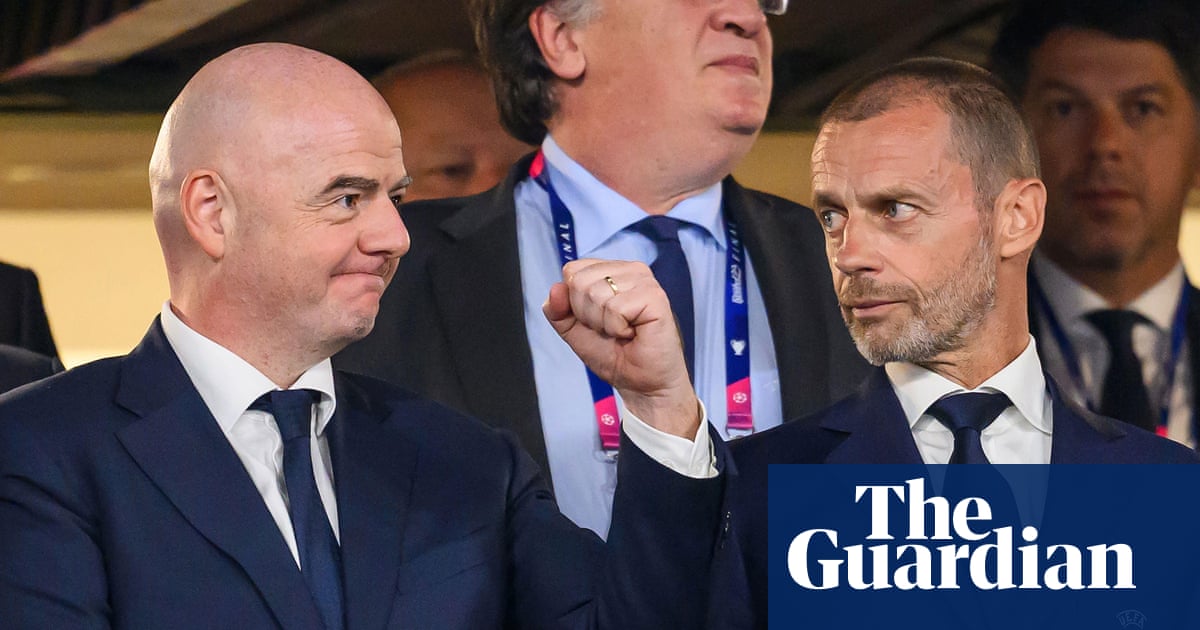
The Copenhagen Ambush
Aleksander Ceferin did not travel to Denmark to discuss grassroots coaching or financial fair play. Standing before hundreds of club representatives at the European Football Clubs general assembly on September 29, 2026, the UEFA president delivered a calculated political assassination.
He chose his venue with theatrical precision. Speaking in Copenhagen, Ceferin reached for Hans Christian Andersen’s famous fable to dismantle Gianni Infantino’s ten-year presidency in front of European football's institutional elite.
“An emperor is persuaded that he is wearing magnificent clothes – clothes which, he is told, only the foolish or unfit cannot see. His court goes along with it. Until a child simply says aloud what everyone can see: the emperor is naked. Perhaps the moral of the story is this: convenient words cannot change uncomfortable realities.”
That was not a clumsy figure of speech. It was the opening salvo in an open war for governance, authority, and money across global sport.
Ceferin systematically itemized the governance failures that have defined Infantino’s recent tenure. He focused directly on the failed FIFA Forward Enterprise project, a scheme marketed as grassroots aid that turned into an opaque financial mechanism.
Ceferin pulled no punches when dismantling the language FIFA uses to justify its expansionist agenda. He took direct aim at financial handouts designed to buy political support across member federations.
“Selling part of football’s future does not become development because you call it development. Putting a fait accompli in front of national associations does not become democratisation because you call it democratisation, however big the cheque is. And secrecy does not become consultation because you call it consultation.”
He also targeted the Folarin Balogun affair from last summer, where administrative opacity sparked standard regulatory fury among clubs and federations. Ceferin framed these incidents not as isolated administrative glitches, but as systemic breaches of fiduciary duty.
To make the stakes concrete for the club executives present, Ceferin translated FIFA's governance style into terms any corporate boardroom would recognize. He stripped away bureaucratic jargon to reveal a basic breakdown of trust.
“Imagine one of your senior executives secretly negotiating away control of your club’s crown jewels. You didn’t know. Your board didn’t know. Your players and fans didn’t know. And by the time you find out, the deal is almost done. What would your board do?”
Then came the sharpest strike of the morning. Ceferin targeted Infantino’s unilateral political maneuvering, pointing to the peace prize handed to political leader Donald Trump without approval from FIFA’s own governing board.
“Imagine that he creates a peace prize for a political leader, without his own board having any say over its creation or its recipient. Then, that same political leader calls during the biggest competition in the world to complain about a decision on the pitch. The rules say one thing. The phone rings. Then the decision changes.”
That charge is brutal. Ceferin explicitly accused the head of global football of altering an on-pitch refereeing decision following a direct phone call from a head of state mid-tournament.
He challenged the room directly, asking how many times such abuses would occur before a corporate board said enough. Ceferin declared that no title and no amount of power gives anyone the right to sell the future of football.
The rhetorical strategy was obvious. UEFA is no longer content with backroom lobbying or quiet diplomatic pressure. Ceferin wants Infantino ousted, and he is laying the public groundwork to force national associations into taking a stand.
Courtrooms, Criminal Complaints, and the November 18 Clock
This conflict has moved far beyond sharp speeches at European assemblies. It is now being actively fought in international courtrooms with heavy legal artillery.
On Tuesday, FIFA filed papers in a United States court attempting to block UEFA from obtaining internal documents. UEFA sought those records specifically to build a planned criminal complaint against Infantino.
FIFA’s response was swift and defensive. Zurich accused UEFA of waging a coordinated misinformation campaign designed to influence the upcoming FIFA presidential election.
That election is fast approaching, and time is running out for the opposition. Nominations close on 18 November 2026, with the formal vote scheduled for March 2027.
Senior figures inside UEFA remain adamant that a candidate to oppose Infantino must be sourced before the November deadline. They know that if they fail to nominate a challenger, Infantino will walk back into office unopposed for another term.
Yet finding someone willing to step into the ring against FIFA's incumbent machinery is proving extraordinarily difficult. The political risk of a failed campaign frightens off potential challengers.
For months, rumors centered on European Football Clubs chair Nasser al-Khelaifi. The Paris Saint-Germain chairman possesses the wealth, political network, and institutional profile required to mount a serious campaign.
In Copenhagen, al-Khelaifi killed those rumors immediately. He closed the door on any potential candidacy with absolute finality.
“I have zero interest in Fifa, zero agenda or ambition to be there. I don’t think I’m the right guy for this position. I’m enjoying what I’m doing, having fun. Fifa, not for me.”
Al-Khelaifi’s refusal exposes UEFA’s primary structural vulnerability. Finding a candidate who satisfies European clubs while appealing to voting blocs in Africa, Asia, and North America is a massive electoral challenge.
FIFA’s electoral system gives equal weight to every national association. The American Samoa Football Association holds the exact same voting power as the German Football Association.
Infantino built his power base by distributing development funding across smaller nations who feel ignored by European dominance. UEFA can scream about governance principles, but without 106 votes locked up across the 211 member associations, Ceferin’s public attack risks becoming an empty political gesture.
The Real Power Play: World Football Clubs
It is easy to applaud Ceferin’s indictment of FIFA’s backroom deals. But treating UEFA as a noble defender of sporting purity requires ignoring how European football actually operates.
Ceferin is not running a charity. UEFA has spent years expanding its own competitions, crowding match calendars, and protecting the financial dominance of Europe's wealthiest clubs.
While Ceferin attacked Infantino from the podium, al-Khelaifi quietly unveiled the real European counter-offensive. He announced plans to expand his organization beyond Europe under a new vision: World Football Clubs.
Al-Khelaifi explicitly stated that a representative body including clubs beyond Europe should be formed. He noted that the organization is more than happy to help colleagues from different clubs across the globe.
This is a masterclass in modern sports politics. Al-Khelaifi does not want to run FIFA because managing national federations involves endless political friction and administrative burdens.
Controlling the clubs is where the true economic weight resides. If European Football Clubs expands into a global cartel, it can negotiate television rights, pre-season tours, and tournament structures independently of FIFA.
This strategy hits FIFA directly at its most sensitive point: the expanded Club World Cup. FIFA needs top European and South American clubs to validate its flagship tournament and attract global broadcasters.
By organizing elite clubs into a unified global coalition under European leadership, al-Khelaifi and Ceferin are building a parallel power structure. They are threatening Infantino’s commercial engine from the outside rather than trying to beat him in a rigged voting booth.
The Governance Illusion and Football's Fractured Future
Football governance has devolved into an outright battle between two competing power blocs. Neither side is fighting for matchgoing supporters or player welfare.
On one side sits Infantino’s FIFA, operating as a centralized political fiefdom that uses development grants to maintain votes while cutting side deals with political leaders. On the other side sits UEFA and the elite European clubs, operating as a commercial cartel seeking to monopolize global football revenues.
Ceferin’s speech in Copenhagen succeeded in exposing FIFA’s emperor. The allegations of altered refereeing decisions, secret asset negotiations, and unapproved political prizes are devastating to Infantino’s moral authority.
As The Guardian reported, Ceferin made it clear that European football’s leadership believes Infantino has crossed every acceptable line.
Yet pointing out that the emperor has no clothes does not automatically mean UEFA is wearing armor. Ceferin’s crusade will remain incomplete unless UEFA can produce an actual candidate before the November deadline.
If UEFA fails to field a candidate by November 18, Infantino will claim victory by default. That outcome would leave global football even more divided, with FIFA holding administrative control while European clubs build an independent financial empire.
Ceferin called for someone to say enough. The coming weeks will reveal whether European football has the courage to fight a real election campaign, or if this Copenhagen speech was merely the loud prelude to an inevitable surrender.
Read Next
adidas Unisex Adult Tiro Match Shin Guards
Solid hard-shell protection with attached ankle guards for Sunday league warrior
Frequently Asked Questions
What did Aleksander Ceferin criticize Gianni Infantino for in Copenhagen?
What is the FIFA Forward Enterprise project mentioned by UEFA?
Why did Aleksander Ceferin reference The Emperor's New Clothes?
What political controversy involving Donald Trump did Ceferin highlight?
When and where did Aleksander Ceferin deliver his speech against FIFA?
More Coverage

Ireland face an impossible Nations League double-header against Israel
6 days, 9 hours agoFIFA's 48-Team World Cup Is Pure Bloat and Total Chaos
4 weeks, 2 days ago
Gianni Infantino tried to sell the World Cup and Norway is officially fed up
1 month, 3 weeks ago
Top 10: UEFA's Most Volatile Moments in the Infantino Era
1 month, 3 weeks agoMexico just threw North America under the bus for Gianni Infantino
1 month, 3 weeks ago
Gianni Infantino's latest power grab is going to backfire spectacularly
1 month, 3 weeks agoMore Analysis
Ireland face an impossible Nations League double-header against Israel
6 days, 9 hours agoFIFA's 48-Team World Cup Is Pure Bloat and Total Chaos
4 weeks, 2 days ago
Gianni Infantino tried to sell the World Cup and Norway is officially fed up
1 month, 3 weeks ago
Top 10: UEFA's Most Volatile Moments in the Infantino Era
1 month, 3 weeks agoMexico just threw North America under the bus for Gianni Infantino
1 month, 3 weeks ago