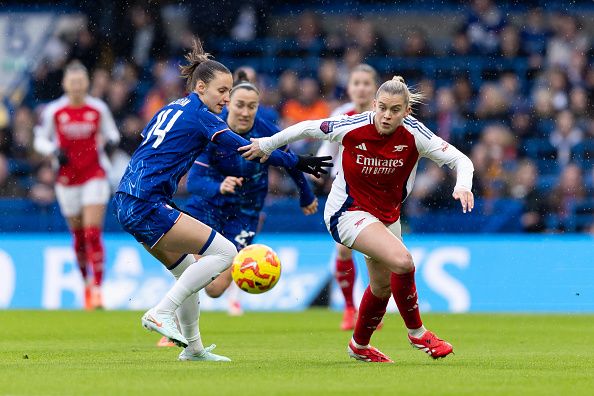
Ten goals in seven matches across club and country is devastating output by any metric. When Alessia Russo stroked home her penalty at Meadow Park on Wednesday night, she did more than secure a 3-0 win over Benfica. The 27-year-old eclipsed every English player in history to become the nation's all-time leading goalscorer in the Women's Champions League.
That milestone propelled Arsenal from fifth up to second in the league phase standings. On paper, it reads like an authoritative European recovery after a turbulent autumn defined by unforced errors and misfiring forwards. The underlying tape, however, tells a far more complicated story about structural hesitation and defensive exposure.
Russo is currently masking persistent systemic flaws. Her sudden explosion of 10 goals in her past seven appearances arrived just as Arsenal's campaign threatened to collapse entirely. Without her penalty-box precision, Renée Slegers's side would still be stuck in mid-table purgatory.
The Mechanics Behind Russo's Resurgence
Russo's display against Benfica was a clinic in forward movement and varied execution. Her first goal stemmed from a patient overload down the left, finishing low past Lena Pauels just before the break. Her second was pure aerial anticipation from a corner, before Caitlin Foord won the penalty that sealed Russo's hat-trick from twelve yards.
This was not empty poachery. Russo operated as Arsenal's tactical anchor, dropping between lines to disrupt Benfica's central structure and release wide runners. As reported by The Guardian, Slegers highlighted that dual operational role after the final whistle.
“She’s one of the leaders and she does it her way. She cares for everyone around her and connects well with her teammates. She leads the way as a role model, doing the right things consistently.”
Yet Arsenal spent the opening half-hour completely smothered. Ivan Baptista drilled Benfica into an ultra-compact mid-block that clogged central lanes and forced Arsenal into passive horseshoe circulation across their backline. The Portuguese champions had won consecutive domestic fixtures and refused to break shape.
Arsenal's early technical sloppiness nearly broke them. In the 28th minute, Frøya Dorsin seized on an unforced turnover, spotted goalkeeper Misa Rodríguez stranded off her line, and attempted an ambitious long-range lob that missed by inches. That defensive scare finally shocked the hosts into gear.
Analyzing the Central Adjustments
Once Olivia Smith drifted into central pockets, passing lanes finally opened for the Gunners. Smith teed up Russo for a near-miss before forcing Pauels into a sharp save herself. Those rapid exchanges shifted the spatial balance, finally putting Benfica on the back foot.
Smith's interior positioning dragged Benfica's screening midfielders out of alignment. That created the passing pocket Russo needed to receive facing forward rather than with her back to goal. From that moment onward, the dynamic tilted entirely in Arsenal's favor.
Slegers Hits 200: Left-Sided Overloads and Tactical Tweaks
Russo's spot-kick also marked the 200th goal of Slegers's tenure in north London. Reaching that milestone required three calculated lineup adjustments from the head coach. Slegers overhauled her tactical setup to inject much-needed tempo.
Ona Batlle returned to her natural right-back role, restoring ball-carrying threat from deep. Meanwhile, summer signings Élisa De Almeida and Géraldine Reuteler earned full debuts to shore up transitions. These tweaks gave Arsenal the baseline platform required to sustain pressure.
The second half exposed Benfica's wide channels through persistent isolation play. Caitlin Foord repeatedly targeted Catarina Amado down the left, manufacturing cutbacks that pinned the visitors deep inside their own defensive third. Slegers noted the visible psychological shift after the match.
“It looks like there is something off our shoulders. We were playing like us tonight and I am so happy. The players enjoyed themselves – they connected, they expressed themselves and they played with intensity.”
That intensity was notably absent in Arsenal's earlier European outings. Supporters remember surrendering a two-goal lead to draw 2-2 against Paris FC through shambolic transition defending. They also remember needing a desperate, stoppage-time winner against Danish minnows HB Køge.
Wednesday's clean sheet provides breathing room, but the underlying frailties linger. Arsenal still look vulnerable whenever an opponent breaks through their first pressing wave. Better sides will not let them off the hook like Dorsin did.
How Europe's Heavyweights Set the Pace
Arsenal's resurgence looks less commanding when framed against the continent's elite. Eight-time champions Lyonnes crushed Internazionale 6-0 to seize top spot on goal difference. Marie-Antoinette Katoto struck twice early, Lily Yohannes added a third on the hour, and Vicki Bècho produced a devastating hat-trick off the bench.
Chelsea also maintained their composure with a 2-0 victory against Roma at Plough Lane. Ellie Carpenter broke the deadlock in the 51st minute before Kadeisha Buchanan headed a late second in the 89th. As noted by BBC Sport, Chelsea's defensive control left Roma scoreless through three European fixtures.
Bench Depth and Continental Benchmarks
The gap between Arsenal and the tournament favorites lies in efficiency and squad rotation. When European powerhouses turn the screw, they dismantle opponents without needing their primary striker to produce historic heroics every ninety minutes.
- Bayern Munich preserved their unbeaten group and league phase record at 17 home games by fighting back from two down against Real Madrid.
- Lyonnes posted six goals from three scorers, powered by Vicki Bècho's lethal second-half hat-trick as a substitute.
- Servette secured their maiden Champions League victory at the ninth attempt, brushing aside OH Leuven 5-1 behind braces from Paola Hernández and Gloria Marinelli.
- Chelsea stayed unbeaten under Sonia Bompastor while extending Roma's European scoring drought past 270 minutes.
Bayern's comeback in Munich illustrates the gap in competitive resilience. Athenea del Castillo and Lineth Beerensteyn put Madrid 2-0 up inside 25 minutes. Yet Edna Imade's header and Momoko Tanikawa's strike leveled the score before Sophie Proost struck the woodwork in stoppage time.
The Counterintuitive Reality of Second Place
Sitting second in the league phase table is deeply counterintuitive given Arsenal's autumnal struggles. Just days ago, unforced errors and toothless finishing had the club under severe internal pressure. A gritty north London derby win stopped the domestic slide, but their European margin remains tiny.
Benfica offered zero attacking threat after going behind, which flatters Arsenal's defensive metrics. Dominating a Portuguese side at Meadow Park does not fix the structural breakdown witnessed against Paris FC. Arsenal cannot rely on Russo delivering hat-tricks across open play, set pieces, and penalties every week.
Russo's finishing run of 10 goals in seven games is an unsustainable conversion heater. When that streak cools, Arsenal will need repeatable chance creation from their supporting cast. If Foord and Smith fail to maintain this creative output, Arsenal's attack will stall again.
Defensively, the new backline remains untested under sustained pressure. Misa Rodríguez's erratic positioning when Dorsin lobbed her exposed a lingering lack of communication with De Almeida. De Almeida's recovery speed patched the problem on Wednesday, but elite forwards will punish hesitation.
The Looming Barcelona Litmus Test
Arsenal's European reality check arrives in exactly a fortnight with a trip to face Barcelona. That fixture represents an unforgiving tactical environment where spatial mistakes carry terminal consequences. Slegers will not have the luxury of thirty sluggish minutes in Catalonia.
Barcelona will deny Russo the space she enjoyed between the lines against Benfica. They will also pin Batlle and Foord deep, denying Arsenal the wide overloads that unlocked Wednesday's match. A single loose turnover in midfield will end in their net.
Slegers deserved to celebrate Wednesday's milestone and the relief it brought her squad. Setting an English scoring record and scoring 200 goals under one manager are legitimate accomplishments. But tactical analysts look at trends, not sentiment.
Arsenal have halted their slide, but their underlying ceiling remains an open question. Russo's brilliant individual form has given them temporary salvation and a high seeding in the table. Whether this marks a genuine tactical turning point or a papered-over crack will be decided in Barcelona.
Read Next
- Arsenal got their derby win at Spurs but the cracks are still showing
- Carrick's truce with Bruno Fernandes won't save Man United at Chelsea
- Why Man City's defensive errors are becoming impossible to ignore
- Harry Kane won the Ballon d'Or, but Lamine Yamal owns 2027
- ⭐ UCL 2026 — Champions League Quarter-Finals Hub