Derek McInnes walked down the tunnel after Tuesday night's 3-2 victory looking like a manager who had just survived a high-speed collision. His Rangers team had claimed three vital points, cut Celtic's lead at the Scottish Premiership summit to one point, and stretched their unbeaten streak. Yet the manager's post-match debrief sounded more like a forensic post-mortem than a celebration.
He was right to sound furious. Masking structural deficiencies with explosive scoring bursts is an addictive habit, but it is a terrible blueprint for winning league titles. For the opening forty-five minutes, Rangers were thoroughly outplayed and outworked on their own pitch by an Aberdeen side undergoing a tactical rebuild under Mario Frick.
Brad Lyons' headed opener for the visitors before the interval was no smash-and-grab fluke. It was the direct consequence of Rangers sleepwalking through their defensive duties and failing to impose any central midfield dominance. Aberdeen absorbed the early home pressure, maintained a compact mid-block, and attacked the wide spaces with sharp purpose.
At half-time, Ibrox was restless and vocal in its disapproval. Rangers had spent the entire first half circulating possession across their backline with zero penetration, recording sterile territory while failing to test the Aberdeen goalkeeper. McInnes recognized the lethargy immediately and pulled the emergency brake.
How the Half-Time Triple Change Broke the Match Open
McInnes hauled off three starters during the break, sending on Findlay Curtis, Tuur Rommens, and Kim Min-Su in a sweeping triple substitution. It was an outright admission that his initial tactical blueprint had failed. It was also an assertive piece of mid-match problem solving that changed the geometry of the pitch.
The shift in dynamics was instantaneous. Rommens and Curtis immediately pinned Aberdeen's wing-backs deep into their defensive third, preventing Frick's side from squeezing the half-spaces. Kim provided vertical running between the lines, attacking spaces behind Aberdeen's double pivot rather than asking for the ball to feet.
What followed was an 11-minute blitz that blew Aberdeen completely out of the water. Rangers scored three goals in that manic spell, energized by a dramatic 64-second turnaround that flipped the mood of the stadium from anxiety to delirium.
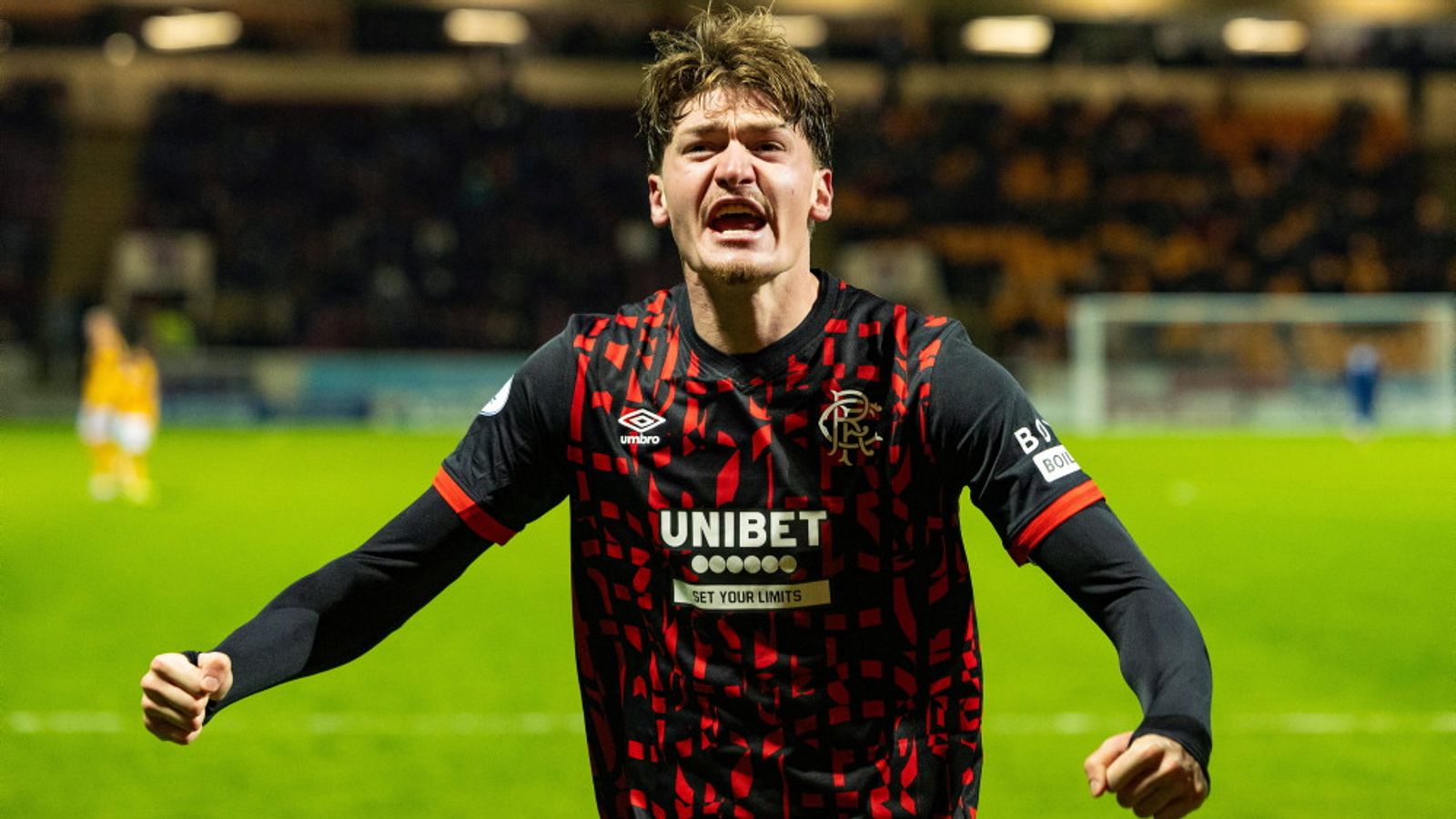
Ryan Naderi sparked the revival, finding the net with the predatory instinct that has come to define his autumn campaign. Before the visitors had even reorganized their shape from the restart, Nico Raskin and Djeidi Gassama had forced turnovers high up the pitch and delivered two rapid blows.
Gassama's finish was ruthless, but the goal was created by the vision and composure of Naderi. The Czech forward received possession under pressure with his back to goal, held off his marker, and slid a perfectly weighted pass directly into Gassama's path.
When Nico Raskin capped the surge with Rangers' third goal, the match appeared settled. Rangers had absorbed an opening blow, changed personnel at the break, and overwhelmed their opponents inside 11 minutes of intense, high-tempo football.
Ryan Naderi Is Masking Every Structural Crack
Step away from the adrenaline of that second-half burst, however, and the tactical reality looks far more concerning. Rangers are currently surviving on the individual brilliance of one 23-year-old striker. Ryan Naderi has transitioned from an unproven signing into the undisputed engine room of this team's attack.
The underlying numbers are staggering. Naderi has registered 13 goal contributions in 13 league appearances, tallying eight goals and five assists in an extraordinary individual campaign.
More importantly, Naderi currently leads the entire Scottish Premiership in both expected goals and xG per 90 minutes. He is not merely feasting on tap-ins; he is consistently generating high-probability scoring chances through his movement, physical power, and aerial threat.
That individual output is currently hiding severe flaws across the squad. With Youssef Chermiti and Lawrence Shankland both sidelined through injuries, McInnes has no genuine alternative at center-forward. If Naderi suffers an injury or a dip in form, Rangers have no proven focal point to absorb the goalscoring load.
Naderi arrived into this clash fresh off two international appearances for the Czech Republic, and his confidence was obvious in every duel. He had already broken Aberdeen hearts earlier this month with the winning goal at Hampden to send Rangers into the Premier Sports Cup final, and on Tuesday night he tormented them once again.
Former Rangers striker Kris Boyd captured the mood accurately when assessing the forward's value on Sky Sports:
"A lot of players have had plaudits recently, but where would Rangers be without Naderi? He's scored big goals for Rangers this season. His goal return has been outstanding and they're big, big goals for Rangers."
Boyd's question highlights the fundamental fragility of Rangers' title bid. When a team's attacking output relies this heavily on a single player converting half-chances and producing assists out of tight spaces, variance eventually strikes. Sustainable title challenges require multiple scoring avenues, not one striker carrying an entire frontline on his back.
The Complacency Trap and the Retreat
What unfolded after Rangers reached their 3-1 lead was the most alarming tactical passage of the entire evening. Having engineered a commanding advantage through aggressive, forward-thinking football, Rangers abruptly stopped playing.
Instead of pressing their advantage and killing the contest with controlled possession, McInnes' players went into a defensive shell. They conceded territory, lost their pressing structure, and allowed Aberdeen to dictate terms for the final thirty minutes of the match.
McInnes was visibly enraged by the lack of maturity shown by his team in game management. In his post-match comments, he refused to hide behind the three points:
"The biggest part for me is how we lose the initiative by just being too complacent and that has to change because we won't always outscore opponents. Once we got ourselves in front you think 'just keep the shoulder to the wheel'. We hit them like a train and they were 3-1 down because of the speed, intensity, intelligence and then we started to play backwards."
The manager's observation about backward passing was devastatingly accurate. Rangers completed more negative, backwards passes in that closing spell than in any match this season. Defenders opted for conservative back-passes to the goalkeeper instead of breaking lines into midfield, which served only to pull Aberdeen higher up the pitch.
That tactical retreat opened the door for Aberdeen, and Mario Frick's young side attacked it without hesitation. While Rangers grew nervous, Aberdeen played with clarity and courage.
Twenty-year-old midfielder Findlay Marshall was comfortably the best player on the park across the ninety minutes. Marshall controlled the tempo, snapped into tackles, and dragged Aberdeen back into contention with a superb goal that made it 3-2.
Aberdeen legend Willie Miller was glowing in his post-match assessment of the Dons' performance under Frick, noting that it had been a long time since he had seen an Aberdeen side play with such authority at Ibrox. Frick even introduced 15-year-old Andrew Fasanya into the pressure cooker of the closing stages, demonstrating a clear commitment to fearless, youth-driven football.
The final minutes turned into an agonizing survival exercise for the home supporters. Aberdeen created multiple dangerous opportunities to equalize, while Rangers cleared balls aimlessly into touch, desperate for the referee's final whistle.
The Illusion of the League Table
This dramatic escape was not an isolated incident. Just three days earlier at Fir Park, Rangers were forced to dig out another late, frantic victory against Motherwell after sleepwalking through long stretches of the afternoon.
Rangers have now collected six points from losing positions in the Scottish Premiership this season. In the entire division, only St Johnstone and Celtic have picked up more, recovering seven points each after falling behind.
Supporters often view comeback victories as proof of mental resilience and fighting spirit. That interpretation is comforting, but tactical analysts view recurring deficits as a symptom of a dysfunctional defensive setup and poor initial game plans.
As BBC Sport reported following the final whistle, McInnes did not shy away from calling out his squad's recurring naivety. He knows that elite teams do not need regular second-half miracles to beat mid-table opposition at home.
Title-winning sides are built on control. They establish a lead, suffocate transitions, deny counter-attacks, and drain the life out of the opposition with calm, progressive possession. Right now, Rangers are doing the opposite, turning comfortable winning positions into chaotic street fights.
On paper, the Scottish Premiership table presents an enticing narrative for the blue half of Glasgow. Rangers are hot on Celtic's heels, sitting just one point off the summit while riding an unbeaten run of 14 games across all competitions.
The schedule now offers McInnes a massive psychological carrot. Rangers host Falkirk at Ibrox on Saturday, while Celtic must negotiate a hazardous trip to face Hearts at Tynecastle on Sunday.
A victory against Falkirk would send Rangers top of the table for only the second time this season, putting genuine scoreboard pressure on their cross-city rivals before Celtic kick a ball in Edinburgh.
Rangers supporters are longing for a first league championship in six years, and the intoxicating smell of a real title race is filling the stands. But emotional momentum cannot disguise tactical flaws forever.
Celtic have spent years demonstrating how to manage league campaigns with clinical efficiency and relentless tempo control. They rarely retreat into panic or surrender multi-goal leads at home to Aberdeen.
McInnes knows that if his team continues to start games slowly, retreat into cautious backwards passes, and depend entirely on Ryan Naderi to pull rabbits out of hats, the title race will end in familiar disappointment. Digging out results is admirable, but sooner or later, chaos collects its debt.
Read Next
- Ryan Naderi is saving Rangers from disaster one ugly goal at a time
- Derek McInnes gets his Fir Park win, but Rangers are flirting with disaster
- Aberdeen's high-tempo reboot leaves huge fitness questions before Ibrox
- Zidane Iqbal has turned Dundee United into Scotland's sharpest side
- ⚽ Scottish Premiership 2025-26 — Celtic vs Rangers Hub