
Accounting Disasters and Dead Money: Serie A's Wage War
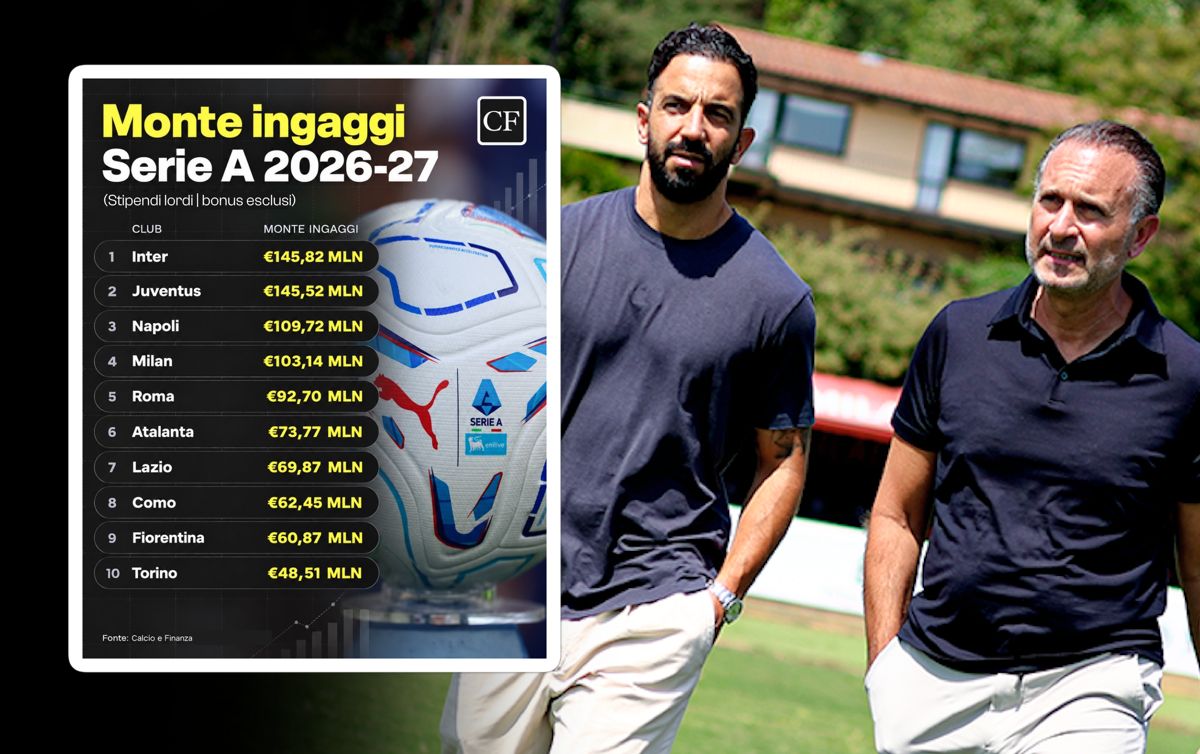
Pull up a stool, order a round, and take a look at the ledger because Italian football finance is cooking up pure theater again. According to Calcio e Finanza's latest Serie A wage estimates, total player salaries across the league jumped to a staggering €1.209bn gross for the 2026-27 campaign. That is up from €1.1bn last term, proving that financial gravity still does not apply when Italian executives get near a checkbook.
At the top of the mountain, Inter leads the pack with an estimated gross payroll of €145.8m. Right on their heels sit Juventus at €145.5m, leaving the two historic rivals separated by a hilariously petty €300,000 gap. Napoli locks down third place at €109.8m, while AC Milan slots into fourth at €103.1m, squeezing past Roma's €92.7m payroll before a massive drop-off to Atalanta down at €73.8m.
That fourth-place standing is a step up from last season when Milan sat fifth with a payroll closer to Lazio than Inter. Naturally, Rossoneri group chats immediately exploded into a civil war over owner Gerry Cardinale's balance sheet management. Enthusiasts spent the afternoon pointing out squad value upgrades like Goncalo Ramos, David Moreira, and Mario Gila, while celebrating how selling Rafael Leao trimmed baseline costs.
The pro-board faction insists Cardinale is operating a high-value enterprise, pointing to incoming talent like Samuele Ricci, Santiago Gimenez, and Youssouf Fofana still sitting on amortization schedules. They argue that squad depth is improving while long-term payroll obligations remain controlled under a strict salary ceiling.
Then the skeptics crashed the party with cold, hard math. Milan bled €25m in the red last year, and right now, roughly ten percent of their current wage bill is going directly to Christopher Nkunku, Youssouf Fofana, and Warren Bondo. None of those three are even playing for Milan this season. Wrap your head around paying ten percent of your payroll for guys wearing another team's tracksuit while working out Ismael Bennacer's severance settlement on the side.
Contrarians on Reddit quickly chimed in that relief is coming once Ruben Loftus-Cheek, Fikayo Tomori, Omari Hutchinson, and Luka Modric roll off the books next summer. But that assumes Milan actually unloads their loaned-out squad members instead of taking them back onto the payroll like boomerang liabilities. If lower-tier results push Milan out of Champions League spots, that spreadsheet gets real ugly real fast.
Can Luis Enrique's PSG Really Claim Dynasty Status?
While Milan fans debate amortization tables like junior accountants, another massive argument is setting football Twitter on fire. PSG kicks off their Champions League title defense this week aiming for three straight European crowns. That quest prompted BBC Sport's ranking of Europe's greatest dynasties, igniting an explosive debate across fan forums over where Paris actually belongs in historical conversations.
PSG diehards argue that Luis Enrique completely re-engineered the club's culture after taking charge in 2023. Gone are the days of superstar ego traps and vanity signings that collapsed every spring under pressure. Club president Nasser Al-Khelaifi signaled the cultural shift himself when discussing the change in club strategy.
"It's the end of the glitter"
The results speak for themselves. Enrique built a disciplined, high-pressing machine stuffed with young talent that smashed Inter 5-0 in the 2025 Champions League final to claim their first European trophy. Following that up with a second consecutive title put PSG into elite territory. Staring down a potential three-peat puts Paris in the company of historical heavyweights who reshaped the sport.
Predictably, traditionalists are having an absolute meltdown at the suggestion. Skeptics argue that oil-backed wealth trivializes domestic league competition, giving Paris a structural advantage over teams fighting weekly domestic wars. They point out that real dynasties required legendary foundational figures who conquered hostile environments without state backing.
Look at the historic benchmarks being referenced across the forum threads. Real Madrid won the first five European Cups between 1955 and 1960, capped by Ferenc Puskas scoring four goals in a 7-3 thrashing of Frankfurt at Hampden Park. Helenio Herrera's Grande Inter defined catenaccio in the 1960s with Sandro Mazzola scoring twice against Madrid, while Benfica's Eusebio piled up 47 European Cup goals after breaking Guttmann's roster mold.
Purists also point to Ajax defining Total Football under Rinus Michels, Stefan Kovacs, and Johan Cruyff with three straight titles from 1971 to 1973. Bayern Munich matched that hat-trick behind Franz Beckenbauer, Sepp Maier, and Gerd Muller from 1974 to 1976. Then came Liverpool's Boot Room era under Bob Paisley and Joe Fagan, where Kenny Dalglish replaced Kevin Keegan and downed Club Brugge in 1978 before Alan Kennedy sank Real Madrid in 1981.
Throw in Sacchi and Capello's AC Milan destroying Steaua Bucharest 4-0 in 1989 and Cruyff's Barcelona Dream Team 4-0 in 1994 with Gullit, Van Basten, Baresi, and Maldini. Add Pep Guardiola's tiki-taka Barcelona built around Messi, Xavi, and Iniesta, plus Zidane's three-peat Real Madrid with Cristiano Ronaldo and Gareth Bale. Nostalgia defenders insist PSG's modern run lacks the romantic soul of those historic sides, arguing that Ligue 1 dominance renders continental success far less impressive.
The Verdict: Who Has the Stronger Case on the Timeline?
Let us slice through the noise and deliver some brutal honesty. On the Serie A wage front, the Milan skeptics have this argument completely won. You cannot pretend a corporate model is thriving when a tenth of your salary cap is funding players who do not wear your shirt on matchdays. Cardinale might be raising total squad valuations on paper, but paying dead weight while relying on Luka Modric's final laps is bad roster design.
If Milan stumbles domestically or drops into the Europa League, those amortizations will turn into a financial anvil around their necks. Relying on loan returns to balance future books is pure financial gambling. You cannot spreadsheet your way out of paying bench players on foreign rosters.
As for the PSG dynasty debate, the anti-Paris contrarians need to take a lap and breathe into a paper bag. Discounting back-to-back Champions League titles because you dislike state ownership is emotional cope, plain and simple. Winning a European final 5-0 is not a fluke. It is total tactical execution on the biggest stage on earth.
Luis Enrique transformed a toxic locker room into a terrifyingly efficient collective. If PSG actually pulls off a third straight Champions League title next May, the debate is officially over. They will join Beckenbauer's Bayern and Zidane's Real Madrid on football's Mount Rushmore whether purists like it or not.
Read Next
- Arsenal look ready to win Europe, but PSG and Barca won't make it easy
- Arsenal Flying into Naples Chaos Is the Ultimate Arteta Test
- Marcus Rashford's Old Trafford return can't mask Man United's early flaws
- Top 10: Top Moments
- ⚽ Ligue 1 2025-26 — PSG, Monaco & the Title Race Hub
- ⭐ UCL 2026 — Champions League Quarter-Finals Hub


