The VAR Smokescreen at Old Trafford
Manchester United lost far more than three derby points on Sunday evening at Old Trafford. A 2-1 defeat to a ten-man Manchester City side exposed deep structural issues that no refereeing debate can hide. United had every advantage handed to them early, yet walked away looking completely out of ideas.
Phil Foden received a straight red card in the 23rd minute after a wild challenge. That red card was supposed to set up a dominant home performance. Up to that point, Old Trafford expected United to take full control and pin City inside their own penalty area for the rest of the match.
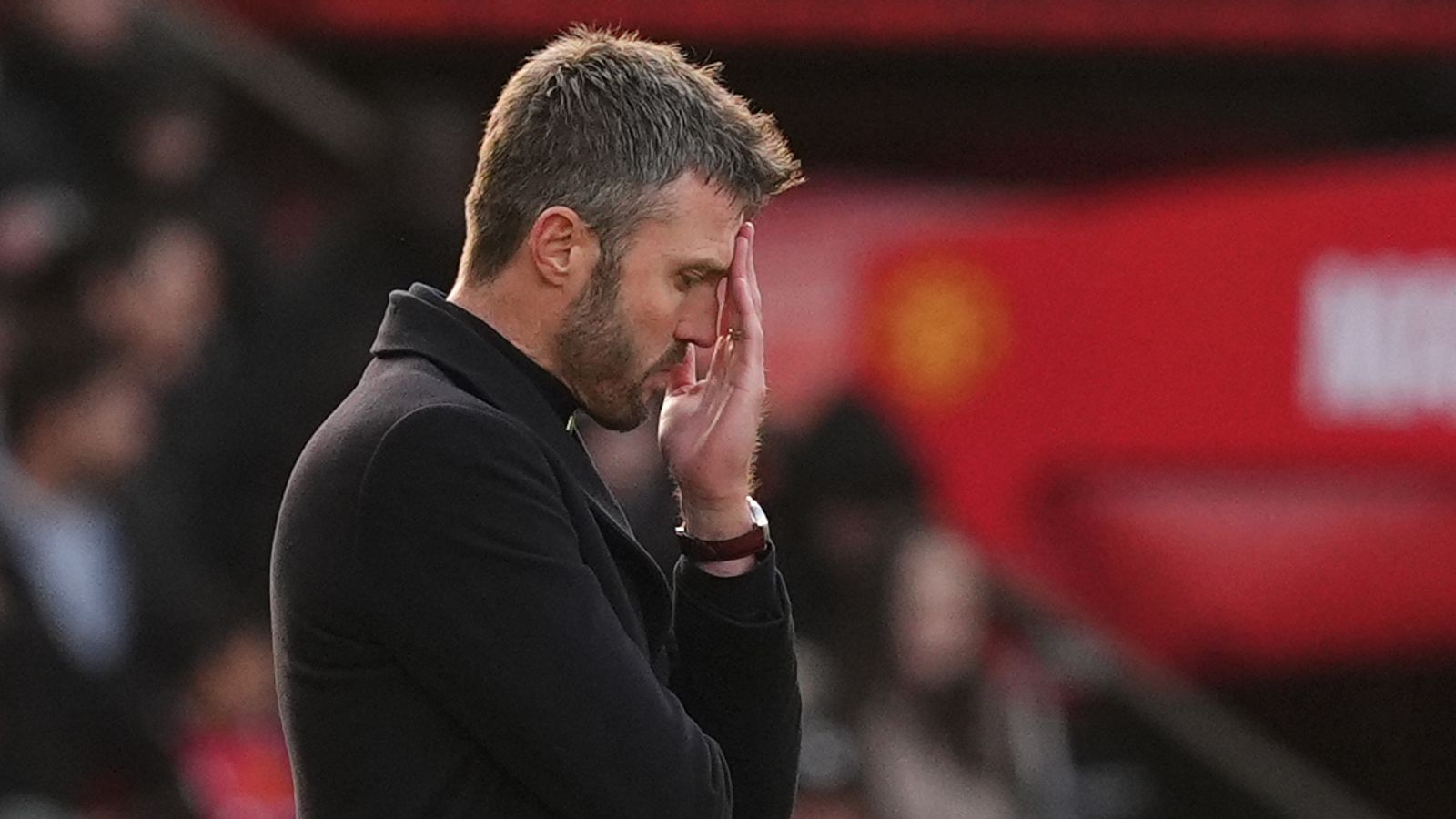
Instead, United looked listless and flat for over an hour. City adjusted their shape immediately, while Michael Carrick watched his players cycle possession sideways without purpose. The home crowd grew quiet as the minutes ticked away without any real threat.
Erling Haaland eventually scored City's winning goal under controversial circumstances, igniting an immediate VAR debate. As Mirror Football reported, Carrick focused almost his entire post-match media appearance on complaining about the refereeing decision.
"It's a staggering decision. I can't understand it once I seen it then the explanation almost makes it worse." — Michael Carrick
Sky Sports pundits Micah Richards and Gary Neville spent their post-match show arguing over offside definitions and official interpretations. That wall-to-wall officiating talk suited Carrick down to the ground. In an era dominated by social media conspiracies, refereeing noise creates the perfect distraction from a dreadful managerial display.
Carrick was delighted to let the media debate lines and angles. But fans leaving the stadium knew the truth. United failed to capitalize on a massive tactical gift, and that failure rests squarely on the manager's shoulders.
Tactical Paralysis Against Ten Men
Before Foden walked off, United actually showed brief moments of promise. Elliot Anderson struggled in midfield to cover both Bruno Fernandes and Matheus Cunha. Central space was open, allowing United to build quick attacks through the middle of the pitch.
City manager Enzo Maresca spotted the problem instantly when Foden was sent off. Maresca shifted City into a tight 4-4-1 formation, closing down central channels completely. He dared United to play through wide areas where City could compress space near the touchline.
Carrick had no answers for Maresca's tactical shift. United took the bait entirely, circulating possession along the perimeter without ever breaking into the penalty box. Pass after pass went sideways or backward, allowing City's defensive line to stay comfortable.
United generated virtually no central penetration. The attack degenerated into floating hopeful crosses into the area, which Gianluigi Donnarumma easily collected. It was predictable football that made City's defensive task simple.
Carrick attempted two changes from the bench to spark life into his team. First, he brought on Benjamin Sesko to offer a traditional aerial focal point up front. The move made sense on paper, but Sesko received zero quality service from wide areas.
Next, Carrick introduced Joshua Zirkzee to replace Marcus Rashford. United had actively tried to sell Zirkzee just two weeks prior, highlighting the lack of reliable attacking depth on the bench. Zirkzee looked off the pace and failed to connect with midfielders.
Rashford had earlier struck the post with a long-range free-kick before pulling up holding his leg. Removing Rashford stripped United of their only true deep threat. Without his pace pulling defenders backward, City's backline pushed up with total confidence.
The underlying metrics underline just how poor United were. Carrick's side managed only three shots on target all evening, generating a meager 0.95 xG across 90 minutes. That is a damning figure for a team playing with a numerical advantage for over an hour.
Ten-man City actually created better chances than the home team. Maresca's side finished with 0.99 xG despite playing 67 minutes with ten men. City looked far sharper on the counter-attack than United did with total ball control.
United hit the woodwork twice during the match. Rashford's free-kick rattled the post in the first half, and Kobbie Mainoo saw a curling second-half attempt clip the upright. Bryan Mbeumo also shot straight at Donnarumma in stoppage time, but those were isolated individual moments rather than constructed team chances.
The Reality of a Packed Calendar
Physical fatigue clearly caught up with United during the final half-hour. On Thursday night, United cruised to a 4-0 victory against Champions League debutants Sabah. That European fixture played out like an easy training exercise, but the travel and short rest took a visible toll on Sunday.
Transitioning from a low-intensity European match to a frantic Premier League derby proved too difficult for several key starters. United's pressing intensity evaporated in the second half, leaving large gaps in midfield whenever City counter-attacked.
During the second half of last season, Carrick built momentum under vastly different conditions. After taking over from Ruben Amorim, Carrick enjoyed full weeks of tactical preparation between games. United were already eliminated from domestic cups and had no European matches on their schedule.
Carrick could field his strongest lineup every weekend without worrying about physical recovery or bench rotation. Players were fresh, game plans were simple, and opposition teams had limited tape on Carrick's setups. That luxury is now gone.
Managing games every three days requires elite squad management and rapid tactical adjustments. Carrick is discovering that mid-week fixture swings test a manager's depth and tactical adaptability in ways a single match week never does.
United's defensive record this season already signals alarming instability. Carrick's defense has conceded twice against Hull, Ipswich, and Everton during the opening month of the campaign. Soft defensive performances are becoming a recurring theme rather than an anomaly.
When opponents apply pressure, United's structure breaks down quickly. Opposing managers have noticed that United struggle to protect space in front of their back four when pushed into transition moments.
Carrick Under Pressure as Honeymoon Ends
Leaving Sunday's derby with just 4 points from 4 games puts Carrick under heavy early-season pressure. The United hierarchy handed him the permanent job in the summer after alternative candidates failed to materialise. However, Carrick's detractors insisted he would struggle once expectations rose.
Those detractors argued that Carrick lacked the tactical flexibility required for elite-level management. Sunday's performance against ten men provided strong evidence for their argument. When Maresca adjusted, Carrick froze.
As noted in post-match analysis of United's start, Carrick must quickly show he can solve tactical puzzles when his initial game plan falls apart. Relying on individual talent works against lower-tier sides, but elite teams exploit predictability.
Rival coaches now have a clear game plan when visiting Old Trafford. Sit in a compact mid-block, close central passing corridors to Fernandes and Cunha, and force United out wide. United simply lack the sharp movement to break down disciplined defensive units.
With Rashford facing time on the sidelines, Carrick's attacking options look increasingly fragile. Sesko needs time to adapt to Premier League defenders, while Zirkzee remains an uncertain option after a summer of transfer speculation. Mbeumo cannot carry the goalscoring burden alone.
Ranting about VAR may buy Carrick a brief reprieve from headlines, but it does not fix United's tactical deficiencies. Results govern Old Trafford, and four points from four matches is unacceptable for a club with United's ambitions.
The goodwill from Carrick's interim spell has evaporated completely. If he cannot engineer a swift turnaround in performance and tactical clarity, the pressure on his position will become overwhelming before autumn ends.
Read Next
- Michael Carrick must change Man United's midfield shape for the derby
- Sesko gives Carrick a derby dilemma after United sweep past Sabah
- How Man City Mastered Old Trafford After Phil Foden's Early Red Card
- Lisandro Martinez is laughing, but Carrick's derby test is no joke
- 🏆 Europa League Final 2026 — Full Coverage Hub