The Last-Minute Substitution Trap
Of the last ten players subbed on after the 115th minute in a World Cup or European Championship match specifically to take a penalty, eight have missed. That is an 80 percent failure rate—a statistic that should make every manager in the world throw their tactical notes in the bin. Yet, managers continue to make this late-game gamble, believing they can bypass the physical and mental realities of the game.
The second night of knockout round matches at the 2026 World Cup saw two of the three games decided via penalty shootout. Paraguay produced the biggest shock, beating Germany 4-3 on penalties following a 1-1 draw after extra-time.
Morocco followed suit, defeating the Netherlands 3-2 in a shootout after a 1-1 deadlock. These matches were not just tests of nerve. They were structural indictments of a failing coaching trend.
For years, managers have treated the final minutes of extra-time as a chess board. They sub on designated penalty takers in the 118th or 120th minute. They believe they are optimization geniuses.
Last night exposed the rot in this logic. Bournemouth forward Justin Kluivert came on in the 113th minute for the Netherlands and missed. Former West Ham defender Fabian Balbuena entered in the 122nd minute for Paraguay and missed.
According to data from Opta compiled by BBC Sport, this strategy has become a statistical black hole. Of the last ten players to be subbed on after the 115th minute at a World Cup or European Championship, eight who took a penalty in the shootout went on to miss. That is a failure rate of 80 percent.
The baseline conversion rate for shootout penalties in elite international football hovers around 74 percent. By subbing on cold players, managers are paying an astronomical premium for what they assume is expertise. It is a mathematical disaster.
The Physiology of the Cold Kick
Why do these specialists fail so consistently? The answer starts with basic biology. A player who has sat on a bench for two hours cannot suddenly simulate the physical state of a match.
Their core temperature has dropped. Their muscles are cold, stiff, and unresponsive. Their cardiovascular system is spiked from 70 to 160 beats per minute by pure adrenaline in the span of sixty seconds.
When Fabian Balbuena stepped up in the 122nd minute, he had not completed a single pass. He had not made a sprint. He had not even felt the texture of the turf with his boots.
A penalty kick is a high-speed mechanical action that requires millimeter precision. The kicker must coordinate their hip rotation, plant foot placement, and ankle contact in a fraction of a second. Doing this without physical calibration is an invitation to mechanical failure.
We see this in the telemetry of the kicks. Cold players routinely miss in two ways. They either pull the ball wide because their hips fail to clear, or they sky it because their plant foot lands too far behind the ball.
Simone Zaza's infamous stutter-step penalty for Italy against Germany at Euro 2016 is the classic caricature of this. He was subbed on in the 120th minute, took a bizarre, uncalibrated run-up, and blasted the ball over the crossbar. It was a failure of motor control masquerading as psychological collapse.
The Psychological Isolation of the Savior
The mental burden is even worse than the physical stiffness. When a starter takes a penalty, they have been part of the battle. They have made mistakes, completed tackles, and felt the flow of the game.
They are integrated into the collective. If they miss, it is a tragedy shared. For the late substitute, the situation is completely isolated.
They are brought on for one reason only: to score. Their entire identity in that match is reduced to a single kick. This creates a hyper-focus on the consequence of failure rather than the execution of the technique.
The player is not thinking about the goalkeeper's positioning or their own target. They are thinking about the headlines if they miss. This anxiety manifests as physical tension, tightening the muscles needed for a clean strike.
Contrast this with the rare successes. At World Cup 2022, Argentina's Paulo Dybala was brought on in the 121st minute against France. He scored his penalty down the middle.
Dybala's success is the exception that highlights the rule. He was executing within a highly structured Argentina side that had dominated the match. The majority of late substitutes do not have the luxury of such collective momentum.
They step into a vacuum of pressure. They must perform without the comforting weight of match rhythm.
The Cost of Tactical Hoarding
There is also a hidden tactical cost to this strategy. By saving a substitution slot for the 119th minute, managers actively hurt their teams during extra-time. They play with fatigued midfielders and cramping defenders because they must hoard that final change.
Last night, the Netherlands played the final ten minutes of extra-time in a deep block. They were unable to press because their front line was exhausted. Had Ronald Koeman used that substitution in the 100th minute to refresh his press, the Dutch might have won the game before penalties.
Gareth Southgate learned this lesson the hard way. In the Euro 2020 final against Italy, he held his changes until the 120th minute, introducing Marcus Rashford and Jadon Sancho solely for the shootout. Both missed.
By Euro 2024, Southgate adjusted his threshold. In the quarter-final against Switzerland, he introduced Ivan Toney and Trent Alexander-Arnold earlier in extra-time. Because they had time to touch the ball, make a pass, and feel the game, both converted their penalties.
The timing of the substitution is the decisive variable. A few minutes make all the difference.
The Ten-Player Sample
The historical record of players introduced after the 115th minute in major tournaments tells a grim story. As BBC Sport's tracking confirms, these decisions almost always backfire. Here is the full breakdown of the last ten instances:
- Fabian Balbuena (Paraguay vs Germany, 2026 World Cup) — Missed
- Zeki Amdouni (Switzerland vs England, Euro 2024) — Scored
- Paulo Dybala (Argentina vs France, 2022 World Cup) — Scored
- Badr Benoun (Morocco vs Spain, 2022 World Cup) — Missed
- Pablo Sarabia (Spain vs Morocco, 2022 World Cup) — Missed
- Jadon Sancho (England vs Italy, Euro 2020) — Missed
- Marcus Rashford (England vs Italy, Euro 2020) — Missed
- Rodri (Spain vs Switzerland, Euro 2020) — Missed
- Simone Zaza (Italy vs Germany, Euro 2016) — Missed
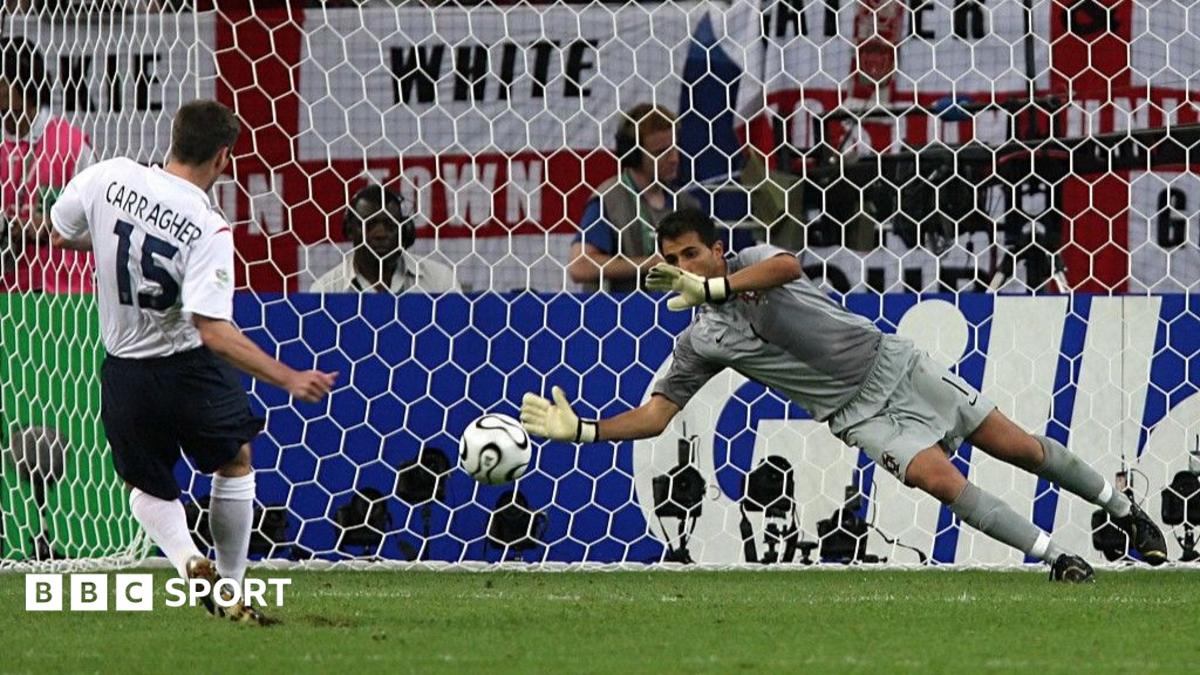
- Jamie Carragher (England vs Portugal, 2006 World Cup) — Missed
This list is not a random collection of poor kickers. It contains elite players like Rodri, Marcus Rashford, and Jadon Sancho. These are individuals who convert penalties regularly for their clubs.
Yet, when subjected to the cold substitute environment, their collective conversion rate drops to 20 percent. This is a systemic failure of coaching theory, not player talent.
The Solution for Managers
Managers must abandon the fantasy of the shootout specialist. If a player is to be brought on for penalties, they must enter the pitch before the 110th minute. They need at least ten minutes of active play to calibrate their muscles and settle their nerves.
To do otherwise is to throw a player to the wolves under the guise of tactical sophistication. Last night's exits for Germany and the Netherlands are simply the latest data points in a lesson that has already been written in red ink.
Read Next
.jpg)