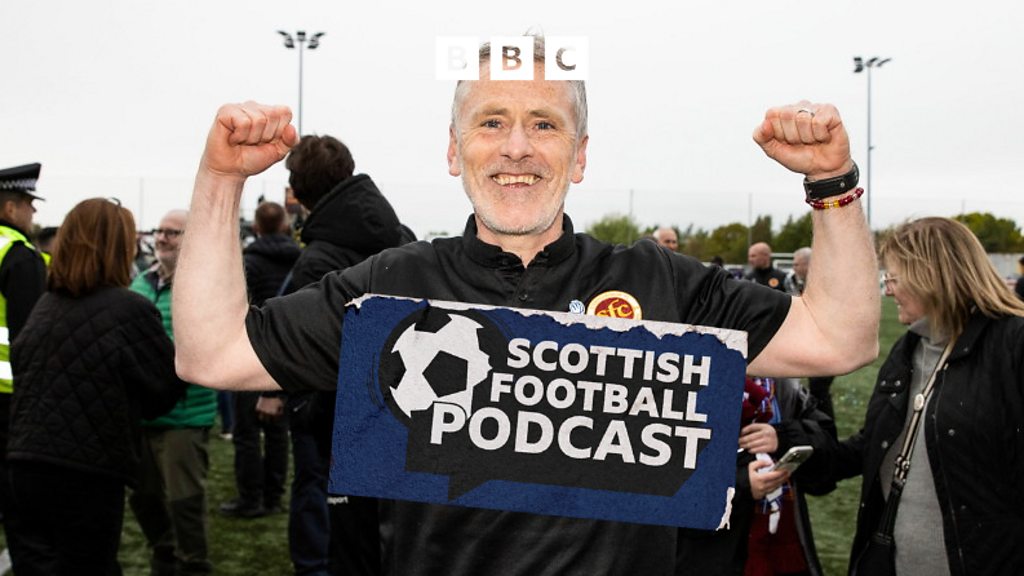
Davie Martindale's dugout return exposes Livingston's deep identity crisis

The Five-Game Sacking and the Shadow in the Boardroom
Glenn Whelan lasted just five matchdays before West Lothian’s hierarchy pulled the plug on his managerial experiment. Firing a manager in early September is rarely about five weeks of football. It is about a terrifying mismatch between board expectations and pitch reality.
Livingston entered the Scottish Championship season with a singular, uncompromising directive from ownership: win the title and return to the Premiership immediately. Instead, three defeats in their opening five league fixtures brought an explosive, swift end to Whelan’s short-lived tenure.
Five games is an impossibly narrow window for any head coach to establish structural clarity or positional mechanics. Yet in West Lothian, Whelan was never operating in a neutral vacuum. He was coaching in the overwhelming shadow of the man sitting directly above him in the director's box.
Davie Martindale managed Livingston for six grueling years before stepping into the sporting director role in January. When an iconic, long-serving manager shifts to the boardroom, any successor walks a perilous tightrope. Every tactical hiccup becomes an immediate invitation for the previous architect to step back in.
That organizational dynamic made Whelan’s task nearly impossible from day one. He inherited a squad forged in Martindale’s pragmatic image while attempting to introduce his own progressive ideas. When results faltered early, the hierarchy defaulted to the familiar comforting hand of their long-time manager.
Martindale and Frankie McAvoy will now step into the dugout for Friday's tricky trip to face Greenock Morton. Martindale insists his return to the bench is strictly an interim patch job. But having the sporting director put on the tracksuit again fundamentally destabilizes the club's organizational hierarchy.
Football players are inherently perceptive creatures in a dressing room environment. They quickly recognize when operational authority is split between the bench and the executive suite. The moment Martindale agreed to step down onto the touchline, he validated the perception that no one else can steer this ship.
Whelan certainly made tactical mistakes, but he was dealt an unfair, unwinnable hand. Trying to build a fluid attacking side under the watchful eye of the club's defining modern figurehead is a thankless task. The shadow in the boardroom eventually consumed the dugout.
The decision to sack Whelan so early also reveals an executive impatience that borders on panic. Relegation hangover is a documented phenomenon in Scottish football, often taking months to shake off. Expecting instantaneous dominance while undergoing a managerial transition was always an unrealistic calculation.
Tactical Collapse Against Part-Time Resistance
The breaking point for Whelan came against the division's part-time clubs. As BBC Sport reported, Martindale candidly admitted the team had gotten nothing against part-time sides who had been magnificent in the league.
In the Scottish Championship, part-time opposition presents a unique tactical trap for full-time outfits. Teams balancing football with daytime careers rarely try to out-possess full-time squads. Instead, they compact central pitch areas in disciplined 5-4-1 or 4-5-1 low blocks, challenging opponents to break them down.
To break down a structured low block, a team needs rapid positional interchange, wide overloads, and vertical midfield passes. Under Whelan, Livingston’s build-up play became painfully slow and predictable. Ball movement degenerated into a sluggish U-shape between center-backs and full-backs, allowing defensive lines to shift comfortably without stress.
Livingston lacked the midfield penetration required to punch passes through compressed central lines. When full-time players fail to move part-time defenders out of position, physical conditioning advantages disappear entirely. The match devolves into a grinding war of attrition that plays directly into the underdog's defensive strategy.
Losing three out of five matches while failing to take points off part-time clubs broke the board's resolve. Full-time wage bills carry an implicit mandate of territorial and statistical dominance. Dropping points to part-time opposition shatters that financial logic and exposes tactical impotence.
Livingston’s recent history makes this sudden collapse even more striking. Their top-flight relegation campaign was a protracted nightmare, yielding victories in just two of their 38 games. It was a agonizing year where defensive solidity completely evaporated against elite opposition.
Yet that disastrous top-flight campaign was preceded by a triumphant 2024-25 season. In that campaign, the West Lothian side lost only six league matches before securing promotion through the play-offs. They proved they possessed the exact DNA needed to navigate the brutal second tier.
That immediate success makes their current position sitting fifth in the league so unacceptable to ownership. In numerical terms, fifth place after five games looks like a minor early-season bump. But dropping 3 of 5 matches exposed a profound absence of structural resilience.
Whelan failed to establish reliable pressing triggers when Livingston lost possession in the final third. Opponents repeatedly exploited the vacant space behind Livingston’s advancing full-backs on direct counter-attacks. Tactical rigidity on offense combined with vulnerability on defensive transitions ultimately doomed his short regime.
The Morton Benchmark and the Interim Paradox
Friday night brings an immediate, hostile examination at Cappielow against Greenock Morton. Scheduled live on BBC Scotland from 19:25 BST, the fixture represents the ultimate Championship crucible.
Morton under Dougie Imrie are masters of second-ball chaos and aggressive aerial duels. They rely on tight pitch dimensions and set-piece saturation to physically unsettle opposition. It is precisely the brand of physical warfare that Livingston failed to manage over the opening month.
Martindale and McAvoy must steady the ship under intense public scrutiny. Yet Martindale has gone out of his way to emphasize that his return to the bench is strictly temporary, insisting that his time as full-time manager has passed.
"That ship's sailed. I miss coaching, but long-term, I think we need to be looking elsewhere rather than Davie Martindale."
This creates a bizarre interim paradox for the playing squad. The man standing on the touchline delivering pre-match tactical instructions has publicly declared he does not want the job long-term. That dynamic creates an inevitable authority vacuum during high-stress match moments.
Martindale framed his return as a practical maneuver to protect the club's recruitment search.
"It probably buys us a wee bit of time to try and bring someone in so there's no immediate reaction on the back of it."
Buying time at Cappielow is a hazardous enterprise. Morton will not grant Livingston space to gently recalibrate their tactical mechanics or ponder their structural future. If Imrie's side physically dominate the central midfield, Martindale’s temporary patch job will look like crisis management.
Interim management spells rarely deliver lasting tactical clarity. They offer emotional resets and short-term intensity spikes, but they inevitably delay structural rebuilding. Livingston cannot afford to linger in this limbo while their primary promotion rivals accumulate points.
The interim coaching staff must also resolve squad morale issues quickly. Players who were brought in by Whelan now find themselves coached by the man who fired him. Managing those fractured dressing room dynamics requires delicate leadership amidst a high-pressure fixture schedule.
The European Recruitment Gamble
The most intriguing declaration from Martindale was his perspective on the upcoming managerial search. He openly admitted that the club must expand its horizon beyond traditional domestic hiring pools to find their next head coach.
Martindale pointed out that while the club possesses strong domestic expertise, European markets demand a different scouting approach. "European football is a little bit different," he observed, signaling a desire to recruit coaching talent with broader tactical exposure.
On the surface, looking abroad represents an ambitious shift for a West Lothian club. Livingston historically relied on British grit, direct set-piece efficiency, and localized scouting networks to punch above their weight in Scottish football.
However, hiring a head coach from European football markets into the Scottish Championship carries substantial tactical risk. The second tier of Scottish football is defined by physical intensity, erratic surface conditions, and refereeing tolerance for heavy contact.
Coaches accustomed to structured European build-up play often suffer severe culture shock in Scotland. If a foreign coach demands positional play out from the back without adapting to physical pressing, Championship opponents will punish every minor turnover.
Furthermore, any new appointment will inherit a squad assembled under Martindale’s domestic vision. Attempting to implement sophisticated European pressing structures mid-season with a squad built for direct Championship duels is a dangerous high-wire act.
Ownership's expectations leave zero margin for error. They demand immediate league victory, not a multi-year tactical development project. A foreign coach learning the nuances of Scottish Championship grounds like Cappielow on the fly could quickly fall behind the required points pace.
Livingston find themselves caught between two incompatible identities. Upstairs, the club wants to modernize its footballing vision through European expertise. Downstairs, the sporting director who built their previous identity is back in the dugout trying to survive Friday night.
Davie Martindale may insist his second managerial act is temporary, but his shadow remains the central governing force at Livingston. Until the club hires a head coach with the authority and tactical clarity to move beyond Martindale’s legacy, West Lothian will remain trapped in structural limbo.
Adidas World Cup 2026 Trionda Training Ball
Bring the spirit of the 2026 World Cup to your local pitch.
Frequently Asked Questions
Why was Glenn Whelan sacked by Livingston after five games?
Who replaced Glenn Whelan as Livingston manager?
What role did Davie Martindale hold before returning to the dugout?
How did Livingston perform under Glenn Whelan?
What was Livingston's goal for the Scottish Championship season?
More Coverage
Hull City and Brentford traded streaks, but neither solved their fatal flaws
2 minutes ago
Chelsea survived a scare at Palace, but Roma will be watching closely
an hour ago
Harvey Elliott's Valencia disaster is backed up by every single metric
12 hours ago
Barrow will finish what Storm Boelo stopped against Forest Green
16 hours ago
Xabi Alonso overthought Chelsea straight into a Tottenham trap
20 hours ago
Arsenal will grind past Everton, but Saka's breakdown was inevitable
2 days, 3 hours agoMore Analysis

Partick Thistle handed Livingston a reality check at Firhill
2 months, 2 weeks ago
Ben Stanway’s extension signals a shift in Partick Thistle's intent
2 months, 2 weeks ago
Ben Stanway’s contract extension is a statement of intent for Partick Thistle
2 months, 2 weeks ago
Ben Stanway just gave Partick Thistle the massive shot in the arm they needed
2 months, 2 weeks ago
John McGlynn faces a cold reality check in the Championship
3 months, 1 week ago