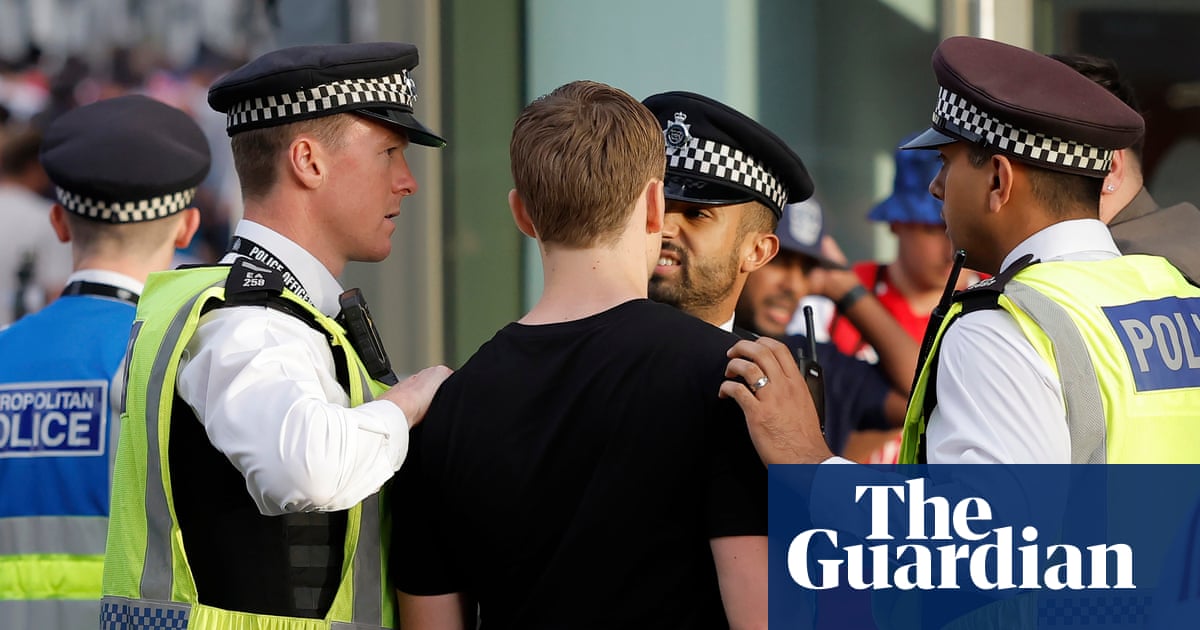
Life-saving CPR and intelligence spotters on London derby day
The concourses around the Emirates Stadium were quiet when Chief Inspector Pete Dearden gathered his officers inside the ground's command centre. Arsenal were preparing to host Chelsea in a 4:30pm Sunday kick-off, a high-stakes derby matching the Premier League champions against a dangerous rival. Dearden, leading public order operations for the Metropolitan Police, framed the afternoon's mission around three core priorities: safety, security, and service.
With 60,000 supporters descending on North London, policing a high-density fixture requires months of behind-the-scenes planning. The Met maintains 17 full-time Dedicated Football Officers who oversee safety across more than 500 seasonal matches in the capital. For Sunday's derby, officers assigned the match a "medium medium" risk rating, deploying three Police Support Units alongside 20 operational football officers known as spotters.
Those spotters do far more than monitor crowds from a distance. Operating under local DFOs, spotters track supporter groups at key transport hubs and gathering spots long before turnstiles open. On Sunday, spotter teams followed Chelsea contingents through Holborn pubs and onto Underground trains bound for Arsenal.
That physical presence paid off in dramatic fashion shortly before kick-off. Outside the stadium gates, a supporter collapsed in sudden cardiac distress. A Met police spotter immediately stepped in to perform life-saving CPR, stabilizing the fan on the pavement until emergency clinical crews arrived. The quick action prevented a tragic outcome before a ball was kicked.
Dearden estimates that the specialized knowledge of spotters doubles their operational efficiency compared to standard public order officers. By engaging directly with fans, spotters gauge mood, track numbers, and identify potential trouble spots early. As The Guardian reported, officer engagement serves as a vital diagnostic tool.
"They will go to pubs in the wider footprint where these people gather and try to identify what their plans are, get a good feeling for their mood and the numbers," Dearden explained before the match.
When supporter groups refuse to speak with spotters, police treat the silence as an immediate red flag. Communication remains the primary tool for defusing tension long before physical intervention becomes necessary.
Facial recognition vans, the £23m budget gap, and steward friction
Outside the turnstiles, high-tech surveillance operated alongside traditional spotter networks. Two blue police vans housed monitoring teams running a live facial recognition pilot funded by multimillion-pound Premier League investment. Pedestrians walked past voluntary scanning stations marked by clear warning signage.
Biometric cameras scanned passing faces in real time, matching images against watchlists containing thousands of individuals subject to Football Banning Orders or wanted for serious criminal offences. Over a two-hour operational window, the system generated six biometric matches.
One intervention involved an individual attending the match with family. The passerby held a Football Banning Order that allowed stadium proximity but had recently been released from prison for human trafficking while wearing an electronic ankle tag. Officers stopped the individual to conduct a welfare check and verify compliance.
While senior officers defend facial scanning as a targeted tool against high-harm offenders, the technology continues to spark debate among matchgoing supporters. Civil liberties advocates argue that automated scanning turns ordinary fans into suspects simply for walking toward turnstiles. Dearden acknowledged the difficulty of proving its preventive value.
"What we can’t measure is the deterrent effect," Dearden noted during the pilot operation.
Financial pressures also shadow modern matchday operations. The Metropolitan Police spends roughly £23m annually policing football fixtures across London, yet recovers only about 10% of that cost from clubs through Special Police Services billing. To narrow that gap, police have shifted financial responsibility for perimeter security, hostile vehicle barriers, and road closures back onto football clubs.
Inside the perimeter, Arsenal relies heavily on private staffing. Roughly 1,000 stewards and private response team members serve as first responders across the stadium footprint. Early in the match, when a Chelsea supporter reacted overzealously to an early away goal, Arsenal's internal response unit moved quickly to eject him from the stands.
Arsenal went on to secure a 2-1 victory, but the action off the pitch remained intense. Post-match enforcement logs recorded 12 incidents across the fixture, resulting in 2 arrests. One arrest followed an assault on a stadium steward, while another involved racial abuse combined with physical assault.
Ten additional fans were reported for criminal offences around the Emirates. Charges ranged from missile throwing and drug possession to homophobic chanting, low-level steward assault, and drinking within view of the pitch. Dearden admitted the total was slightly higher than desired, though he pointed to steward proactivity in reporting minor pushes rather than accepting abuse as standard work conditions.
Post-match crowd clashes and the brutal reality for frontline stewards
When the final whistle blew, crowd control tested ground-level operations outside the away sector. Approximately 3,000 Chelsea supporters exited into public concourses alongside celebrating Arsenal fans, with no physical police cordon separating the two groups. Gloating home fans confronted departing away supporters, creating immediate friction points.
The absence of physical barriers left officers relying on verbal de-escalation. In one instance, two Chelsea content creators attempted to film videos in the middle of the crowded exit routes, drawing expletive-heavy reactions from passing Arsenal supporters. Spotters intervened calmly, advising the creators to pack away their equipment and move along for their own safety.
This soft-touch approach highlights an ongoing conflict in modern stadium management. Private stewards earn modest hourly wages while standing on the front line of fan hostility. Expecting low-paid contract staff to absorb physical shoves, verbal abuse, and thrown objects places an unfair burden on private workers while police forces pull back to cut public costs.
To address stadium culture beyond violence, the Met also deployed a specialized Violence Against Women and Girls unit. The three-person team lapped the stadium footprint before and during the match, monitoring crowds for inappropriate behavior and encouraging victims of domestic abuse or misogynistic harassment to report incidents.
Dearden highlighted how regular officer presence builds trust among fans who previously suffered in silence:
"We’ve had people at football matches come forward and say: ‘I’ve heard you talk three or four times now and I’m now confident enough to report that I think I’m a victim of domestic abuse and controlling behaviour.’"
Low-profile policing meets the impending contrast of Naples
Sunday's operational footprint reflects a deliberate shift in Metropolitan Police tactics. High-visibility riot squads parked outside grounds have been replaced by targeted intelligence networks and data-driven deployments. Rather than flooding streets on a contingency basis, officers focus strictly on known threats.
As The Guardian reported, matchday commanders now avoid heavy-handed policing that can inadvertently escalate crowd hostility. Dearden summarized the department's modern philosophy during pre-match preparations:
"We don’t work on a ‘just in case’ basis these days. We deal with known knowns."
That low-visibility strategy will face an immediate contrast when Arsenal travel to Italy to face Napoli on Wednesday, September 9, 2026. European away trips present vastly different security environments, where local authorities routinely deploy armored vehicles, riot gear, and strict cordons around visiting English supporters.
While soft-touch policing succeeded in defusing post-match taunts outside the Emirates, European fixtures offer little room for dialogue. Traveling Arsenal fans will exchange North London's intelligence-led monitoring for heavy police escorts and militarized crowd control in southern Italy.
Ultimately, Sunday's derby proved that modern matchday policing relies as much on swift medical intervention and steward proactivity as it does on surveillance vans. Maintaining safety across 60,000 passionate supporters requires constant calibration. As public forces push financial duties onto wealthy clubs, the balance between public safety, civil privacy, and steward protection remains a work in progress.
Read Next
- Emi Martinez walking past angry Arsenal fans with bodyguards is pure chaos
- Arteta has Arsenal flying while Alonso's Chelsea defense bleeds goals
- Arsenal survived Chelsea's early shock to prove who really runs London
- Arsenal's comeback against Chelsea proved Mikel Arteta still rules London
- ⭐ UCL 2026 — Champions League Quarter-Finals Hub